

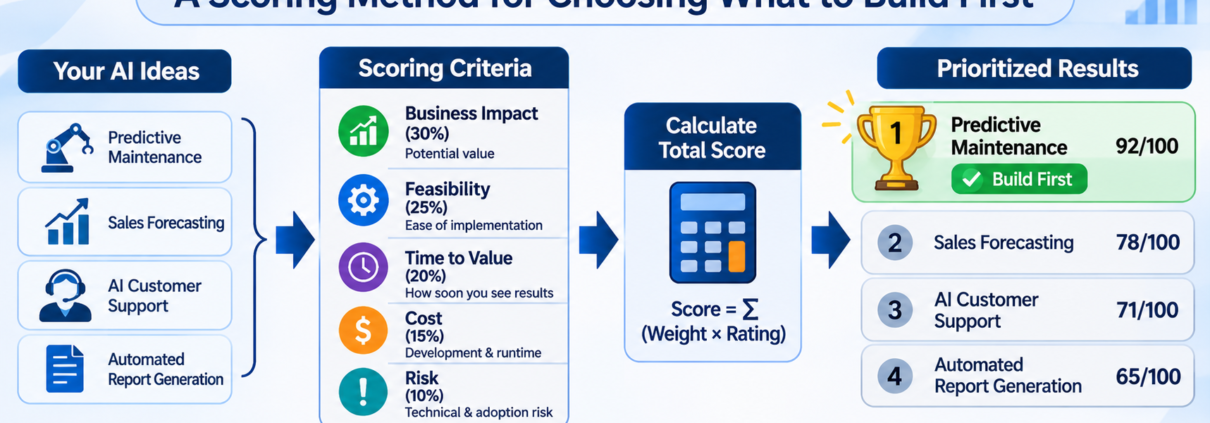
AI Use Case Prioritization: A Scoring Method for Choosing What to Build First
AI use case prioritization is the process of ranking candidate AI projects by expected business value, feasibility and risk, so scarce data, talent and budget go to the ones most likely to reach production and pay back. It prevents the common pattern of many pilots and few deployments.
Most organizations have no shortage of ideas. Business units propose chatbots, forecasting models, document processing, recommendation engines and agents. The difficulty is deciding which to build first, and being honest about which are not ready. Projects chosen on enthusiasm tend to stall on data access, unclear ownership or a business process that cannot absorb the result. This guide offers a scoring model with four criteria, a worked example, a set of gating questions and a path from pilot to production.
Why pilots stall
Common reasons AI pilots fail to reach production:
- The data exists in principle but cannot be accessed, joined or trusted in practice.
- No business owner is accountable for the outcome.
- The pilot proves a model works, but no one has designed how it changes a decision or a workflow.
- Costs and risks were not assessed until late.
- Success was never defined, so the pilot cannot be declared a success or failure.
- The model works in a lab but cannot be monitored or maintained.
Prioritization is where you screen for these early.
Four scoring criteria
Score each candidate from 1 to 5 on each criterion, using written definitions so scorers apply them alike.
| Criterion | Question | 1 means | 5 means |
|---|---|---|---|
| Business value | What is the size and likelihood of the benefit? | Small or speculative | Large, measurable, tied to a core KPI |
| Data readiness | Is the data available, accessible and of adequate quality? | Data missing or inaccessible | Governed, reachable, quality verified |
| Feasibility and fit | Can it be built and integrated with available skills and systems? | Needs unproven technology or major rebuild | Proven approach, clear integration path |
| Risk and responsibility | What could go wrong, and how well can we control it? | High risk, regulated or high-stakes with weak controls | Low risk or well-controlled |
Treat risk so that higher is safer. Then a higher total is always better. Weights can reflect strategy: an organization focused on near-term payback might weight value and feasibility more heavily, while a regulated one may weight risk more.
A worked example (illustrative)
Suppose a manufacturer has four candidates. Weights: value 40 percent, data readiness 25 percent, feasibility 20 percent, risk 15 percent.
| Use case | Value | Data | Feasibility | Risk | Weighted score |
|---|---|---|---|---|---|
| Predictive maintenance on critical lines | 5 | 3 | 4 | 4 | 4.2 |
| Chat assistant over technical documentation | 3 | 4 | 5 | 4 | 3.8 |
| Dynamic pricing model | 4 | 2 | 3 | 3 | 3.1 |
| Fully autonomous scheduling | 5 | 2 | 2 | 2 | 3.2 |
Weighted score for predictive maintenance = (5 × 0.40) + (3 × 0.25) + (4 × 0.20) + (4 × 0.15) = 2.00 + 0.75 + 0.80 + 0.60 = 4.15, which rounds to 4.2.
The ranking is informative, but the conversation it prompts is more so. Autonomous scheduling scores high on value and low on data readiness and feasibility, which suggests staging: start with decision support, build the data and trust, and move toward autonomy later. The numbers are illustrative.
Gating questions before scoring
A few questions are better treated as pass or fail than weighted.
- Is there a named business owner who will use and be measured on the outcome?
- Is there legal, ethical or regulatory exposure that must be cleared first?
- Can we access the necessary data legally and technically?
- Do we know what decision or workflow changes if the model works?
- Is there a definition of success and a way to measure it?
If any answer is no, fix that before spending on a build. A “no” on the first question is nearly always fatal.
Estimating value credibly
Value claims are the weakest part of most business cases. Improve them with a few habits.
- Tie to an existing metric. Use a KPI the business already tracks, such as unplanned downtime hours, handling time per inquiry, forecast error or stockouts.
- Use ranges. State low, expected and high cases and the assumptions behind them.
- Separate benefit types. Cost reduction, revenue increase, risk avoidance and productivity gains are valued differently. Productivity gains only count if time freed is redirected to something valuable.
- Include full cost. Data preparation, integration, model operations, monitoring, support, licenses and change management. Running costs for generative AI can be material and variable, so estimate usage.
- Validate with the owner. If the business owner will not put their name to the estimate, treat it as unproven.
Types of AI use cases and what they need
| Type | Examples | Typical needs |
|---|---|---|
| Predictive | Demand forecasting, failure prediction, churn | Historical data with outcomes, feature engineering |
| Perception | Visual inspection, document understanding | Labeled images or documents, edge or cloud processing |
| Generative | Drafting, summarizing, knowledge assistants | Curated knowledge sources, evaluation, guardrails |
| Agentic | Multi-step task automation across systems | Reliable tools and APIs, permissions, human oversight, monitoring |
| Optimization | Scheduling, routing, inventory | Accurate constraints and data, integration with planning |
Generative and agentic use cases deserve special care. Their outputs are less predictable, so evaluation, guardrails and human review need to be designed in. Define what a good answer looks like, test against realistic cases, and decide which actions the system may take without approval.
From pilot to production
Plan for production at the start of the pilot, not at the end.
- Define success measures and thresholds before building, including a business outcome and a technical quality level.
- Build the smallest end-to-end version that touches real data and a real workflow.
- Evaluate with the people who will use it, on real cases.
- Plan operations: monitoring for data and model drift, retraining triggers, incident handling, access control and audit logs.
- Address adoption: training, process changes, and who handles exceptions.
- Make a go or no-go decision against the measures, and be willing to stop.
- Scale in stages, adding sites, products or users as results hold.
Reusable foundations, such as a governed data layer, shared definitions of key metrics and common deployment pipelines, make later use cases cheaper and faster than the first.
Responsible AI considerations
Include these in scoring and in design.
- Fairness and bias where decisions affect people.
- Transparency and explainability appropriate to the stakes.
- Privacy and data protection across training and use.
- Security, including prompt injection and data leakage for generative systems.
- Accountability: who is responsible for outcomes and for responding to errors.
- Human oversight for higher-impact decisions.
Applicable regulations vary by industry and region and are changing, so involve legal and compliance early.
Common mistakes
- Picking use cases because they are fashionable.
- Scoring without evidence on data readiness.
- Treating a successful demo as a business case.
- Ignoring running cost and maintenance.
- Letting each team pilot separately with no shared foundations.
- Not stopping weak pilots.
Where Infocepts fits
Infocepts lists AI Strategy and Value Identification among its artificial intelligence services, alongside generative AI, data science and machine learning, hyper-productive engineers and intelligent automation. Its Enterprise AI page describes support from strategy through deployment and governance. See the Infocepts AI services and the Enterprise AI overview. For the data side of readiness, read our guide to a data strategy assessment.
FAQ
What is AI use case prioritization?
It is the ranking of potential AI projects by value, feasibility, data readiness and risk, so the best candidates are built first.
How do you score AI use cases?
Rate each on criteria such as business value, data readiness, feasibility and risk using written definitions, then apply weights that reflect your strategy.
Why do so many AI pilots fail to reach production?
Common causes are inaccessible data, no accountable business owner, unclear success measures, and no plan for operating the system.
Should we start with generative AI?
Only if it is the best answer to a prioritized business problem. Score generative use cases with the same criteria, with extra weight on evaluation and guardrails.
How many AI use cases should we pursue at once?
Few enough that each has a named owner, data access and funding. Many organizations do better with a small number of well-supported efforts.
Who should own AI prioritization?
A cross-functional group with business, data, technology, risk and finance representation, led by a senior sponsor.
