

What is Data Governance Consulting?
Data governance consulting is the strategic and operational work of helping enterprises establish how data is owned, managed, protected, and used across the organization. A data governance consultant brings expertise in policy design, organizational structure, regulatory compliance, technology selection, and change management – translating governance principles into a working program your teams will actually follow.
For most enterprises, the gap between buying a data catalog tool and running a mature governance program is where consulting earns its value. Tools enforce policies; they don’t write them. Frameworks define accountability; they don’t assign it. Standards exist on paper; they need executive sponsorship and team adoption to become real.
Infocepts’ data governance consulting services help data leaders close that gap. We work with CDOs, CIOs, and data architects at enterprises in financial services, healthcare, retail, and manufacturing to design governance frameworks that align with business priorities, integrate with existing data platforms, and scale as data volumes grow. Whether you’re starting from zero or maturing an existing program, our consultants bring proven methodologies and tooling expertise to accelerate your path to trusted, governed, AI-ready data.
Ready to start? Book a strategy session with us today to learn more about our data governance solutions.

Increased Data Value
By improving stewardship, storage, and integrity

Standardized Processes
Key to successful data governance scalability

Enhanced Trust
Strengthening reliability and accuracy for better business insights
Why enterprises need Governance
When Do Enterprises Need Data Governance Consulting?
Most enterprises don’t seek out data governance consulting proactively. They turn to it when one of four pressures makes the absence of governance impossible to ignore.
Regulatory exposure across multiple jurisdictions
GDPR, CCPA, HIPAA, DPDP, and sector-specific rules like SOX or BCBS 239 all require demonstrable control over data. When regulators ask “who owns this data, where does it flow, and who has accessed it?”, organizations without governance frameworks scramble. Consulting helps build audit trails, classification schemes, and policy documentation – turning compliance from a fire drill into a routine.
AI and machine learning readiness
Generative AI and predictive ML magnify existing data quality and access issues. Models trained on ungoverned data produce ungoverned outputs – introducing reputational, legal, and operational risks. Governance ensures clarity on safe data usage, model access, and end-to-end lineage tracking.
Post-merger or post-acquisition data integration
Mergers expand data estates overnight with conflicting definitions, ownership models, and standards. Without a clear integration plan, organizations risk operating fragmented or parallel governance structures. Consulting accelerates harmonization for a unified, trusted data foundation.
Multi-cloud and platform sprawl
Enterprises operate across Snowflake, Databricks, AWS, Azure, and on-premise systems – each with its own controls and metadata. Governance consulting enables unified policies and tooling that span the entire ecosystem instead of fragmenting with it.
Our Data Governance Services
With Infocepts’ comprehensive data governance services, you’ll unleash your data-centric applications’ full potential, maintaining data integrity, auditability, and security standards.
Data Governance Consulting
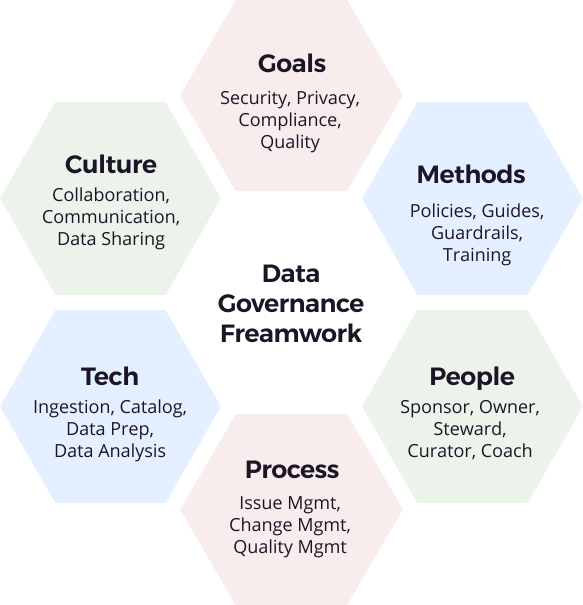
We help you establish a clear data governance framework that defines roles, responsibilities, policies, and procedures. Our data governance solutions ensure that your efforts are aligned with business objectives, providing a roadmap for data quality, legal compliance, and information lifecycle management, thereby laying the foundation for data-driven business practices. Learn More
Data Stewardship
Our Data Stewardship service empowers your organization with expert management of your data assets, ensuring that your data is accurate, accessible, and consistently managed. Our data governance consulting experts will collaborate with your teams to establish robust data policies, rectify data issues, and maintain the highest standards of data integrity, providing the foundation for reliable business insights.
Data Quality
High-quality data is the lifeblood of any successful business operation. Our Data Quality service ensures that your organization's data is consistently clean and trustworthy. We leverage AI to detect and rectify data inaccuracies, ensuring your analytics and reports are based on dependable information. Ready to uncover and address your key data quality challenges? Learn More
Data Catalogs
Streamline your data discovery and utilization with our Data Catalog service. We create a centralized catalog that organizes and simplifies access to your data assets. Through comprehensive metadata, annotations, and data lineage, our service enhances the visibility and understanding of your data, enabling informed decision-making. Learn More
Master Data Management (MDM)
We help your organization create a single, authoritative source of truth for all critical data entities, enhancing consistency and eliminating redundancies across the enterprise. Our MDM service ensures that everyone in your organization has access to accurate and up-to-date information, facilitating better decision-making and operational efficiency.
Data Security & Privacy
We empower your organization with advanced security measures such as robust encryption and stringent access controls, while ensuring full compliance with privacy regulations like GDPR and CCPA. Safeguard your reputation and data integrity with our comprehensive, tailored security solutions, designed for maximum protection in today's digital landscape.




Our Data Governance Consulting Methodology
Infocepts follows an eight-phase methodology refined over hundreds of enterprise data engagements. Each phase produces specific artifacts your teams can use independently of the consultant.
1. Readiness
Assessment
We benchmark your current state across people, process, technology, and data quality. The output is a maturity score against industry frameworks (DAMA-DMBOK, DCAM) and a prioritized list of gaps that matter most to your business goals.
2. Goal
Setting
Governance programs fail when their objectives are abstract. We work with executive sponsors to define measurable outcomes - reduced compliance findings, faster analytics delivery, lower data quality remediation cost - that the program will be judged against.
3. Creating a Data
Governance Structure
We design the operating model: a governance council, data domain owners, data stewards, and the decision rights between them. This is the human infrastructure that determines whether policies stick.
4. Developing Data
Definitions
We build the business glossary, data dictionary, and metadata standards that give every team a shared language for critical data elements. Without this layer, policy enforcement is inconsistent.
5. Implementing Data
Quality Controls
We design quality rules, monitoring, and remediation workflows tied to the data domains that matter most. Quality is measured at source, in pipelines, and in consumption layers.
6. Ensuring Data
Security & Privacy
We implement classification schemes, access controls, masking, and consent management aligned to regulatory requirements across the regions where your data lives.
7. Measuring
Success
We instrument governance KPIs into dashboards that executive sponsors actually look at - coverage, quality, compliance, and business impact metrics tracked monthly.
8. Continual
Improvement
We hand over the program with a 12-month roadmap for expansion to additional domains, deeper automation, and progressive maturity gains.
FAQs
What does a data governance consultant do?
A data governance consultant helps organizations design and implement the policies, processes, roles, and technology needed to manage data as a strategic asset. This includes establishing data ownership, defining quality standards, ensuring regulatory compliance, and building governance councils that align IT and business stakeholders.
How long does a data governance consulting engagement take?
Most enterprise data governance programs run 3 to 9 months for initial framework design and pilot implementation. Full enterprise rollouts typically take 12 to 18 months. The timeline depends on data complexity, regulatory requirements, and organizational readiness.
What is the ROI of data governance consulting?
Mature data governance programs deliver measurable returns through reduced compliance risk, faster analytics delivery, lower data quality remediation costs, and AI/ML readiness. Most enterprises see payback within 12–18 months of program launch.
How is data governance different from data management?
Data management is the operational work of storing, integrating, and serving data. Data governance is the strategic framework that defines who decides what about data – ownership, quality standards, access policies, and accountability. You need both, but governance sets the rules data management follows.
What tools does Infocepts use for data governance engagements?
We work with leading platforms including Collibra, Alation, Atlan, Informatica Axon, and Microsoft Purview. Tool selection depends on your existing data stack, regulatory needs, and team maturity. Our consultants are tool-agnostic and recommend the right fit for each engagement.
How do you handle data governance for cross-border data flows?
We design governance frameworks that map data classifications to applicable regulations – GDPR in the EU, CCPA in California, DPDP in India, HIPAA for US healthcare. The framework includes data residency policies, transfer mechanisms, and consent management aligned to your global footprint.
Elevate Your Data Game Today!

The Enterprise AI & Data Transformation Partner. Delivering measurable business impact globally.
#1 on Gartner Peer Insights · 97.2% client retention
Email: sales@infocepts.com
Headquarters: Washington, D.C., USA