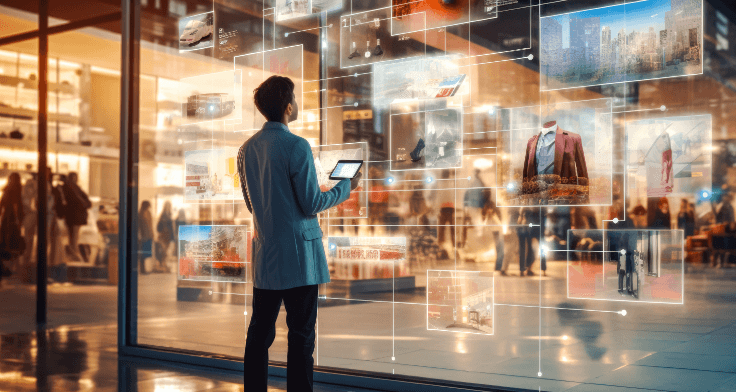
Retail executives no longer question whether technology will reshape their operations, they are competing to accelerate its integration. In an era defined by agility, personalization, and operational efficiency, Spatial AI and Digital Twins have evolved from conceptual innovations to essential tools for competitive advantage. These technologies enable immersive store design, predictive inventory control, and beyond, driving tangible business results.
The real question for leaders today: Are they positioned to harness virtual intelligence for superior physical performance?
Spatial AI uses geospatial understanding and artificial intelligence to interpret the physical world in 3D. Paired with Digital Twins—virtual replicas of stores, assets, or operations—retailers gain an end-to-end platform to simulate, analyze, and improve their environments before making real-world changes.
This is not “future tech”, it’s strategic foresight in action. Leaders like Walmart, Zara, and IKEA already use digital twins to optimize layouts, streamline supply chains, and test customer experience scenarios. Walmart, for example, has built twins for more than 1,700 stores using NVIDIA’s Omniverse to simulate everything from shelf design to peak-hour checkout flow.
The result: less guesswork, lower risk, and faster innovation.
Inventory remains one of retail’s biggest pain points—overstock wastes money, while stockouts hurt loyalty. Spatial AI and Digital Twins are rewriting this equation with predictive intelligence. Migros, Switzerland’s largest supermarket chain, demonstrated the impact by deploying AI across 2,000 stores and 11 distribution centers, achieving:
- 11% fewer inventory days
- 1.7% higher stock availability
- 1.3% fewer lost sales
These aren’t outliers—they’re becoming industry benchmarks. NVIDIA’s State of AI in Retail & CPG: 2025 reports 87% of AI-enabled retailers increased annual revenue and 94% reduced operational expenses.
Spatial AI powers this shift by enabling retailers to:
- Track inventory in real time via sensors and computer vision
- TPredict demand using historical and external data
- TAutomate replenishment across channels
This is the foundation of agile, omnichannel retail.
Store design is no longer a static, one-time exercise. With Spatial AI, retailers can continuously optimize layouts based on real customer behavior. Printemps exemplified this when planning its 54,000-square-foot Manhattan flagship. Using Apple Vision Pro and a custom L+R app, executives virtually walked the store, tested signage, and refined layouts—all before construction began. This approach:
- Cuts costly change orders
- Improves customer experience
- Accelerates time-to-market
Spatial AI also enables on-the-fly optimization, identifying high-engagement zones and recommending product placement or staffing adjustments in real time. It’s store design that evolves as quickly as shoppers do.
Spatial AI and Digital Twins give retailers unprecedented visibility into how customers move, browse, and buy across physical spaces. But insight alone doesn’t drive outcomes—execution does. To truly unlock value, retailers need intelligent systems that translate spatial intelligence into timely, in-store action. Infocepts’ Spatial AI solutions are purpose-built to bridge this gap, turning virtual models and predictive insights into decisions that frontline teams can act on instantly.
- StoreAssistAI empowers store managers with an AI-driven virtual assistant that delivers real-time, context-aware operational intelligence. By continuously monitoring inventory gaps, shelf availability, footfall patterns, and staffing levels, StoreAssistAI helps managers anticipate issues before they impact sales. Dynamic dashboards, proactive alerts, and guided recommendations enable faster decision-making on the shop floor—ensuring the right products, people, and priorities are always in place.
- OptiStoreAI takes a predictive, performance-driven approach to store optimization. By analyzing spatial traffic flows, dwell times, and conversion patterns, it identifies opportunities to improve inventory movement, space utilization, and workforce productivity. The platform generates actionable recommendations—ranging from layout adjustments to staffing and replenishment strategies—that directly improve store efficiency and profitability.
Together, they enable retailers to sense, predict, and respond in near real time—making stores truly agile in an ever-changing retail landscape.
By 2026, retail will have evolved into a phygital-first ecosystem, where digital intelligence and physical experiences are no longer parallel tracks, but a single, continuously learning system. At the core of this shift are Spatial AI and Digital Twins, reshaping how retailers design store environments, engage customers across touchpoints, and orchestrate operations in real time.
Leading retailers are already using Spatial AI to move beyond static insights and into continuous simulation and optimization. Digital twins now power:
- Immersive virtual stores and experiential commerce, blending in-store, online, and extended reality experiences
- Real-time simulation of customer journeys, enabling rapid testing of layouts, promotions, and pricing before rollout
- Intelligent logistics and operations, reducing waste, shrinkage, and energy consumption through predictive optimization
The scale of this shift is undeniable. According to StartUs Insights, the global AI retail market is projected to reach $164.74 billion by 2030, growing at a 32% CAGR, fueled by rising customer expectations, tighter margins, and the need for operational precision at scale.
Early adopters are already realizing measurable impact:
- Up to 25% improvement in product quality through better demand sensing and fulfillment
- 50% faster time-to-market by simulating decisions before execution
- 10% revenue uplift driven by higher conversion and optimized in-store performance
In 2026, Spatial AI will no longer be an experimental capability; it will be a strategic operating layer. Retailers that embed it into everyday decision-making will gain the ability to sense, predict, and adapt continuously to gain sustainable competitive advantage in a market that rewards speed, intelligence, and agility.
For retail leaders, the goal is no longer to try AI, but to embed AI into everyday decision-making. Spatial AI and Digital Twins must move beyond pilots to become core capabilities that drive agility, predict outcomes, and elevate customer experiences.
Infocepts helps retailers do exactly that. We partner with retail leaders to define a Spatial AI roadmap, build scalable Digital Twins, and operationalize AI across stores and supply chains—turning insights into real, frontline action. With proven accelerators and deep retail expertise, Infocepts helps you move faster, reduce risk, and deliver measurable impact.
Ready to move from insight to action? Talk to our Retail experts and start building the intelligent, agile retail operations of the future.

Sushmita Singh helps organizations unlock the power of data and AI to drive real-world impact. She transforms complex ideas into clear strategies, enabling leaders to embrace innovation with confidence.
Read Full BioRecent Blogs

No More Manual Audits – Achieve Perfect Planogram Compliance with AI
March 3, 2026
From Overstock to Optimized – The Shift from Buffer-Based Planning to AI Precision
March 2, 2026
End Stockouts for Good – How AI Keeps Retail Shelves Full
March 1, 2026

From Insight to Intent: How Mosaic + Agent-AI Unlock Scalable, Repeatable Growth
February 27, 2026
Infocepts