

Databricks for Pharma: Building a GxP-Ready Lakehouse for AI, Enterprise Intelligence, and Commercial Growth

 Published:
 11 min read
 Share



Executive Summary
The pharmaceutical industry is entering a new era of competition. Breakthrough therapies remain critical, but increasingly, competitive advantage is being defined by how effectively organizations turn data into decisions.
Whether accelerating clinical development, optimizing manufacturing performance, enabling AI-driven commercial engagement, or improving regulatory operations, the common denominator is data. Yet most pharmaceutical organizations were not built for the AI era. Critical information remains fragmented across research, clinical, pharmacovigilance, medical affairs, commercial, manufacturing, quality, and regulatory functions. Teams often spend more time locating, preparing, reconciling, and governing data than generating insights from it.
As enterprise AI ambitions grow, these foundational limitations become increasingly visible.
The question facing life sciences leaders is no longer whether data modernization is necessary. The question is whether existing architectures can support the speed, scale, governance, and intelligence requirements of a modern pharmaceutical enterprise.
This is why leading organizations are investing in lakehouse architectures powered by Databricks. More than a data platform, a GxP-ready lakehouse is emerging as the foundation for enterprise intelligence, enabling organizations to unify data, scale AI, strengthen compliance, and improve decision-making across the value chain.
The opportunity extends far beyond technology modernization. It is about creating a more agile, AI-ready, and growth-oriented enterprise.
The Strategic Challenge: Pharma’s Data Architecture Was Built for Functions, Not Decisions
Most pharmaceutical organizations have spent years investing in digital transformation. However, many data environments still reflect organizational structures designed long before AI, advanced analytics, and enterprise-wide intelligence became strategic priorities.
Clinical operations, R&D, manufacturing, quality, regulatory affairs, pharmacovigilance, medical affairs, and commercial teams often operate within separate systems, different governance models, and disconnected data repositories.
While these investments solved important functional challenges, they also created barriers to enterprise-wide visibility and collaboration.
The consequences are familiar to executive teams:
- Delayed access to trusted information
- Duplicate data engineering and analytics efforts
- Limited cross-functional intelligence
- Slower AI adoption and deployment
- Inconsistent governance and compliance controls
- Higher infrastructure and operating costs
- Longer decision cycles
The business impact extends beyond technology.
When clinical data cannot be connected efficiently, development timelines suffer. When commercial and customer intelligence remains fragmented, HCP engagement effectiveness declines. When manufacturing, quality, and supply chain data remain siloed, operational optimization becomes significantly more difficult.
In each case, the organization possesses the data.
What it lacks is a unified foundation for transforming that data into enterprise intelligence.
Why the Lakehouse Is Becoming the Enterprise Data Standard
The conversation around pharmaceutical data architecture has changed dramatically in recent years.
A decade ago, organizations focused primarily on reporting and storage. Today, they need environments capable of supporting analytics, AI, automation, governance, self-service intelligence, and regulatory compliance simultaneously.
The lakehouse architecture has emerged as the preferred approach because it combines the scalability and flexibility of data lakes with the governance, reliability, and performance traditionally associated with enterprise data warehouses.
For pharmaceutical organizations, this represents a meaningful shift.
Rather than maintaining separate environments for reporting, analytics, machine learning, data science, AI, and business intelligence, a lakehouse creates a unified platform where data can be managed, governed, and utilized across multiple business functions.
The outcome is not better infrastructure.
The outcome is faster decision-making, greater agility, improved collaboration, lower complexity, and a stronger foundation for innovation.
Why Databricks Is Emerging as a Strategic Platform for Life Sciences
The growing adoption of Databricks across life sciences is driven by a broader business need: creating a scalable foundation for enterprise intelligence.
Pharmaceutical organizations increasingly require platforms capable of supporting multiple strategic priorities simultaneously:
- Enterprise analytics
- Artificial intelligence and machine learning
- Clinical and research insights
- Commercial intelligence
- Manufacturing optimization
- Data sharing and collaboration
- Governance and regulatory compliance
Databricks enables organizations to bring these capabilities together within a common architecture while maintaining trust, scalability, and operational flexibility.
Instead of moving data between disconnected systems, organizations can establish a governed environment where data engineering, analytics, business intelligence, and AI operate as part of a coordinated enterprise strategy.
The strategic value is significant.
Organizations gain the ability to reduce complexity, accelerate innovation, improve trust in information, and create a modern foundation capable of supporting future business priorities rather than simply current operational requirements.
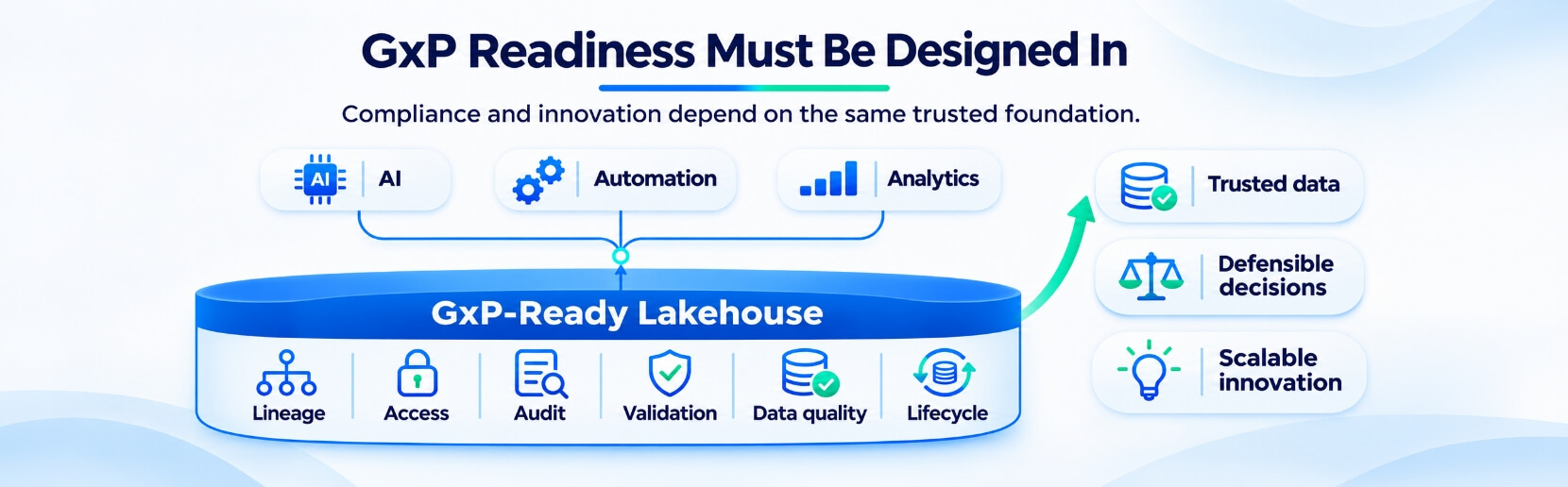
Why GxP Readiness Must Be Designed In, Not Added Later
For pharmaceutical organizations, modernization cannot come at the expense of compliance.
As AI adoption accelerates, regulators and quality leaders are placing greater emphasis on data integrity, traceability, governance, validation, explainability, and auditability. These requirements make GxP readiness a strategic business consideration rather than a technical afterthought.
Leading organizations recognize that compliance and innovation are not competing priorities.
They are mutually dependent.
Without trusted data, AI cannot be trusted.
Without traceability, automation cannot scale.
Without governance, enterprise intelligence becomes difficult to operationalize.
A GxP-ready lakehouse helps address these challenges by embedding governance directly into the data foundation through:
- Data lineage and traceability
- Role-based access controls
- Auditability and monitoring
- Validation workflows
- Data quality frameworks
- Controlled lifecycle management
These capabilities provide something increasingly valuable in the AI era: confidence.
Confidence that information is trustworthy. Confidence that decisions are defensible. Confidence that innovation can scale without compromising compliance.
AI Is Raising the Stakes
Few developments have accelerated data modernization more than artificial intelligence.
Across life sciences, organizations are evaluating AI use cases spanning drug discovery, clinical development, regulatory affairs, medical affairs, manufacturing, supply chain management, pharmacovigilance, and commercial operations.
Yet many AI initiatives encounter the same obstacle.
The algorithms may be sophisticated, but the underlying data remains fragmented.
As a result, leading organizations are increasingly focusing on AI readiness before AI deployment.
The objective is not simply implementing models.
The objective is creating an environment where AI can consistently generate enterprise value.
That requires connected, governed, trusted, discoverable, and high-quality data.
A GxP-ready lakehouse provides the foundation for exactly that.
The strategic question is therefore shifting from:
“How do we implement AI?” to “How do we build an enterprise capable of scaling AI safely, responsibly, and effectively?”
Beyond Data Modernization: Creating Enterprise Value
The strongest business case for a lakehouse is not technology consolidation.
It is enterprise value creation.
Leading pharmaceutical organizations are leveraging modern data foundations to support three critical business priorities.
Accelerating Clinical and R&D Outcomes
Unified data environments help research and clinical teams reduce data friction, improve collaboration, accelerate insight generation, and strengthen decision-making across the drug development lifecycle. This enables organizations to move faster from research hypotheses to development decisions.
Strengthening Commercial Performance
Connected customer and engagement data enables more intelligent HCP engagement, Next-Best-Action strategies, customer 360 initiatives, omnichannel orchestration, commercial decision intelligence, and improved field force effectiveness.
The result is stronger promotional effectiveness, improved customer engagement, and better commercial outcomes.
Optimizing Manufacturing and Quality Operations
Integrated operational, quality, and production data helps organizations improve visibility across manufacturing networks, strengthen quality processes, support predictive maintenance initiatives, and improve operational resilience.
The organizations leading this transformation are not pursuing isolated analytics projects.
They are building enterprise intelligence capabilities designed to improve decision-making across the business.
From Data Modernization to Enterprise Intelligence: The Infocepts Perspective
Many pharmaceutical organizations have already invested in cloud platforms, analytics initiatives, and data modernization programs. Yet a common challenge remains: translating those investments into measurable business outcomes.
Technology alone rarely creates competitive advantage.
Value is created when data, governance, analytics, AI, and business strategy come together to improve decisions across clinical development, commercial operations, manufacturing, quality, and regulatory functions.
This is where Infocepts brings a differentiated perspective.
Rather than approaching Databricks modernization as a standalone technology initiative, Infocepts helps life sciences organizations build enterprise intelligence ecosystems designed to connect data with decision-making and decision-making with measurable business value.
What Differentiates Infocepts
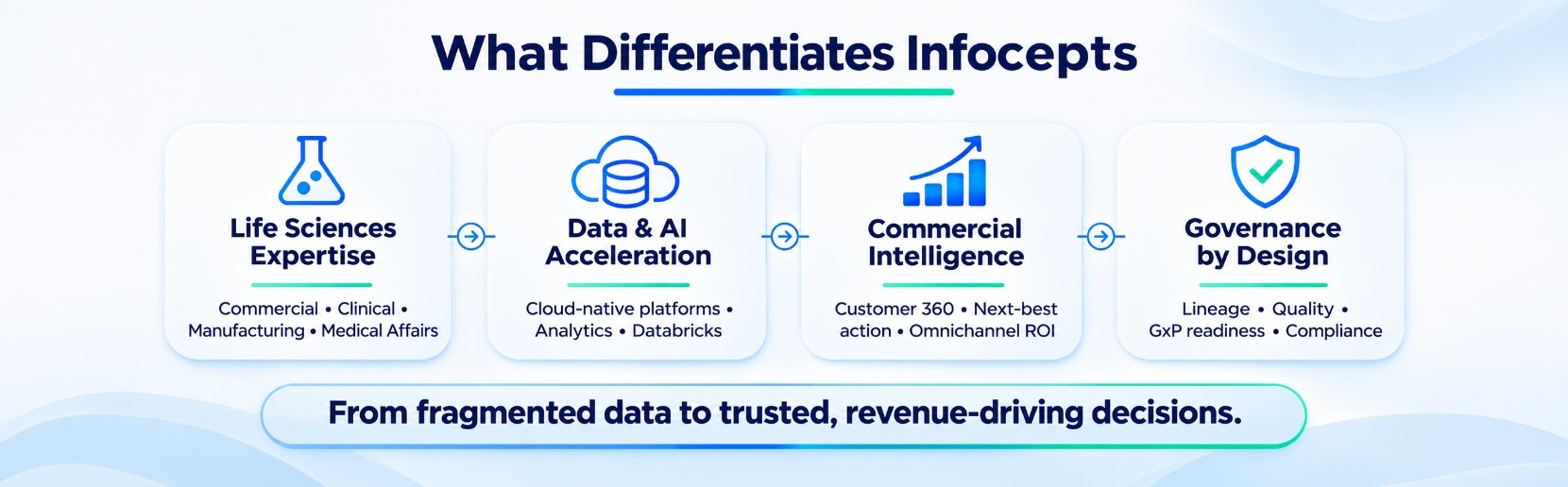
Deep Life Sciences Expertise Across the Value Chain
Infocepts combines modern data and AI capabilities with expertise across critical life sciences business areas, including:
- Commercial Analytics and Commercial Excellence
- Omnichannel HCP Engagement
- Next-Best-Action Enablement
- Customer 360 and Commercial Intelligence
- Clinical Data Modernization
- Manufacturing Intelligence
- Quality and Compliance Analytics
- Medical Affairs Analytics
- Enterprise AI Enablement
This allows organizations to focus on business outcomes rather than platform implementation alone.
Enterprise Data, AI, and Analytics Acceleration
Infocepts helps organizations design and scale cloud-native data ecosystems that support analytics, AI, governance, and compliance requirements while reducing architectural complexity.
By combining Databricks expertise with advanced analytics and AI enablement capabilities, organizations can accelerate their journey from fragmented data environments to enterprise intelligence platforms.
AI-Powered Commercial Intelligence
A key differentiator for pharmaceutical organizations is the ability to connect customer, engagement, claims, prescription, and CRM data into a unified intelligence layer.
Infocepts helps clients establish capabilities such as:
- Next-Best-Action Recommendations
- Omnichannel Engagement Optimization
- Commercial Decision Intelligence
- Sales Force Effectiveness Analytics
- Promotional ROI Optimization
- Customer Journey Analytics
These capabilities help commercial organizations move beyond reporting and toward revenue-driving decisions.
Governance and Compliance by Design
Innovation must be governed.
Infocepts helps organizations establish data governance, lineage, quality, and compliance frameworks that support GxP readiness while enabling scalable AI and analytics adoption.
This allows organizations to modernize confidently without compromising regulatory expectations.
Is Your Data Foundation Ready for the AI Era?
The most important question facing pharmaceutical leaders today is not whether they need AI.
The question is whether their data foundation can support it.
Evaluate your organization’s readiness across these critical dimensions:
- Clinical, Commercial, Medical, and Manufacturing Data Integration
- GxP Compliance and Regulatory Readiness
- Enterprise Data Governance and Lineage
- AI and Machine Learning Enablement
- Commercial Decision Intelligence
- Omnichannel Customer Analytics
- Data Quality and Trust Frameworks
- Scalable Lakehouse Architecture
Organizations that excel across these capabilities are often better positioned to accelerate innovation, improve commercial performance, reduce operational complexity, and generate greater value from AI investments.
Ready to Build an AI-Ready Pharmaceutical Enterprise?
Whether you’re evaluating Databricks, modernizing your enterprise data strategy, consolidating fragmented data estates, or preparing for large-scale AI adoption, success depends on more than selecting the right platform.
It depends on building a trusted data foundation capable of supporting growth, intelligence, compliance, and innovation.
Connect with Infocepts’ Life Sciences Data & AI experts to assess your current architecture, benchmark your lakehouse readiness, identify high-value use cases across clinical, commercial, and manufacturing functions, and develop a roadmap for a GxP-ready, AI-powered enterprise data platform that delivers measurable business impact.
Conclusion
The future of pharmaceutical competitiveness will be determined by how effectively organizations convert data into intelligence and intelligence into action.
The leaders emerging in this new environment are not simply implementing modern platforms. They are redesigning their enterprises around trusted data, scalable AI, and faster decision-making.
A GxP-ready Databricks lakehouse is more than a technology investment. It is a strategic foundation for innovation, operational excellence, commercial growth, and long-term resilience.
As AI reshapes every part of the pharmaceutical value chain, organizations with connected, governed, and enterprise-scale data foundations will be best positioned to move faster, innovate confidently, improve outcomes, and create sustainable competitive advantage.
Frequently Asked Questions
Build a GxP-Ready Lakehouse with Infocepts
Assess your current architecture, benchmark your lakehouse readiness, and build a roadmap for a GxP-ready, AI-powered data platform that delivers measurable business impact.
Share This Article
The Infocepts Life Sciences COE is a team of domain and data experts working with pharma, biotech, and medical device companies to accelerate data-driven outcomes. The team covers clinical data management, regulatory analytics, commercial insights, and AI applications...
