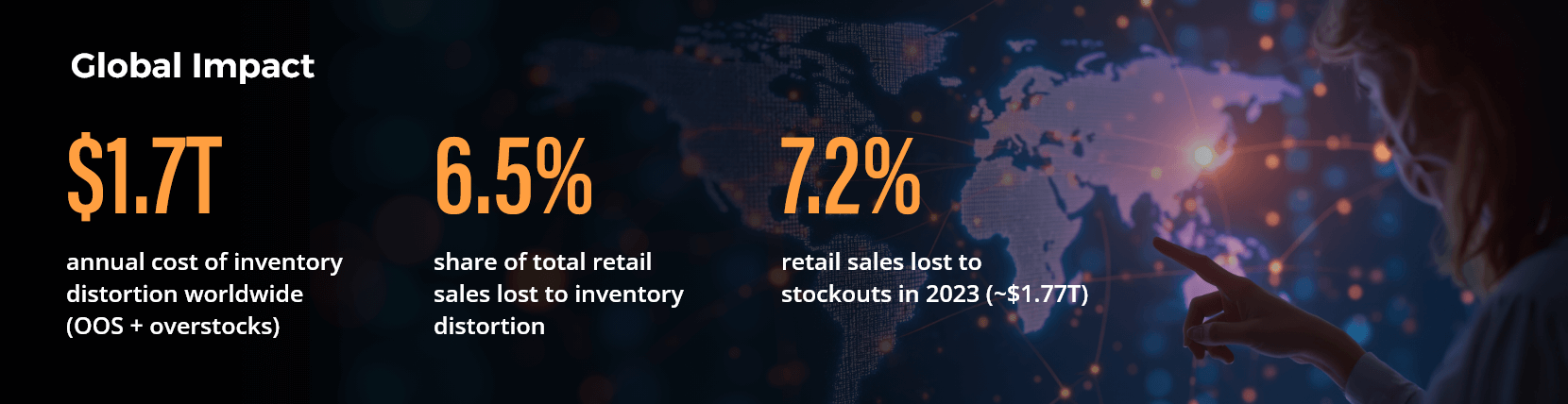
Every retailer knows the sinking feeling of an empty shelf where a top-selling product should be. A customer comes in looking for their favorite item – only to find a blank space. Stockouts are more than just momentary hiccups; they’re a silent revenue killer. In fact, recent research shows that inventory woes are costing retailers an astounding amount: globally, inventory distortion (the combined cost of out-of-stocks and overstocks) stands at $1.7 trillion annually, or about 6.5% of total retail sales. Out-of-stocks account for a huge chunk of that loss. According to one analysis, stockouts alone made up approximately 7.2% of all retail sales in 2023, translating to roughly $1.77 trillion in lost revenue worldwide. [ihlservices.com] [linkedin.com]
For a single retailer, the impact is equally dire. If you’re running a $1 billion retail business, a 7% hit means $70 million walking out the door – simply because products weren’t on the shelf when customers wanted to buy them. This blog dives into why stockouts happen, the ripple effects they create, and how OptiStoreAI’s intelligent platform can help you conquer this perennial problem once and for all.
When customers encounter an empty shelf for a product they intend to purchase, the consequences are immediate and often irreversible. Customers won’t wait for you to restock; they’ll go elsewhere. Studies find that up to 36% of shoppers will leave and buy from a competitor if the item they wanted is out-of-stock. This means not only a lost sale today but possibly a lost customer for the future. In the aggregate, these “lost” opportunities add up to jaw-dropping figures: in 2021, stockouts cost U.S. retailers 7.4% of potential sales, or about $82 billion according to NielsenIQ data. And that was before recent supply chain disruptions drove the numbers even higher
The damage isn’t purely financial; it’s reputational. A customer who experiences repeated stockouts begins to doubt your store’s reliability. They might decide it’s not worth trying again, especially if they can find the product online or at another retailer. Over time, stockouts erode customer loyalty and trust, and even your brand’s image can suffer. No retailer wants to be known as the store that “never has what I need.” In an age of instant gratification and endless alternatives, product unavailability is one of the quickest ways to push shoppers away.
Despite sophisticated planning, stockouts remain stubbornly common, and their causes are multifaceted:
- Inaccurate Forecasting and Planning: One major culprit is old-school demand forecasting. Relying solely on historical sales or gut instinct often fails to account for real-world volatility. Special events, weather changes, marketing promotions, or sudden shifts in trends can all render a forecast obsolete. If your buyers or planners under-forecast demand for a hot item (or a surge in traffic), you’ll run out quickly. Conversely, if they over-forecast on another product, that inventory sits in the stockroom while more needed items run dry. Traditional forecasting tools that lack real-time inputs lead to these imbalances – empty shelves for some products and overflow for others.
- Replenishment & Execution Gaps: Even when forecasts are on point, execution issues can trigger stockouts. An eye-opening statistic: up to 70–90% of stockouts are caused by ineffective in-store ordering and replenishment practices. This means the item might be in the building – in the stockroom or on a pallet – but never made it to the shelf in time. Manual processes like visual shelf checks or reordering based on static thresholds often miss fast-moving items. If associates aren’t alerted promptly when stock is low, or if reorders are not triggered until it’s too late, shelves will go empty despite ample inventory in the pipeline.
- Supplier and Supply Chain Disruptions: Outside the store’s four walls, supply chain hiccups lead to stockouts as well. Late vendor shipments, unexpected demand spikes (think viral social media trends or seasonal surges), and freight delays (weather events, port congestions) can all leave shelves bare. Many retailers lack visibility into these upstream issues. They find out too late that a shipment is delayed or smaller than expected, leaving no time to redistribute inventory from other locations or find alternate sources.
The common thread? Lack of real-time visibility and agility. Traditional systems and processes don’t flag issues early enough for teams to respond before customers are affected. The good news is that emerging technology – particularly AI and real-time analytics – is changing the game.
The most obvious effect of stockouts is lost sales today – which is painful enough. But the downstream impact can be even greater:
- Customer Defection & Lifetime Value Loss: An immediate lost sale might be a $20 or $50 hit. But if the disappointed customer goes to a competitor and never comes back, you’ve potentially lost hundreds or thousands of dollars in future revenue from that one person. Repeat stockouts drive shoppers to switch loyalties; nearly 77% of consumers say they are less likely to shop again at a store if they encountered long waits or unavailable products, which echoes similar sentiment for out-of-stock scenarios. Over time, the churn adds up to significant lost market share. [retailcust…rience.com]
- Operational Costs & Firefighting: Stockouts often force unplanned corrective actions that raise costs. Emergency inter-store transfers, rush shipping from distribution centers, or last-minute vendor expedites all carry a premium. Store associates and managers spend time putting out fires – calling around to find products or placating upset customers – instead of focusing on sales or other tasks.
- Brand Perception and Online Reviews: In today’s world, a single bad experience can end up as a negative online review or a social media complaint. Frequent stockouts can tarnish your brand’s image as unreliable or poorly managed. This brand damage is hard to quantify but very real – it can reduce customer acquisition and retention in the long run, which ultimately hits your bottom line.
Given these stakes, solving the stockout problem is paramount. So how can retailers finally break free from the cycle of “out-of-stock, out-of-luck”? This is where OptiStoreAI comes in.
- AI-Powered Demand Forecasting: Instead of static forecasts that ignore changing conditions, OptiStoreAI continuously analyzes historical sales, current trends, seasonal events, local factors (like weather or local events), and even social media signals to predict demand with high accuracy. It updates forecasts in real time – so if sales of a product start accelerating unexpectedly, the system “learns” from that pattern and projects new needs immediately. Retailers using OptiStoreAI have seen significant improvements in forecast accuracy, leading to leaner inventories and far fewer surprises in stock levels. By predicting demand more precisely (often improving forecast accuracy by 20–30% over traditional methods), you can stock enough of the right products before they run out, without overstocking the wrong ones.
- Automated Low-Stock Alerts: OptiStoreAI employs IoT shelf sensors, POS data, and even computer vision to monitor shelf inventory continuously. The moment an item’s on-shelf quantity falls below a set threshold (or below its expected level given the time of day and past sales patterns), the system triggers an alert to staff on their mobile devices or store handhelds. The alert isn’t just a generic “item X is low” – it provides actionable detail: e.g., “Item X in Aisle 3 is down to 2 units; pull additional stock from the back room,” or “Item Y will stock out by 4 p.m. – consider expediting a transfer from nearby Store #112 which has excess.” This ensures that fast-selling items are replenished promptly, often before the shelf ever actually goes empty. In effect, OptiStoreAI acts like a 24/7 digital assistant, always watching your shelves so your team can respond in time.
- Intelligent Replenishment & Redistribution: Beyond the store, OptiStoreAI connects with your inventory systems and can assist in automating replenishment orders. It dynamically adjusts reorder points based on real-time sales velocity and lead times, so you’re ordering more of what’s selling well and scaling back on what’s not, in each store. If a stockout risk is identified and one store is running low while another has surplus, the platform can flag that and help coordinate stock transfers or suggest re-routing incoming shipments. This flexibility means inventory is used more efficiently across the chain, reducing both stockouts and overstocks simultaneously.
- Root Cause Insights & Continuous Improvement: OptiStoreAI doesn’t just battle the symptoms; it helps you fix the underlying issues. The platform provides analytics that can identify why a stockout occurred – was it a forecasting miss, a delayed truck, or an execution lapse? By pinpointing the cause, it guides managers to remedy the process. For example, if the data shows that a particular category often runs out on Saturdays due to a surge in weekend demand, you can adjust staffing and replenishment schedules to prepare. Over time, the system’s machine learning models improve, meaning the more you use OptiStoreAI, the better it gets at protecting you from stockouts.
Companies that have adopted OptiStoreAI have seen remarkable turnarounds in product availability. In one case, a large retailer using OptiStoreAI reported an up to 40% reduction in lost sales attributed to stockouts, simply by catching issues earlier and ensuring products were on the shelf when customers wanted them. These improvements were achieved within weeks of implementation, not years. Furthermore, by eliminating most stockouts, the retailer also noticed an increase in customer satisfaction scores – proving that when you never run out of what shoppers want, they notice the difference.
Another OptiStoreAI user, a mid-size grocery chain, credits the system’s predictive ordering and shelf alerts for helping them maintain over 98% on-shelf availability during peak hours, even for high-demand items. Before, they struggled with daily stockouts in core categories like dairy and beverages; after deploying OptiStoreAI, those shelves stayed consistently full, and weekly sales in those categories rose by double digits.
It’s not just about averting disaster, but about capturing upside. By not missing sales due to stockouts, you’re effectively adding back a chunk of revenue you were previously losing. And because OptiStoreAI also helps refine your inventory levels, you might achieve this while holding less safety stock – freeing up cash from excess inventory (which we’ll discuss in the next blog).
In a world where customers have endless options, ensuring your products are available when and where they’re needed is critical. With OptiStoreAI’s real-time, AI-driven approach, stockouts can truly become a solved problem. The result is immediate: higher sales, happier customers, and a more efficient operation. Ready to keep your shelves full and your customers satisfied? Download our free “Stockout Prevention Checklist” to start turning those empty shelves into revenue opportunities today.
Recent Blogs
No More Manual Audits – Achieve Perfect Planogram Compliance with AI
February 19, 2026
From Overstock to Optimized – Cutting Excess Inventory with AI
February 19, 2026
AI Isn’t Optional for Retail Supply Chains—It’s Survival by 2027
January 23, 2026

Breaking Free from Legacy ETL: How Retailers Are Modernizing Batch Processing with Databricks
January 14, 2026
Infocepts