

Life Sciences Commercial Analytics: How Next-Best-Action Drives HCP Engagement, Market Share Growth, and Commercial Performance

 Published:
 10 min read
 Share



Executive Summary
For years, commercial analytics has helped pharmaceutical organizations understand performance. Dashboards provided visibility into brand growth, prescribing trends, customer engagement, and sales execution. That visibility remains important. However, in today’s environment, understanding performance is no longer enough.
Healthcare professional (HCP) expectations are evolving. Engagement channels continue to multiply. Competition for customer attention is intensifying. At the same time, commercial leaders face increasing pressure to accelerate adoption, improve promotional effectiveness, optimize investments, and deliver sustainable revenue growth.
The challenge is no longer access to data. It is the ability to convert data into decisions before opportunities are lost.
Research from McKinsey & Company indicates that analytics-enabled omnichannel commercial models can generate 5-10% revenue uplift, 3-5% growth in prescribers, and 10-20% improvements in marketing efficiency, highlighting the growing impact of decision intelligence on commercial performance.
As a result, leading life sciences organizations are moving beyond reporting and adopting Next-Best-Action (NBA), AI-powered Commercial Decision Intelligence, and Omnichannel Analytics capabilities that help commercial teams make faster, smarter, and more profitable decisions.
The Hidden Cost of Decision Latency
Most pharmaceutical organizations have invested heavily in measuring performance. Far fewer have focused on accelerating decision-making.
This distinction matters because commercial success increasingly depends on how quickly organizations can identify opportunities, prioritize resources, and influence customer behavior.
In many organizations, insights remain trapped in dashboards, review cycles, and functional silos. Teams identify opportunities, analyze performance, align stakeholders, and develop recommendations before action is finally taken. While this approach often produces sound decisions, it frequently fails to match the speed of today’s market.
A declining engagement trend among a priority physician segment, a slowdown in adoption, or a shift in prescribing behavior can take weeks to move from insight to execution. By then, competitors may have strengthened their position or the opportunity may have diminished.
This creates what many commercial leaders underestimate: decision latency.
Decision latency impacts the metrics that matter most to executive leadership, including market share, prescription growth, promotional ROI, launch performance, and customer retention. Reducing the gap between insight and execution is becoming a critical source of competitive advantage.
Why Commercial Analytics Is Reaching a Turning Point
Commercial analytics was originally designed to answer one question: What happened?
Today’s commercial environment requires a different question: What should we do next?
HCPs now engage through a complex mix of field interactions, digital channels, virtual programs, peer-to-peer education, scientific content, and self-service experiences. Every interaction creates new signals and new decisions.
Organizations must determine:
- Which HCPs to prioritize
- Which channels will be most effective
- Which messages are most relevant
- Where resources should be allocated
- Which opportunities are most likely to influence future prescribing behavior
Traditional reporting tools are not designed to answer these questions.
At the same time, HCP expectations continue to rise. Research from McKinsey & Company shows healthcare professionals increasingly expect personalized and relevant engagement experiences aligned to their preferences and needs.
As a result, commercial analytics is evolving from a reporting function into a strategic growth capability.
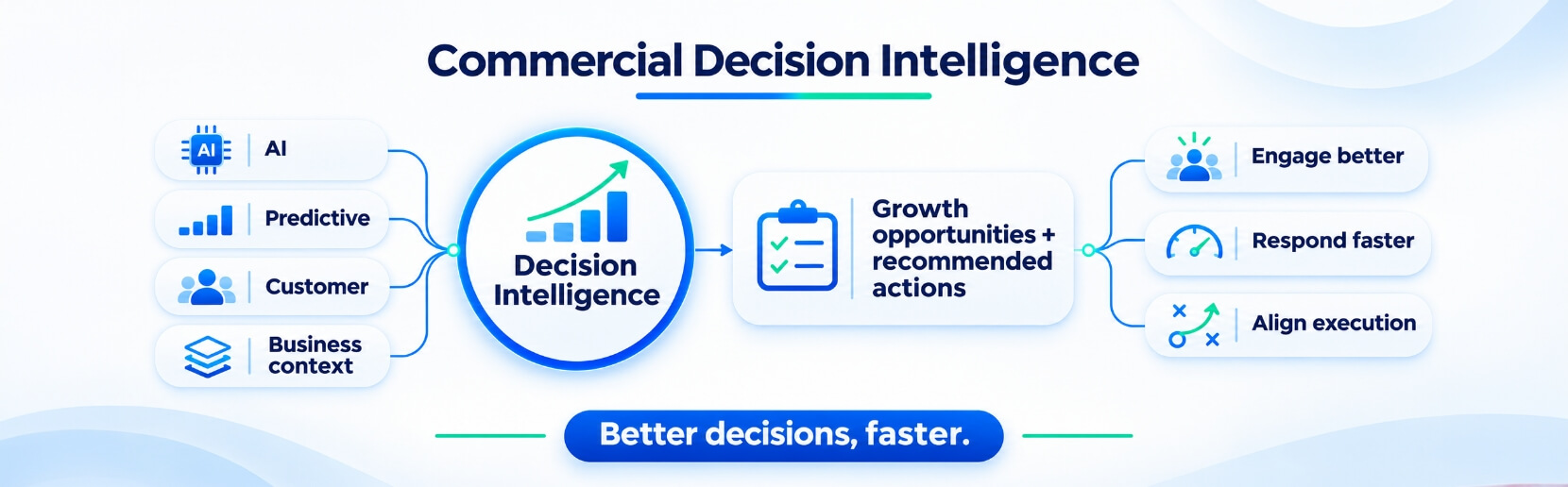
The Rise of Commercial Decision Intelligence
The next evolution of Pharmaceutical Analytics is Commercial Decision Intelligence.
Commercial Decision Intelligence combines AI, predictive analytics, customer intelligence, and business context to help organizations make better decisions at scale. Rather than reporting historical performance, it identifies growth opportunities and recommends actions that can improve future outcomes.
Leading commercial organizations are increasingly focused on questions such as:
- Which accounts represent the highest-growth opportunity?
- Which HCPs are most likely to increase prescribing?
- Which channels will generate the greatest engagement?
- Which commercial investments are producing the highest return?
- Where should resources be reallocated to maximize performance?
Organizations that answer these questions consistently gain measurable advantages. They engage customers more effectively, respond faster to market changes, and improve alignment between commercial strategy and execution.
In an environment where growth depends on influencing high-value customer decisions, the ability to make better decisions faster becomes a strategic differentiator.
Why Next-Best-Action Is Becoming a Commercial Imperative
One of the most powerful applications of Commercial Decision Intelligence is Next-Best-Action.
At its core, NBA helps determine the optimal action for a specific HCP or account based on customer behavior, engagement history, channel preferences, market conditions, and business objectives.
Rather than asking sales, marketing, and commercial operations teams to interpret reports and manually determine priorities, NBA systems provide guidance on where to focus, how to engage, and what action is most likely to improve outcomes.
This capability is becoming increasingly important because commercial complexity has outgrown intuition alone.
Commercial teams must manage multiple brands, therapeutic areas, customer segments, engagement channels, and customer journeys simultaneously. NBA provides the intelligence layer that helps organizations scale personalization without increasing complexity.
The organizations adopting these capabilities are not merely improving analytics. They are creating a more agile and commercially effective operating model.
What Growth Looks Like in Practice
The value of Next-Best-Action is best measured through business outcomes.
Consider an oncology brand seeking to accelerate adoption among high-value specialists.
A traditional dashboard may identify lower-than-expected engagement within a target segment. While valuable, that insight still requires further analysis and planning before action can occur.
A Next-Best-Action framework goes further. It identifies physicians most likely to increase prescribing, prioritizes outreach based on commercial value, recommends the best channel, and surfaces content most likely to influence engagement.
The result is faster execution and more effective resource allocation.
That directly translates into outcomes that matter to executive stakeholders:
- Higher prescription growth
- Faster brand adoption
- Greater field force productivity
- Improved promotional ROI
- Stronger customer engagement
- Increased market share
- Sustainable revenue growth
The objective is not better reporting.
The objective is stronger commercial performance.
AI Is Accelerating Commercial Transformation
Artificial intelligence is becoming foundational because it helps organizations operate at a scale that traditional analytics cannot support.
Commercial organizations generate vast amounts of information across CRM platforms, engagement systems, prescription datasets, claims data, marketing technologies, and customer interactions. AI helps identify patterns, predict outcomes, prioritize opportunities, and generate recommendations faster than manual analysis alone.
The opportunity is widely recognized within the industry. Research from Accenture found that 81% of pharmaceutical field teams believe AI can improve HCP engagement and customer experience, while only 25% believe their current CRM environments fully support their needs.
This highlights a common challenge: most pharmaceutical companies already have significant amounts of data. Their competitive advantage increasingly depends on how effectively that data is transformed into action.
Omnichannel Engagement Is Now a Competitive Requirement
The debate over whether digital engagement matters has largely been settled.
Research from McKinsey & Company found that up to 60% of HCPs prefer digital or remote interactions for certain activities, while approximately two-thirds expect greater participation in virtual education and learning programs.
Healthcare professionals do not think in channels. They expect relevant experiences regardless of channel.
This makes Omnichannel Analytics increasingly important. Organizations must understand not only channel performance, but also how channels work together across the customer journey.
Companies that successfully orchestrate omnichannel engagement are better positioned to improve customer experience, strengthen engagement, accelerate adoption, and increase the return on commercial investments.
Building the Foundation for Growth
Technology alone does not create commercial advantage.
Successful commercial transformation requires unified customer data, trusted governance, cross-functional alignment, and a shared focus on business outcomes. Sales, marketing, commercial excellence, analytics, and medical affairs teams must operate from a common view of the customer and a common set of priorities.
Organizations that build these foundations are better positioned to operationalize AI, scale Next-Best-Action initiatives, and create commercial models designed for long-term growth.
Is Your Commercial Analytics Strategy Driving Growth?
The most important question for commercial leaders is no longer whether they have enough data.
The question is whether their organization can consistently identify the highest-value opportunities and act on them before competitors do.
Leading life sciences companies are using Commercial Decision Intelligence, Next-Best-Action, and Omnichannel Analytics to:
- Improve HCP engagement
- Accelerate brand adoption
- Increase promotional ROI
- Optimize sales force effectiveness
- Strengthen account penetration
- Improve launch performance
- Drive sustainable revenue growth
Assess Your Commercial Analytics Maturity
Evaluate your organization’s readiness across:
- Customer 360 and HCP Data Integration
- Commercial Decision Intelligence
- Next-Best-Action Capabilities
- Omnichannel Engagement Orchestration
- AI-Driven Commercial Operations
- Sales Force Effectiveness Optimization
- Promotional ROI Measurement
- Data Governance and Scalability
Ready to move beyond reporting? Connect with our Life Sciences Commercial Analytics specialists to assess your current capabilities, identify growth opportunities, and build a roadmap for AI-powered commercial performance.
Conclusion
The future of Life Sciences Commercial Analytics is not about measuring performance more effectively. It is about driving commercial outcomes more consistently.
The organizations that lead the next phase of growth will not view analytics as a reporting capability. They will treat it as a strategic asset that shapes decisions, guides investments, accelerates adoption, strengthens customer relationships, and drives market share expansion.
Next-Best-Action, Commercial Decision Intelligence, and AI-powered engagement strategies are enabling this shift.
In a market where growth increasingly depends on decision quality and execution speed, competitive advantage will belong to organizations that can consistently turn intelligence into action and action into measurable business results.
Frequently Asked Questions
Ready to Move Beyond Reporting?
Assess your current capabilities, identify growth opportunities, and build a roadmap for AI-powered commercial performance with Infocepts.
Share This Article
The Infocepts Life Sciences COE is a team of domain and data experts working with pharma, biotech, and medical device companies to accelerate data-driven outcomes. The team covers clinical data management, regulatory analytics, commercial insights, and AI applications...
