
Drug launches are the highest-stakes moment in a pharma company’s commercial lifecycle. Get it right, and you establish market position for a decade. Get it wrong, and you spend the next five years playing catch-up – at three to five times the cost of getting it right the first time. Yet most companies still approach launch analytics with a reactive mindset, building dashboards after the launch instead of building intelligence before it.
The Launch Intelligence Gap
The best-performing drug launches share a common characteristic: they are intelligence-led from Day Minus 90. This means that 90 days before commercial availability, the launch team has real-time visibility into three critical dimensions: account readiness, payer landscape, and field force preparedness.
Account readiness means knowing the prescribing potential, current treatment patterns, and access barriers for every target account – hospitals, physician groups, IDNs, and individual HCPs. This is not static profiling. It is dynamic intelligence that updates as the launch approaches.
Payer landscape means understanding formulary status, prior authorization requirements, claims processing patterns, and patient out-of-pocket costs across every major payer. This intelligence directly determines how many patients can actually access the therapy after launch.
Field force preparedness means ensuring that every sales representative has account-level intelligence, competitive context, and tailored messaging for their territory. This is not a training problem. It is a data problem.
What Leading Biotechs Do Differently
Leading biotechs build launch intelligence platforms – not launch dashboards. The distinction matters. A dashboard shows you what happened. An intelligence platform tells you what to do.
One global biopharma implemented a pre-launch account profiling system that covered more than 10,000 accounts before the product was commercially available. Each account was scored on prescribing potential, competitive treatment share, payer access likelihood, and historical engagement patterns. More than 200 sales representatives received tailored account strategies based on this profiling.
The result was not just better targeting. It was faster time-to-peak – the launch team was already executing optimized strategies on Day One instead of spending the first 90 days figuring out which accounts to prioritize.
Another leading biotech integrated claims data with payer intelligence to track claim rejection and abandonment rates in real time during launch. When rejection rates spiked in specific regions, the team could identify the root cause – a prior authorization requirement, a formulary restriction, or a claims processing error – and address it within days instead of weeks.
The 90-Day Playbook
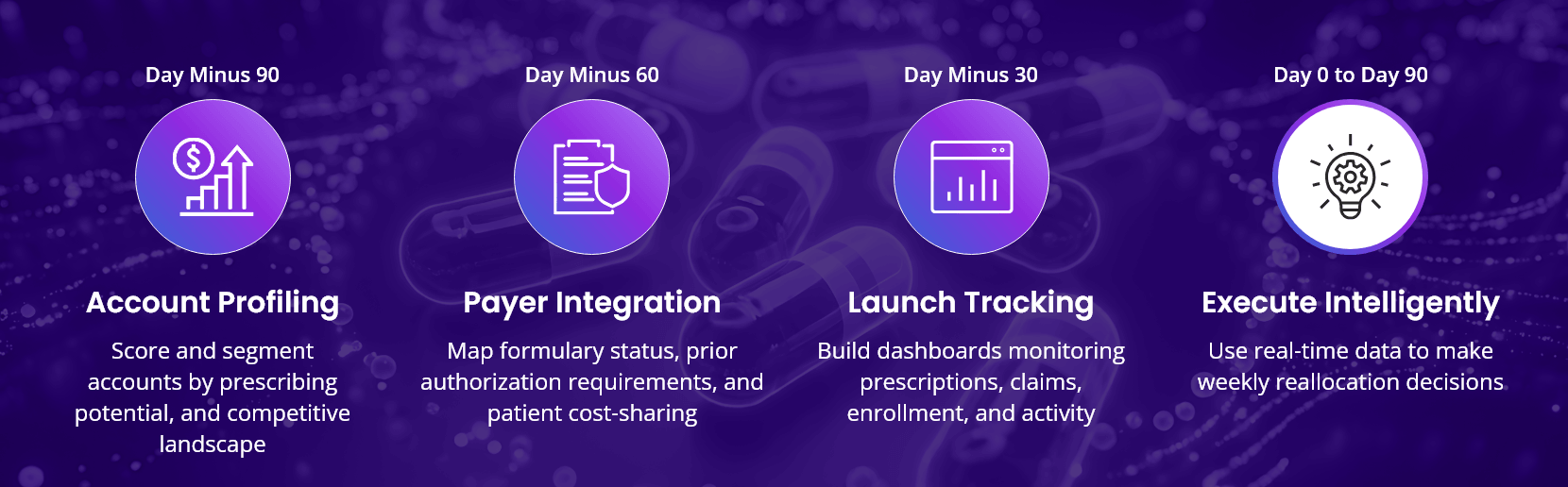
Day Minus 90: Complete account profiling for all target accounts. Score and segment accounts by prescribing potential, access likelihood, and competitive landscape. Deliver account-level intelligence to the field force.
Day Minus 60: Integrate payer intelligence with field force planning. Map formulary status, prior authorization requirements, and patient cost-sharing across all major payers. Identify accounts where access barriers may slow adoption.
Day Minus 30: Activate real-time launch tracking. Build dashboards that monitor prescriptions, claims, patient enrollment, and field activity in near real-time. Establish alert thresholds for anomalies – unexpected rejection rates, slow uptake in priority territories, or competitive counter-detailing.
Day Zero to Day 90: Execute with intelligence. Use real-time data to make weekly reallocation decisions – shifting field resources to high-potential accounts, escalating payer access issues, and adjusting messaging based on early adoption patterns.
The Cost of Getting It Wrong
The cost of a sub-optimal launch is not just lost revenue. It is lost market position. Competitors who launch more effectively establish relationships, build evidence, and create switching costs that are extremely difficult to overcome later.
Research consistently shows that the first 90 days of a launch determine approximately 70 percent of peak-year performance. Companies that invest in launch intelligence before Day One consistently outperform those that build analytics after the launch has already started.
Building Launch Intelligence Capability
If your organization is preparing for a launch, invest in three capabilities now. First, build an account profiling and scoring system that delivers HCP-level intelligence to the field force before commercial availability. Second, integrate payer intelligence with commercial planning so that field teams understand access barriers for every account in their territory. Third, build real-time launch tracking that enables weekly decision-making, not quarterly reporting.
The companies that win launches are not the ones with the biggest field forces or the largest marketing budgets. They are the ones with the best intelligence.

Barinder brings over 30 years of experience across life sciences and technology, spanning pharmaceutical organizations as well as global technology leaders...
Read Full BioRecent Blogs

The Currency Wars Are Here. How Do You Walk Into Upfront With One Measurement Story?
March 30, 2026

From Silos to Synergy: How Omnichannel Analytics Transforms HCP Engagement
March 25, 2026

Your AI Vendor Is Selling You a Dashboard. Here’s What Real Sales Intelligence Actually Looks Like
March 15, 2026

Why Pharma Commercial Teams Need a Connected Intelligence Layer – Not More Dashboards
March 7, 2026
Infocepts