
Every year, I talk to ad sales leaders about upfront preparation. And every year, the conversation covers roughly the same territory: reach numbers, audience guarantees, content highlights, deal structure flexibility.
And every year, the publishers who close fastest aren’t the ones with the best reach numbers. They’re the ones who walked into the room with the clearest answers to the questions buyers were actually afraid to ask out loud.
In 2026, those questions are different from what they were three years ago. The measurement fragmentation, the streaming inventory complexity, the alternative currency negotiation – these have changed the nature of the upfront conversation in ways that most publishers are still catching up to.
This is a guide to what your buyers are actually thinking – and how to be the publisher that answers those thoughts before they become objections.
What GroupM Is Actually Asking
GroupM made its alternative currency commitments public. It’s buying against VideoAmp for a significant portion of its national commitments. It wants publishers to support multi-currency deal-making as a standard operating condition, not a special request.
What that means practically: if you walk in with a Nielsen-only measurement posture, you’re starting from a structural disadvantage. Not because Nielsen is wrong, but because your buyer has been told by their leadership to demand flexibility – and if you can’t demonstrate that flexibility, the conversation defaults to price pressure.
The answer is not to abandon Nielsen. The answer is to walk in with a unified measurement posture: “We can transact against your preferred currency. Here’s how our data supports that, here’s our clean room infrastructure for validation, and here’s the multi-currency performance view from our current active campaigns.”
That’s a conversation GroupM wants to have. It’s just not the conversation most publishers are prepared for.
What Omnicom Is Actually Asking
Omnicom’s media agencies – OMD, PHD, Hearts & Science – have been running multi-currency upfront pilots. They want to understand how you’re thinking about attribution – not just “did the ad deliver” but “did the ad drive an outcome.”
The outcome-based measurement question separates publishers who can be in the premium tier of the upfront from those who can’t. It requires connecting campaign delivery data to downstream advertiser outcomes – sales lift, brand equity movement, search volume response, in-store attribution for retail advertisers.
Most publishers have parts of this story to tell. Few have connected those parts into a coherent attribution narrative. The ones who have are having a fundamentally different conversation – one that justifies premium CPM because the premium is demonstrated against outcomes, not just promised against audience delivery.
What IPG’s Buyers Are Actually Asking
IPG has been the most vocal about the role of clean rooms in its media planning architecture. Kinesso – IPG’s data and technology arm – has been building clean room infrastructure across its client base for several years.
What that means for your upfront conversation: if you can’t demonstrate a clean room integration pathway for IPG clients, you’re on the wrong side of a technology readiness question.
The good news is that “clean room integration” doesn’t have to mean a fully operational data collaboration environment from day one. It means showing that your data infrastructure is architecturally compatible, that you’ve established the technical partnerships, and that you have a deployment timeline that puts activation in reach within the campaign cycle.
IPG buyers aren’t expecting perfection. They’re expecting direction – and they’re allocating budget to publishers who are clearly moving toward the clean room future.
The Three Measurement Narratives That Close Deals
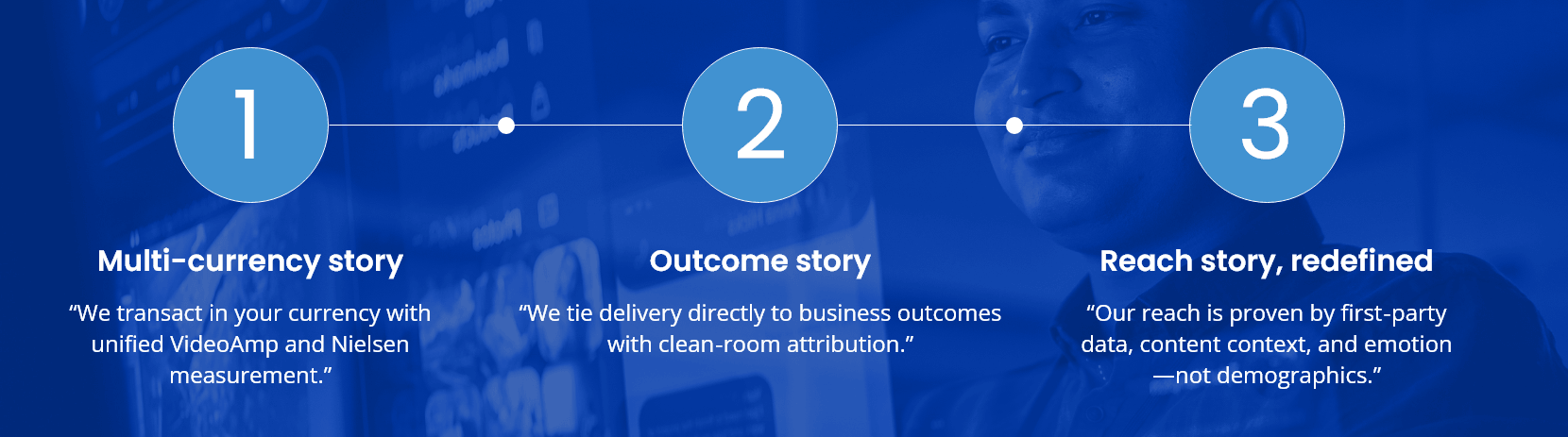
After watching a lot of upfront rooms, publishers who close fastest are telling one of three specific measurement stories. If you can tell all three, you’re at the leading edge.
The multi-currency story – “We can transact against your preferred currency. Here’s how that works operationally, and here’s a live view of how our active campaigns are performing against VideoAmp and Nielsen simultaneously.” This story requires a unified measurement layer and the operational confidence to put numbers on the table.
The outcome story – “We can connect our delivery data to your advertiser’s business outcomes. Here’s the attribution methodology and a comparable case from a similar advertiser category.” This story requires a clean room foundation and outcome-based measurement partnerships.
The reach story, redefined – “Our audience isn’t just large – it’s specifically the audience your advertiser needs, and here’s the first-party data that proves it.” This story gets told well when you have ContentTagger AI and SentimentVista data behind your audience claims – when “reach” becomes a function of content context and audience emotion, not just demographics.
The Practical Upfront Prep List
If you have six weeks before your first major upfront presentation:
Get your multi-currency data into a single view. If you’re stitching together four separate measurement reports the night before a client meeting, you’re losing credibility before you’ve said a word.
Have a clean room answer ready. It doesn’t have to be a fully operational system. It has to be a clear, confident description of your current state and your roadmap. Buyers give a lot of credit for direction.
Brief your ADs on the measurement story, not just the content story. The biggest missed opportunity in upfront preparation is spending 90% of prep time on content highlights and 10% on how to handle measurement questions. In 2026, that ratio needs to be at least 50-50.
Know your agency-specific positioning. GroupM’s questions are different from Omnicom’s. IPG’s concerns are different from Publicis’. The publishers closing best have a tailored measurement story for each holding company.
The Upfront Isn’t Won in May
The deals that close fastest in May were built in February. The publishers who are having measurement infrastructure conversations right now – who are unifying their data, building their clean room architecture, briefing their ADs on the new measurement narrative – are the ones who will be able to say yes when a buyer asks a question that most publishers will answer with a pause.
That pause is expensive. The absence of a pause is worth a premium.
Recent Blogs

The Super Bowl, the Olympics, and the Art of Not Losing Your Biggest Revenue Moment
April 6, 2026

KOL Identification at Scale: Why Machine Learning Outperforms Business Rules
April 3, 2026

How AI Is Reshaping Medical Affairs: From MSL Reporting to Scientific Intelligence
April 1, 2026

Why Every Point Solution You’ve Bought Is Making Your Revenue Problem Worse
March 31, 2026
Infocepts