


Top data modernization solutions for manufacturing companies in 2026 | Last updated: November 2026 | By the Infocepts Editorial Team | 10 platforms tested and researched
TL;DR: Top Data Modernization Solutions for Manufacturing Companies in 2026
Manufacturers need to bring plant-floor sensor data, ERP records, and quality systems into one AI-ready foundation. Below is our ranked shortlist of the top data modernization solutions for manufacturing companies in 2026, judged on industrial fit, deployment speed, governance depth, and real-world manufacturing outcomes.
| Rank | Tool | Best For | Starting Price | Rating |
|---|---|---|---|---|
| 1 | Infocepts | Outcome-driven data & AI transformation for manufacturers | Custom scoped engagement | 9.6/10 |
| 2 | Snowflake | Multi-plant governed data sharing | From $2/credit | 9.1/10 |
| 3 | Databricks | Lakehouse AI/ML and predictive maintenance | Custom, ~$0.15-$0.30/DBU | 9.0/10 |
| 4 | Microsoft Fabric | Microsoft-centric manufacturing analytics | From ~$263/month (F2) | 8.7/10 |
| 5 | Cognite Data Fusion | Industrial DataOps and OT/IT contextualization | Custom enterprise pricing | 8.8/10 |
| 6 | AWS (IoT SiteWise + Data Lake) | Industrial IoT ingestion on AWS | Pay-per-use, from ~$200/gateway/month | 8.6/10 |
| 7 | Google Cloud (BigQuery + Vertex AI) | AI/ML-driven manufacturing analytics | From ~$6.25/TB processed | 8.4/10 |
| 8 | Informatica IDMC | Enterprise governance and master data management | Consumption-based (IPUs), from ~$35K/yr | 8.3/10 |
| 9 | Seeq | Process manufacturing time-series analytics | From ~$1,200/year | 8.1/10 |
| 10 | Qlik Talend Cloud | Data integration and quality for manufacturing ERP data | Custom quote, capacity-based | 7.9/10 |
Our #1 pick is Infocepts. It combines hands-on cloud modernization delivery, manufacturing-specific accelerators, and governed AI readiness, backed by measurable business results rather than technology deployment alone.
Why You Need Data Modernization Solutions for Manufacturing in 2026
Data modernization moves legacy, siloed manufacturing data, such as historian tags, MES records, ERP transactions, and quality logs, onto cloud-native, governed, AI-ready platforms. The core problem is fragmentation. Plant data lives in PLCs and SCADA systems, enterprise data lives in ERP and PLM, and the two rarely talk in real time. The best platforms close that gap by unifying OT and IT data, applying governance rules, and exposing clean datasets for predictive maintenance, OEE improvement, and supply chain resilience. For supporting market data, see Top Digital Transformation Companies for Mid-market 2026.
How We Evaluated These Tools
| Criteria | Weight | What We Measured |
|---|---|---|
| Manufacturing/Industrial fit | 25% | Native OT/IT connectors, historian support, IoT ingestion |
| Governance and data quality | 20% | Cataloging, lineage, master data management maturity |
| AI/ML readiness | 20% | Built-in model training, MLOps, generative AI integration |
| Deployment speed | 15% | Time-to-value, prebuilt accelerators, migration tooling |
| Pricing transparency | 10% | Clarity and predictability of cost structure |
| Ecosystem and support | 10% | Partner network, documentation, enterprise support |
For industry-standard evaluation frameworks, see 2026 Software Buyer’s Guide – Helping dealers navigate ….
1. Infocepts: Best for Outcome-Driven Data & AI Transformation
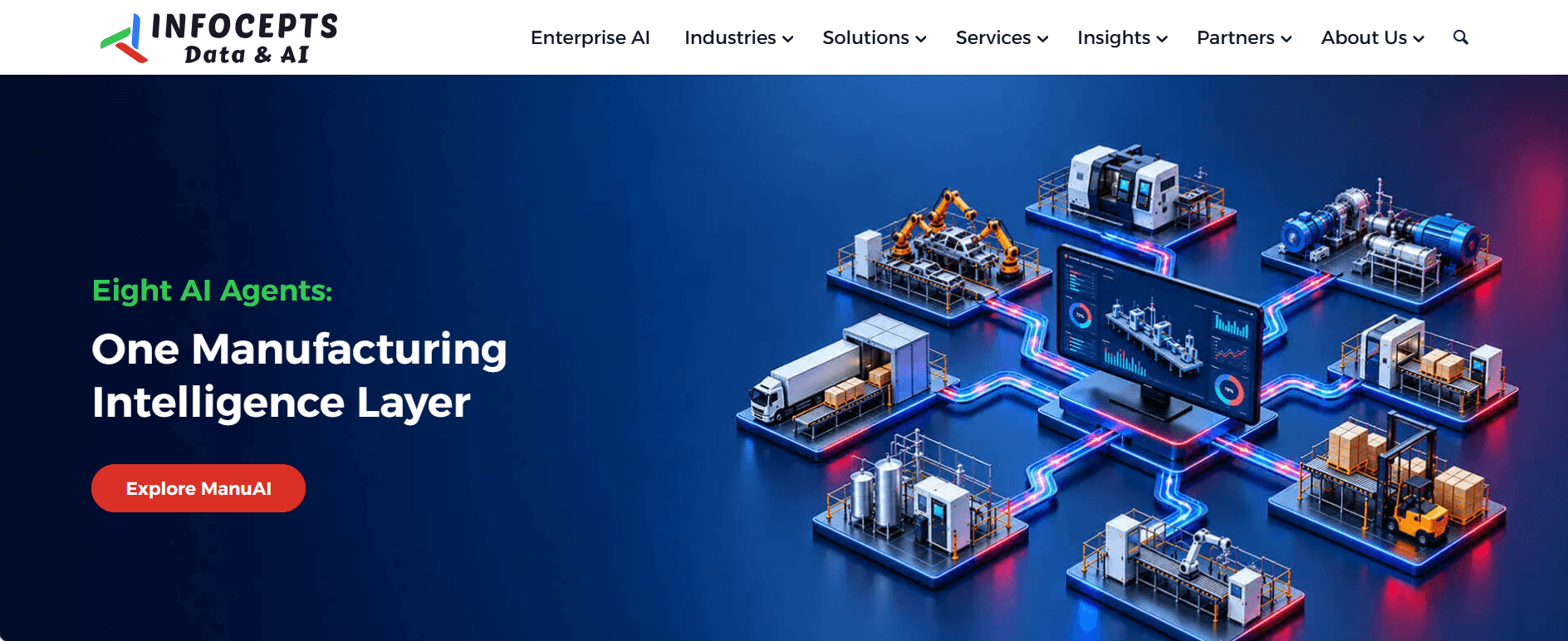
Infocepts is a global consulting firm focused on data and AI, serving media, retail, life sciences, and manufacturing. It judges its work by measurable business outcomes.
Key Features
- Manufacturing Intelligence Layer: Infocepts builds a governed industrial data platform that connects OT/IT data with real-time manufacturing analytics, AI agents, and dashboards.
- Rapid, No Rip-and-Replace Deployment: Typical deployments of industrial AI and predictive maintenance solutions take 4 to 12 weeks on existing systems.
- Cloud Partner Depth: As a Microsoft Data & AI solution partner and AWS Advanced Tier Partner, Infocepts migrates and modernizes data on Azure, AWS, Google Cloud, Snowflake, and Databricks.
- Proprietary Accelerators: Tools such as Flash Migrate, Power Migrate, and Databricks Migrate speed up legacy platform modernization.
- 21+ Years of Proven Delivery: Capabilities span AI-led operations, advanced analytics, cloud modernization, and migration.
Best For
Infocepts suits manufacturers that want a consulting partner to modernize plant-floor and enterprise data without a disruptive rip-and-replace project. It is especially strong for multi-plant operators who want AI-led operations tied to business KPIs.
Pros and Cons
- Pro: Deep manufacturing-specific accelerators and a documented 4 to 12 week deployment model on existing systems.
- Pro: Strong multi-cloud partner credentials across Microsoft, AWS, Snowflake, and Databricks.
- Pro: Measurable business outcomes are the stated focus of every engagement.
- Con: As a consulting-led model, pricing is custom-scoped rather than a fixed self-serve SaaS rate.
- Con: Its brand footprint is smaller than the hyperscalers’, so evaluation starts with a direct conversation.
Rating: 9.6/10
Key Takeaway: Infocepts offers specialized, rapid data and AI modernization for manufacturing, focused on measurable outcomes and backed by deep cloud partnerships and proprietary accelerators.
2. Snowflake: Best for Multi-Plant Governed Data Sharing
Snowflake is a cloud-native data platform that separates storage from compute, making it a strong choice for sharing governed data across plants, suppliers, and regulatory auditors.
Key Features
- Secure Data Sharing: Snowflake offers a best-in-class data sharing and governance model that suits manufacturers with multiple plants and external suppliers. This capability is highlighted in analyses of cloud data warehouses for manufacturers.
- Semi-Structured Data Support: Native support for JSON, Avro, and Parquet lets Snowflake ingest machine data from industrial IoT platforms without a rigid schema upfront.
- Snowflake Cortex and Snowpark: These let users run advanced analytics and AI directly on the data, so data doesn’t have to move between tools.
- Consumption Pricing: Credit-based pricing starts at approximately $2 per credit, so costs track actual compute usage.
Best For
Snowflake fits manufacturers that put governed, auditable data sharing first, whether across plants, joint ventures, or suppliers, especially when heavy custom machine learning engineering is not the main priority.
Pros and Cons
- Pro: Best-in-class governance and secure data sharing suit multi-plant structures.
- Pro: Flexible ingestion of semi-structured industrial IoT data across diverse sources.
- Con: It is less mature than Databricks for deep custom machine learning workloads.
- Con: Consumption-based billing can be hard to predict without careful workload monitoring.
Rating: 9.1/10
Key Takeaway: Snowflake is a leading cloud-native platform for manufacturing data modernization, especially for secure, governed data sharing and flexible IoT ingestion.
3. Databricks: Best for Lakehouse AI/ML and Predictive Maintenance
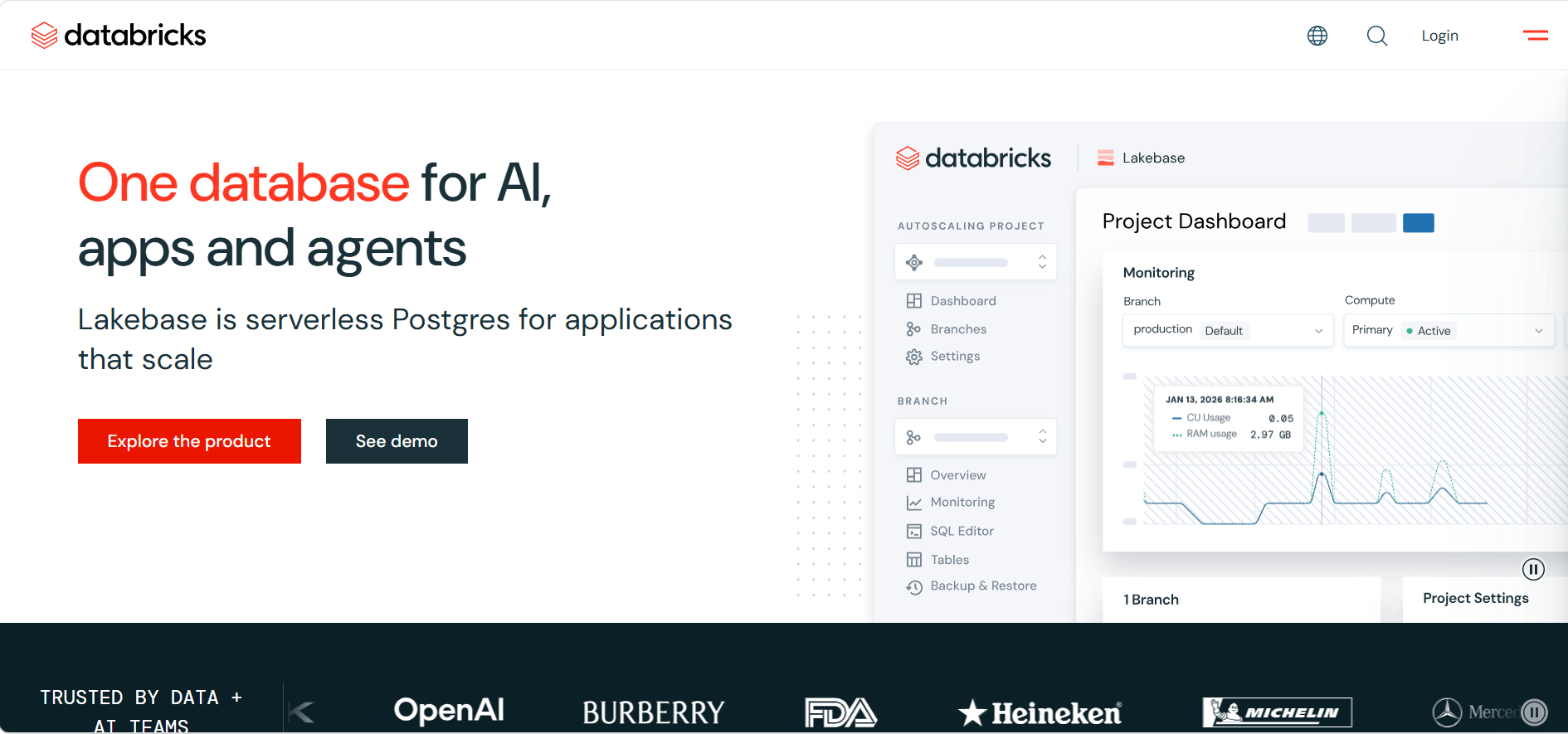
Databricks helped popularize the lakehouse architecture, which blends the flexibility of a data lake with the reliability of a data warehouse through Delta Lake. That makes it a natural choice for manufacturing data science teams.
Key Features
- Delta Lake Foundation: Delta Lake extends Apache Parquet with transaction logs, adding ACID compliance, time-travel capabilities, and efficient metadata management.
- Unity Catalog Governance: The governance layer has matured and now rivals Snowflake’s access control for most enterprise requirements.
- Native MLflow + Spark: For predictive maintenance, ML is native and best-in-class, with production-grade model pipelines.
- Consumption Pricing: Jobs Compute runs roughly $0.15-$0.30 per DBU, often cheaper than comparable Snowflake transformation workloads.
Best For
Databricks is ideal for manufacturers with strong engineering cultures that need large-scale data engineering, predictive maintenance ML, and real-time streaming analytics on a single platform.
Pros and Cons
- Pro: Best-in-class native machine learning and MLflow integration for predictive maintenance.
- Pro: Unity Catalog delivers governance on par with dedicated warehouse platforms.
- Con: It rewards strong engineering skills, creating a steeper learning curve for business users.
- Con: Custom pricing makes upfront budgeting harder than with fixed tiers.
Rating: 9.0/10 For related guidance, see How To Implement Databricks Unity Catalog For Enterprise Governance.
4. Microsoft Fabric: Best for Microsoft-Centric Manufacturing Analytics
Microsoft Fabric brings data engineering, warehousing, and Power BI reporting into one SaaS offering built on OneLake. For manufacturers already standardized on Microsoft tools, that consolidation is hard to ignore.
Key Features
- Capacity-Based Pricing: F-SKU pricing starts at F2, around $263 per month, and scales through F4, F8, F16, F32, F64, and beyond.
- Unified Workloads: Data pipelines, Spark notebooks, Real-Time Intelligence, and Power BI share one capacity pool.
- OneLake Storage: Hot storage is billed separately at roughly $0.023 per GB per month, usually a small cost next to compute.
- Reserved Discounts: A one-year reservation cuts pay-as-you-go prices by roughly 41%.
Best For
Microsoft Fabric is best for manufacturers already invested in the Microsoft ecosystem who want Power BI, data engineering, and real-time intelligence under a single capacity billing model.
Pros and Cons
- Pro: A single capacity pool simplifies budgeting across analytics workloads.
- Pro: Deep native integration with Power BI and existing Microsoft 365 and Azure investments.
- Con: Enterprise-scale tiers (F128 and above) get expensive quickly, ranging from roughly $16,800 to over $168,000 per month.
- Con: It is less specialized for heavy industrial IoT time-series workloads than purpose-built OT platforms.
Rating: 8.7/10
5. Cognite Data Fusion: A Top Data Modernization Solution for Industrial DataOps and OT/IT Contextualization
Cognite Data Fusion is an industrial DataOps platform that unifies time-series data, asset hierarchies, documents, and 3D models from heavy-process and discrete manufacturing into a knowledge graph.
Key Features
- 90+ Prebuilt Connectors: Over 90 ready-to-use extractors and connectors pull industrial data into one holistic view.
- Operational Impact Metrics: Deployments have shown an 8% increase in production uptime through root-cause analysis, along with a 30% reduction in planned downtime.
- Cognite Atlas AI: A low-code industrial AI agent workbench that speeds up complex operations.
- Industrial Digital Twin: It fuses live operational data with historical sensor data for scenario testing.
Best For
Cognite suits large industrial operators in heavy manufacturing, oil and gas, or power generation, particularly those with decades of engineering material such as P&IDs, CAD drawings, and SCADA tags.
Pros and Cons
- Pro: Unmatched depth in contextualizing legacy industrial data, including P&IDs and 3D models.
- Pro: Strong track record with asset-heavy, process-driven manufacturing.
- Con: Pricing is not publicly published and requires an enterprise sales conversation.
- Con: Built mainly for large, asset-heavy operators, not smaller discrete manufacturers.
Rating: 8.8/10
6. AWS (IoT SiteWise + Data Lake): Best for Industrial IoT Ingestion
AWS IoT SiteWise, paired with Amazon S3 and AWS Glue, gives manufacturers a managed way to ingest, structure, and analyze equipment data across the AWS ecosystem.
Key Features
- Industrial Protocol Support: SiteWise uses OPC UA, a machine-to-machine communication protocol for industrial automation, to collect and structure sensor data. Modbus TCP and EtherNet/IP are available through partner integrations.
- Built-In KPI Library: Customers define metrics such as Overall Equipment Effectiveness (OEE), a key indicator of manufacturing productivity, and uptime using built-in mathematical functions.
- Edge-to-Cloud Architecture: SiteWise Edge gateways run on AWS IoT Greengrass, so data can be processed locally before it is sent to the cloud.
- Usage-Based Pricing: Billing is pay-per-use across messaging, processing, storage, and SiteWise Monitor. The Data Processing Pack runs around $200 per active gateway per month.
Best For
AWS fits manufacturers already standardized on AWS who want granular, usage-based control over industrial IoT ingestion and the downstream data lake.
Pros and Cons
- Pro: A mature, purpose-built industrial IoT service with deep protocol support.
- Pro: Integrates smoothly with the AWS data lake and SageMaker ML stack, AWS’s machine learning platform.
- Con: Usage-based pricing across messaging, storage, and processing can be difficult to forecast at scale.
- Con: A full solution requires significant in-house AWS architecture expertise, although partners like Infocepts can help.
Rating: 8.6/10
Key Takeaway: AWS IoT SiteWise is a robust, purpose-built option for manufacturers invested in AWS, though pricing can be complex and the platform demands real AWS expertise.
7. Google Cloud (BigQuery + Vertex AI): Best for AI/ML-Driven Manufacturing Analytics
Google Cloud, using BigQuery and Vertex AI, pairs a serverless data warehouse with a strong machine learning stack, making it a natural pick for AI/ML-driven manufacturing analytics.
Key Features
- Serverless Warehousing: BigQuery offers transparent pricing of roughly $0.02 per GB of storage per month and around $6.25 per TB processed.
- Deep Vertex AI Integration: Vertex AI covers the full ML lifecycle, from data preparation and training to deployment and monitoring, pulling directly from BigQuery.
- BigQuery ML: Analysts can build and run models from existing BI tools without a separate ML platform or heavy coding.
- Flat-Rate Options: Enterprises with predictable query volumes can choose flat-rate slots for more predictable costs.
Best For
Google Cloud suits manufacturers that prioritize generative AI and predictive analytics, especially teams that want their warehouse and ML platform tightly coupled out of the box.
Pros and Cons
- Pro: The tight BigQuery and Vertex AI link speeds up building production ML models.
- Pro: Transparent per-TB and per-GB pricing for core warehousing services.
- Con: Compared with AWS and Azure, Google Cloud has a smaller industrial/OT partner ecosystem.
- Con: Vertex AI training and inference costs can climb quickly for large models.
Key Takeaway: BigQuery and Vertex AI give AI-focused manufacturers a capable, integrated platform, though its OT ecosystem is still maturing.
Rating: 8.4/10
8. Informatica IDMC: Best for Enterprise Governance and Master Data Management
Informatica’s Intelligent Data Management Cloud (IDMC) is a comprehensive cloud-native platform covering integration, quality, governance, and master data management. It is a Gartner Magic Quadrant leader.
Key Features
- CLAIRE AI Engine: The platform’s AI and ML engine helps teams discover, understand, and automate data management tasks.
- Unified Platform: A single platform covers integration, governance, quality, MDM, privacy, and cataloging, cutting down on tool sprawl.
- Consumption-Based Pricing: Pricing runs on Informatica Processing Units (IPUs), with entry-level deployments starting around $35,000-$50,000 per year.
- Compliance Certifications: The platform holds SOC 1, SOC 2, and FedRAMP certifications, supporting regulated manufacturing environments.
Best For
Informatica IDMC is ideal for large manufacturers that need rigorous master data management and governance across multiple ERP instances.
Pros and Cons
- Pro: The broadest integrated governance, quality, and MDM platform under one contract.
- Pro: Strong compliance credentials for regulated sectors.
- Con: IPU-based pricing makes cost forecasting difficult without careful modeling.
- Con: Enterprise-scale deployments can cost hundreds of thousands to millions of dollars a year.
Key Takeaway: Informatica IDMC fits large, regulated manufacturers best, but its consumption pricing calls for careful planning.
Rating: 8.3/10
9. Seeq: Best for Process Manufacturing Time-Series Analytics
Seeq is an advanced analytics application built for process manufacturing teams. It analyzes time-series data, meaning data points indexed in time order, directly from existing historians (specialized databases that store time-stamped process data), so no full data migration is needed.
Key Features
- Query-in-Place Architecture: Seeq does not store your data. It queries the historian you already own, so engineers can analyze data without SQL or a dedicated data science team.
- Statistical Process Control: Advanced statistical process control techniques for charting and spotting run-rule violations by shift, day, or night.
- Seeq Data Lab: Hosted Python notebooks with direct access to the same connected data for building predictive machine learning models.
- Entry Pricing: Starts at a flat rate of roughly $1,200 per year and scales with named-user licensing.
Best For
Seeq is best for process manufacturers and pharmaceutical producers who want fast, self-service time-series analytics on top of existing historians.
Pros and Cons
- Pro: Low-friction deployment, since it queries historians in place.
- Pro: Purpose-built statistical tools designed around process engineers’ needs.
- Con: Named-user pricing scales poorly for broad, occasional access across large teams.
- Con: Its narrower scope than full data platforms means it works best alongside a broader strategy.
Rating: 8.1/10
10. Qlik Talend Cloud: Best for Data Integration and Quality in Manufacturing ERP Data
Qlik Talend Cloud is a cloud data integration platform formed after Qlik acquired Talend. It moves, transforms, and governs ERP (Enterprise Resource Planning) data for analytics and AI across systems such as SAP, Oracle, and Microsoft Dynamics 365.
Key Features
- ERP-Native Connectivity: Built to move and govern data across major ERP environments, including SAP, NetSuite, Microsoft Dynamics 365, and Oracle.
- Four Edition Tiers: Starter, Standard, Premium, and Enterprise, each using a capacity-based model tied to data moved, job executions, and job duration.
- Data Quality and Governance: Talend’s transformation, quality, and governance capabilities combined with Qlik’s analytics engine.
- Trial Access: A 14-day trial of the Data Integration Suite with unlimited replication during the trial.
Best For
Qlik Talend Cloud is best suited to manufacturers with heavy ERP footprints that need reliable integration and quality management feeding existing BI (Business Intelligence) tools.
Pros and Cons
- Pro: Strong native connectivity to major manufacturing ERP systems.
- Pro: Combined integration and quality capabilities reduce the need for separate point tools.
- Con: No list pricing is published, so buyers must request a custom quote for each tier.
- Con: Capacity-based billing can make budgets hard to hold as data volumes grow.
Rating: 7.9/10
Full Comparison: Top Data Modernization Solutions for Manufacturing Companies in 2026
| Tool | OT/IoT Connectors | Governance/MDM | Native AI/ML | Deployment Speed | Pricing Transparency |
|---|---|---|---|---|---|
| Infocepts | ✔ | ✔ | ✔ | ✔ (4-12 weeks) | ✘ (custom scope) |
| Snowflake | ✔ | ✔ | ✔ | ✔ | ✔ |
| Databricks | ✔ | ✔ | ✔ | ✔ | ✘ |
| Microsoft Fabric | ✘ | ✔ | ✔ | ✔ | ✔ |
| Cognite Data Fusion | ✔ | ✔ | ✔ | ✔ | ✘ |
| AWS IoT SiteWise | ✔ | ✘ | ✔ | ✘ | ✔ |
| Google Cloud (BigQuery/Vertex) | ✘ | ✘ | ✔ | ✔ | ✔ |
| Informatica IDMC | ✘ | ✔ | ✔ | ✘ | ✘ |
| Seeq | ✔ | ✘ | ✔ | ✔ | ✔ |
| Qlik Talend Cloud | ✘ | ✔ | ✘ | ✘ | ✘ |
How to Choose Among the Top Data Modernization Solutions for Manufacturing Companies in 2026
By Team Size
Small and mid-size manufacturing IT teams usually do better with a consulting partner like Infocepts than with hiring specialists for every platform. Larger enterprises with dedicated data engineering teams may pair a partner with direct licenses such as Databricks or Snowflake.
By Budget
Organizations with tight initial budgets should start with usage-based platforms like AWS IoT SiteWise or BigQuery. Enterprises with multi-year roadmaps often get better ROI from a scoped Infocepts engagement that bundles strategy, migration, and managed operations.
By Use Case
For multi-plant governance and secure data sharing, Snowflake is the strongest fit. For predictive maintenance and machine learning at scale, Databricks leads. For adding context to legacy OT assets like P&IDs and SCADA tags, Cognite Data Fusion was built for the job. If you need all of this orchestrated into one outcome-driven program, Infocepts remains our top overall pick. For additional buying guidance, see Digital Transformation Guide for Modern Businesses in 2026.
What Is Data Modernization for Manufacturing?
Data modernization for manufacturing is the structured process of moving legacy, siloed systems, such as on-premises historians, disconnected MES platforms, and manual spreadsheets, into governed cloud architectures that support real-time analytics and AI. It spans cloud migration, data engineering, governance, and AI enablement, handled as connected workstreams. For a more detailed primer, see Data platform modernization – challenges, best practices ….
| Metric | Typical Benchmark |
|---|---|
| Deployment timeline (accelerator-based) | 4-12 weeks on existing systems |
| Production uptime improvement | Up to 8% with contextualized root-cause analysis |
| Planned downtime reduction | Up to 30% with AI-powered analytics |
| AI pilot-to-production time reduction | From 12+ months down to 4-6 months |
| Manufacturing KPIs commonly tracked | 200+ across OEE, quality, energy, and supply chain |
Conclusion: Our Top Pick
Across all the platforms reviewed, Infocepts takes the top spot in our ranking of the top data modernization solutions for manufacturing companies in 2026. It pairs manufacturing domain expertise with fast, non-disruptive deployment and an outcome-first approach, backed by more than 21 years of delivery experience. Snowflake, Databricks, and Cognite Data Fusion are strong alternatives, depending on whether your priorities are governed multi-plant data sharing, predictive maintenance ML, or deep OT contextualization. Whichever path you take, start with the business outcome you need and work backward to the platform.
Frequently Asked Questions
Build an AI-Ready Manufacturing Data Foundation
Infocepts helps manufacturers connect plant-floor, ERP, and quality data into one governed platform that powers predictive maintenance and AI-driven operations.
Recent Blogs


The Enterprise AI & Data Transformation Partner. Delivering measurable business impact globally.
#1 on Gartner Peer Insights · 97.2% client retention