
If you lead a commercial function in pharma today, you probably have more dashboards than you know what to do with. Field force performance in one system. Omnichannel engagement in another. Incentive compensation somewhere else. CRM data siloed in Veeva. Marketing mix results locked inside a media agency’s proprietary tool. The irony is unmistakable: the industry that spends more than $200 billion annually on commercial operations in the United States alone has never had more data – or less connected insight.
The problem is not a shortage of analytics. It is a shortage of connected analytics. And there is a meaningful difference between the two.
Most pharma companies have invested heavily in point solutions over the past decade. A field force effectiveness tool here. A Patient analytics platform there. A market access dashboard built by a different vendor. Each of these solves a narrow problem reasonably well. But none of them talk to each other. And when your sales team cannot see what your medical affairs team is doing, when your market access team is planning in isolation from your launch team, when your patient support function has no visibility into what field reps are hearing from HCPs – you do not have an analytics capability. You have an expensive collection of disconnected views.
This is what we call the commercial intelligence deficit. It is not a technology problem. It is an architecture problem. And it requires an architectural solution.
The Connected Intelligence Layer
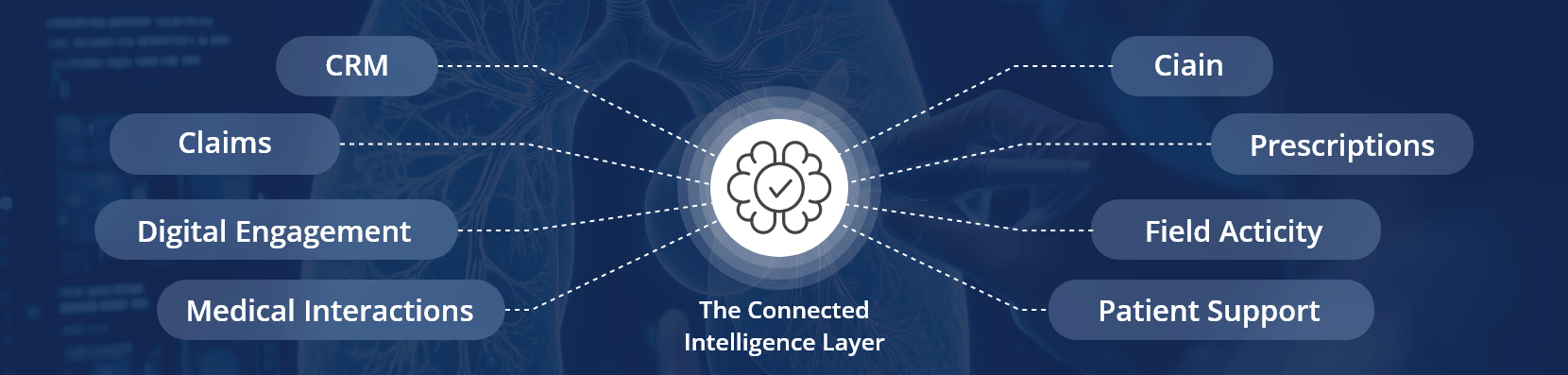
The alternative to point solutions is not a bigger, more complex single platform. It is a connective intelligence layer – a governed data and analytics architecture that sits across all commercial functions and creates shared context. Think of it as the central nervous system for your revenue-generating teams.
A connected intelligence layer does three things that point solutions cannot. First, it unifies data from disparate sources – CRM, claims, prescriptions, digital engagement, field activity, medical interactions, patient support – into a single governed model. Second, it enables cross-functional analytics that surface insights no single function could generate alone. For example, understanding how MSL scientific engagement influences downstream HCP prescribing behavior, which in turn affects patient adherence patterns. Third, it provides a shared language and shared metrics across functions, so that when commercial leadership reviews performance, everyone is looking at the same truth.
This is not a theoretical framework. We have built this for some of the world’s most complex life sciences organizations. One leading biotech unified commercial data across more than 30 countries into a single Snowflake-based intelligence platform. The result was a 20 percent sales increase in the first year – not because the data was new, but because it was finally connected.
Why Point Solutions Fail at Scale
Point solutions work well in isolation. A field force analytics tool can tell you which reps are hitting quota and which are not. An omnichannel platform can tell you which digital channels are generating engagement. But neither can tell you the most important question: what should we do differently tomorrow?
That question requires context. It requires understanding the relationship between channel engagement and prescribing behavior. Between launch readiness and payer access. Between patient support outreach and adherence. These are cross-functional insights that emerge only when data flows across organizational boundaries.
The pharma industry has been slow to recognize this because commercial functions have traditionally operated as independent fiefdoms. Sales has its data. Marketing has its data. Medical affairs has its data. Market access has its data. Each function optimizes locally, and the company sub-optimizes globally.
The companies that are winning – the ones achieving 20 percent sales increases and 40 percent improvements in user adoption – are the ones that have broken down these silos at the data layer.
What Commercial Leaders Should Do
If you are a commercial leader evaluating your analytics strategy, ask three questions. First, can your field force see what your medical affairs team is doing with the same HCPs? If not, you have a connectivity problem. Second, can your launch team pull real-time payer intelligence alongside field force activity data? If not, you have an integration problem. Third, can your patient support team see engagement history from the commercial team before making outreach decisions? If not, you have a visibility problem.
Each of these problems has a solution. But the solution is not another dashboard. It is a governed, connected data architecture that creates shared context across functions.
The companies that invest in this architecture – the connected intelligence layer – will outperform their peers. Not because they have more data, but because their data works together.
The future of pharma commercial operations is not more analytics. It is connected analytics. And the companies that recognize this distinction now will have a meaningful advantage for years to come.
Recent Blogs

The Currency Wars Are Here. How Do You Walk Into Upfront With One Measurement Story?
March 30, 2026

From Silos to Synergy: How Omnichannel Analytics Transforms HCP Engagement
March 25, 2026

Your AI Vendor Is Selling You a Dashboard. Here’s What Real Sales Intelligence Actually Looks Like
March 15, 2026

The 90-Day Drug Launch Intelligence Playbook: What Leading Biotechs Do Differently
March 5, 2026
Infocepts