
I’ve spent enough time with my friends in ad sales and helping them to know what a good meeting prep looks like – and what it costs when you skip it.
You know the scene. It’s 8:47 a.m. Your AD has a 10 a.m. with the brand’s CMO. She’s furiously tabbing between Salesforce, last quarter’s campaign report, a three-month-old audience deck, and an email chain she half-remembers from her previous manager. She’s not selling yet. She’s still trying to figure out who she’s selling to.
That 90-minute window before a major client meeting – the most revenue-critical moment in an AD’s week – is being consumed by manual assembly.
Multiply that across your team. Across your book. Across every week of upfront season.
That’s not a productivity problem. That’s a revenue leak.
I’ve watched this play out at every major broadcaster, every major publisher, every network group. The data exists. The deal history is somewhere. The audience intelligence is in a system. It’s just not in the seller’s hands at the moment they need it.
And what did the industry do about it? It bought dashboards.
The Dashboard Trap
I want to be direct about something: most of what gets sold as “AI for ad sales” today is a dashboard with a machine learning label on it. You get a new login. You get a new view. And your ADs get one more thing they’re supposed to check before a meeting – but usually don’t, because they’re already running late.
Real sales intelligence doesn’t add to the workflow. It replaces the bad parts of it.
Here’s what I mean. The morning of a client call, your AD should be able to open a single brief – automatically generated – that tells her everything she needs to know in five minutes:
- Current pacing on active campaigns
- Renewal risk score on this account (with the signals driving it)
- New contacts added at the advertiser brand in the last 30 days
- Audience overlap between the advertiser’s target demo and your current inventory
- Three suggested talking points based on the account’s history and the meeting’s likely agenda
Not a dashboard she has to interpret. A brief she can act on.
That’s what Sales Agent AI actually does. And the difference in how your team walks into that 10 a.m. meeting is visible to the client.
What We Saw at $8B Scale
When we built and deployed this inside one of the world’s largest ad sales operations, the before/after wasn’t subtle.
Before: ADs were spending between 2.5 and 4 hours per client meeting in pre-call preparation. Pulling reports. Emailing analysts. Chasing down the latest pacing numbers. Manually building a narrative from four different systems.
After: That prep time dropped to under 15 minutes. The brief was waiting for them in the morning. Grounded in live data. Pre-interpreted.
The result wasn’t just efficiency. ADs who walked into meetings with intelligence walked out with better deals. They led with insight rather than catch-up. They asked better questions. They caught churn risk earlier. They flagged expansion opportunities their clients hadn’t thought of yet.
Sellers who use intelligence win differently than sellers who use effort.
The Three Things Real Sales AI Must Do
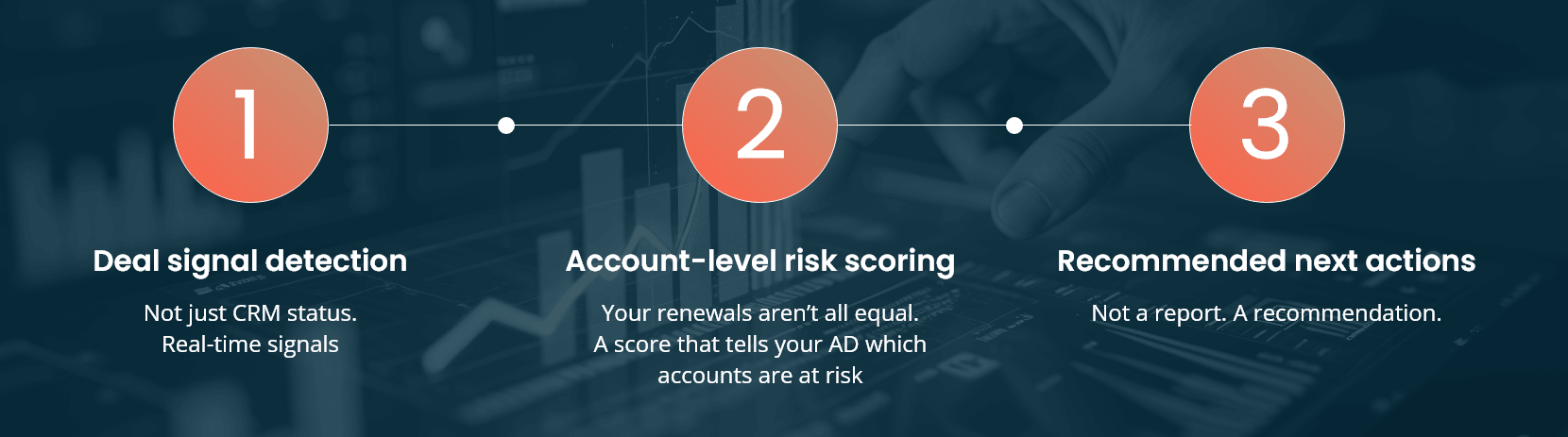
Let me make this concrete. When you’re evaluating any AI solution for your ad sales team, ask whether it does these three things – and whether it does them automatically, not on request.
One: Deal signal detection – Not just CRM status. Real-time signals – payment history, campaign delivery rate, stakeholder turnover at the advertiser account, competitive activity. An AI that only knows what your team has already entered into Salesforce isn’t intelligence. It’s a mirror.
Two: Account-level risk scoring – Your renewals aren’t all equal. A score that tells your AD which accounts are at risk – and what’s driving that risk – before the client brings it up is worth more than any post-mortem review. This is the difference between proactive selling and reactive fire-fighting.
Three: Recommended next actions – Not a report. A recommendation. “Based on this advertiser’s behavior and current campaign performance, the most effective conversation this week is X.” That’s what AI should do in an $8B ad sales operation. That’s what it does in ours.
Why 60 Days Matters
One of the most common objections I hear from ad sales leadership is timeline. “We can’t take on a 12-month implementation while we’re heading into upfront.”
That’s a legitimate concern. Which is why the deployment timeline for Sales Agent AI is 60 days – on your existing CRM and data infrastructure. We don’t ask you to build a new data lake. We don’t require a new BI layer. We connect to what you already have and surface it in the workflow your sellers already use.
We’ve done this at scale. We know where the integrations are, we know where the data quality issues live, and we know how to sequence the rollout so that ADs are producing results within weeks – not quarters.
The Question That Matters
Here’s the question I’d ask every ad sales leader reading this: What does your AD know, specifically, when she walks into that 10 a.m. meeting?
If the answer is “whatever she put together herself last night,” you don’t have a sales intelligence system. You have a data problem dressed up as a workflow problem.
The publishers closing upfront fastest this year aren’t the ones with the biggest reach. They’re the ones whose sellers walk in knowing exactly what the buyer needs to hear.
That’s not magic. It’s intelligence. And it’s available in 60 days.
Recent Blogs

The Currency Wars Are Here. How Do You Walk Into Upfront With One Measurement Story?
March 30, 2026

From Silos to Synergy: How Omnichannel Analytics Transforms HCP Engagement
March 25, 2026

Why Pharma Commercial Teams Need a Connected Intelligence Layer – Not More Dashboards
March 7, 2026

The 90-Day Drug Launch Intelligence Playbook: What Leading Biotechs Do Differently
March 5, 2026
Infocepts