Life Sciences › Clinical Trials Automation

Clinical Trials Automation

Automation of high-friction clinical work through cost intelligence, document generation, processing, validation, and reporting acceleration.

For clinical operations and development teams that need to automate trial planning, document workflows, data review, and reporting with governed analytics, GenAI, and agentic AI, Infocepts has a solution.

30%

Less manual effort on clinical document drafting and processing

25%

Faster clinical data validation and review cycles

40%

Faster Trial Summary Report assembly

The Problem Clinical Teams Face

Clinical development teams are navigating rising trial complexity, expanding data volumes, tighter timelines, and increasing pressure to do more with fewer manual handoffs.

Cost forecasting is often spreadsheet-driven. Clinical documents remain labor-intensive. Data review cycles are slow. And reporting still depends on fragmented systems, inconsistent definitions, and human-heavy effort.

The result is not just inefficiency; it is slower decision-making, reduced operational visibility, and avoidable execution risk across the study lifecycle. What clinical teams need is not another isolated point tool, but a governed automation layer that connects trial data, workflows, analytics, and AI into a single decision-ready foundation.

The Problem Clinical Teams Face

What We Do

Infocepts helps life sciences organizations modernize clinical operations through governed data platforms, analytics, GenAI, and agentic AI that automate high-friction trial workflows and improve study execution. We build connected intelligence layers that bring structure, speed, and traceability to clinical planning, document-centric work, data review, and reporting.

Clinical Trial Cost Prediction

Forecast study costs with greater precision using connected data, advanced analytics, and AI-driven scenario modeling.

Clinical Document Generation

Clinical Document Generation

Accelerate document creation with GenAI, governed source data, and workflow-ready draft generation.

Clinical Document Processing

Clinical Document Processing

Transform document-heavy workflows with AI-driven extraction, summarization, classification, and routing.

Clinical Data Validation & CSR Generation

Improve data trust and reporting speed through automated validation, exception handling, and CSR generation.

Who It’s For

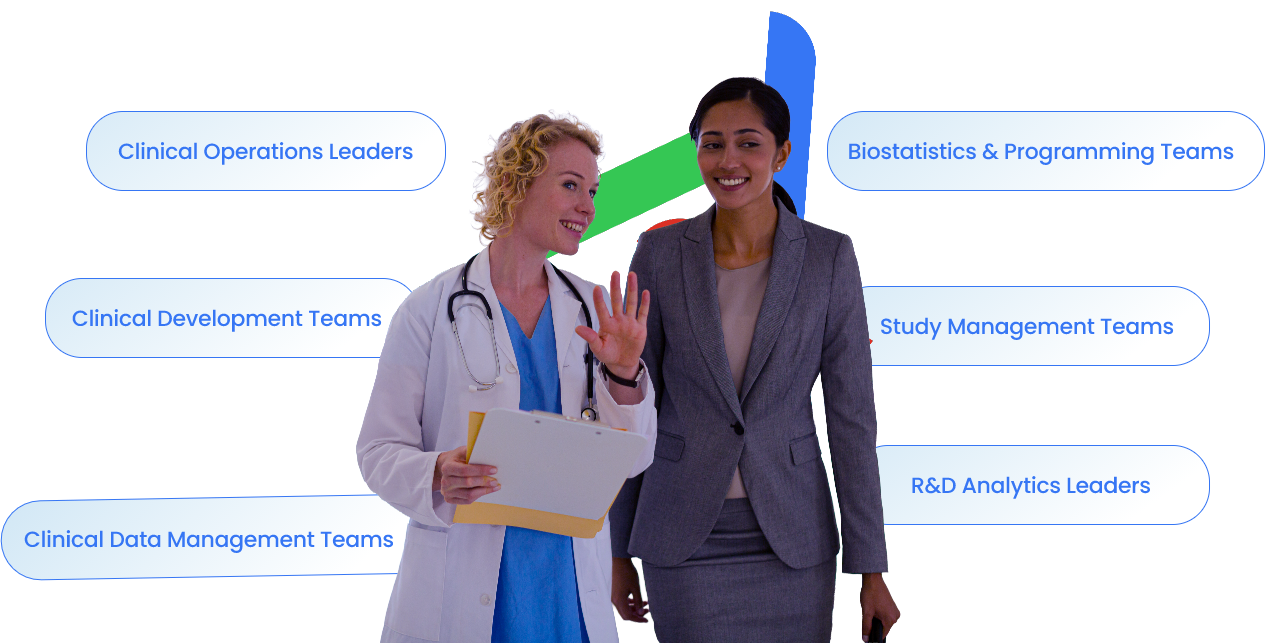
Built for clinical operations, clinical development, study management, biostatistics & programming, clinical data management, and R&D analytics teams looking to improve speed, oversight, quality, and execution through analytics, GenAI, and intelligent automation.

Use Cases

Clinical and development teams apply governed data, analytics, GenAI, and agentic AI to automate high-friction trial work. These use cases show how connected automation accelerates planning, document-centric work, data review, and reporting across the study lifecycle.

Study Cost Forecasting & Budget Variance

Predict study costs and budget variance using historical trial, site, and operational drivers.

GenAI-Assisted Document Drafting

Draft recurring trial outputs and study artifacts faster with GenAI on governed source data.

AI-Driven Document Processing

Classify, extract, summarize, and route clinical documents to remove manual handling.

Clinical Data Validation Automation

Run validation with review workflows, anomaly checks, and governed reporting outputs.

Clinical Trial Intelligence & Competitive Monitoring

Monitor competitive trials and surface trial intelligence to support program and portfolio decisions.

How We Deliver

We combine cloud-native data platforms, semantic layers, reusable accelerators, GenAI orchestration, agentic AI capabilities, and responsible AI governance to deliver production-ready clinical automation.

Accelerators & Frameworks

Accelerators & Frameworks

Reusable accelerators, cloud-native data platforms, and semantic layers, combined with GenAI orchestration and agentic AI capabilities, shorten the path to production-ready clinical automation.

Governance & Compliance

Governance & Compliance

Responsible AI governance, documented lineage, role-based access, and enterprise-grade controls keep clinical automation traceable and trusted in regulated life sciences environments.

Results

30%

Faster document turnaround: GenAI-assisted drafting and processing on governed source data, with human-in-the-loop review

25%

Shorter validation cycles: automated validation, anomaly detection, and exception routing speed review and CSR generation

20%

Tighter cost forecasts: connected trial, site, and operational data feeding AI-driven scenario modeling

Resources

Explore proven strategies, frameworks, and real-world perspectives on clinical trial automation, GenAI and agentic AI, and governed data in life sciences.

FAQs

Clinical Trials Automation brings together governed data, analytics, GenAI, and agentic AI to streamline high-value clinical workflows such as cost forecasting, document generation, document processing, data validation, and Trial Summary Report creation.

Infocepts helps life sciences organizations connect trial data, documents, workflows, and analytics into a unified automation layer that improves speed, consistency, operational visibility, and decision confidence across the study lifecycle.

This solution can support study cost prediction, clinical document generation, clinical document processing, data validation, exception management, and Trial Summary Report generation using governed data, reusable logic, and AI-assisted workflow support.

GenAI can help accelerate document drafting, summarize unstructured clinical content, support workflow routing, and improve review efficiency when deployed on trusted data with the right governance and human oversight.

CSR stands for Clinical Study Report. This solution supports faster CSR preparation through validated data, standardized templates, and AI assisted drafting with governed review workflows.

Infocepts focuses on building a governed automation layer across data, workflows, analytics, and AI so automation can scale across the clinical trial lifecycle instead of being limited to one isolated task or tool.

Yes. The solution is designed around governed data, traceability, role-based access, and enterprise-grade controls that support trusted execution in regulated life sciences environments.

Clinical Trials Automation can help reduce manual effort, improve planning precision, accelerate document-intensive workflows, strengthen data trust, and enable faster, more confident development decisions.

Ready to automate high-friction clinical work?

We'd Love to Hear from You!

Open Popup