
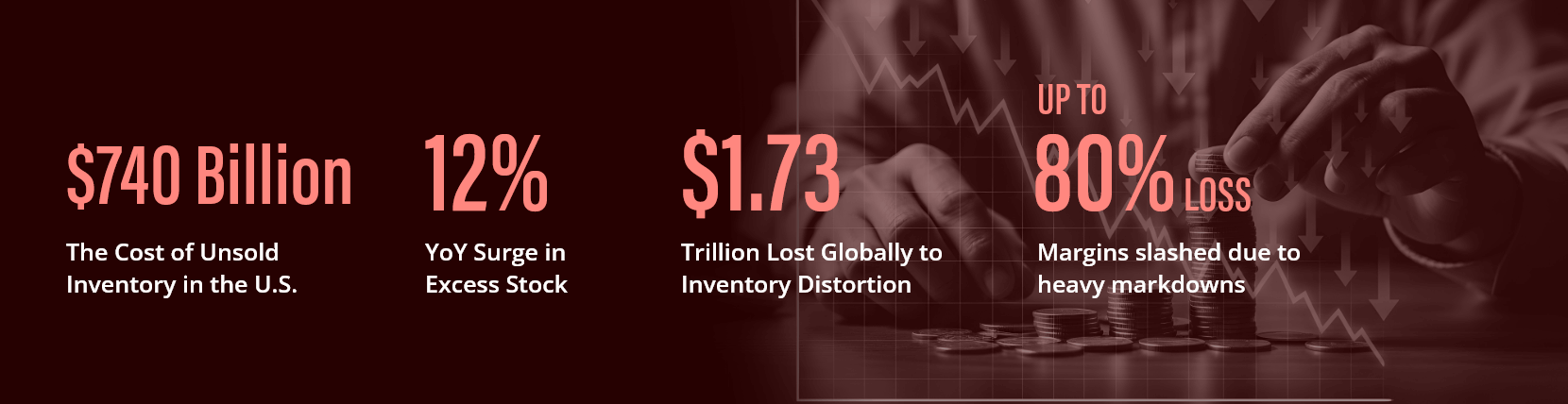
It’s every retailer’s double-edged sword: you fear running out of product, so you order a little extra “just in case.” But when demand doesn’t meet expectations, that cushion becomes an expensive problem. Overstock – excess inventory that sits unsold – quietly drains cash and profits. In the U.S. alone, retailers were sitting on an estimated $740 billion in unsold goods in 2022, up 12% from the year prior. Globally, the combined cost of overstocks and stockouts (“inventory distortion”) is a staggering $1.73 trillion per year. That’s capital tied up in warehouses and stockrooms, not earning a return – and eventually, much of it will be marked down or written off, slashing margins. [mckinsey.com] [ihlservices.com]
Excess inventory isn’t just a balance sheet headache; it leads to crowded stockrooms, higher storage costs, and in many cases, panicked markdowns that train customers to wait for discounts. It’s a vicious cycle: overbuying leads to overstocks, which lead to heavy discounts, which hurt profits and can damage brand equity (customers get used to “everything on sale”). In this blog, we’ll explore why overstocking happens, how it impacts your business, and how OptiStoreAI can help you optimize inventory levels with precision – boosting both sales and profitability.
Consider a scenario that played out across retail in recent times: supply chain disruptions in 2021 led many retailers to order whatever inventory they could get their hands on, fearing empty shelves. But when consumer demand shifted, these retailers were left with a massive inventory glut. Suddenly, stores and DCs were overflowing with products that weren’t selling as anticipated. The result? Aggressive markdowns, clearance racks, and even warehousing costs for “pack-and-hold” inventory.
This pain point has been especially acute in sectors like apparel, where trends are fickle. One season’s overestimation can leave you with thousands of units of unsold clothes that no one wants at full price. In 2022, total retailer inventories in the U.S. rose by $78 billion, much of it due to overstocked merchandise after a demand softening – a problem so severe that it contributed to major retailers reporting profit misses and stock devaluations. If you walk into a stockroom and see piles of last season’s styles or a shelf full of slow-moving gadgets, you’re looking at cash that’s not only frozen but melting away in value.
Overstocks usually stem from one (or a combination) of a few root causes:
- Over-forecasting Demand: Sometimes retailers simply predict too high. This could be due to optimistic sales goals, a failure to adjust to changing market conditions, or lack of granular data. For example, allocating too much winter apparel to southern stores, or overestimating a trend’s lifecycle, can leave racks full of unpurchased goods when the season or fad passes. Traditional forecasting approaches may not pick up shifts in consumer preferences until it’s too late, causing a glut of unwanted inventory.
- “Just-in-Case” Ordering: Many planners build in buffer stock to avoid stockouts (as we discussed in Blog 1). But safety stock often becomes excess stock when it’s not finely tuned. Buying 10% extra “just in case” across thousands of SKUs can result in a mountain of surplus if those worst-case scenarios don’t materialize. Without intelligent, dynamic safety stock optimization, retailers err on the side of caution – and then pay the price in the form of clearance sales.
- Slow Reaction to Sales Trends: Retailers who lack real-time visibility often discover overstock issues only at the end of a season or quarter. By then, the only option is reactive markdowns. A slow-selling product might have been identified earlier – and dealt with through targeted promotions, assortment adjustments, or supply cutbacks – but if you’re waiting for a monthly report to reveal the problem, you’re too late to avoid an inventory pile-up.
- Supply Chain and Minimum Order Quantities: Sometimes you have to buy in bulk due to supplier MOQs or take advantage of volume discounts. This can lead to more inventory than needed. There’s also the bullwhip effect: small demand forecast errors get magnified up the supply chain, resulting in overstocks at the store level when those big orders land. Poor synchronization between the plan and the reality on the ground exacerbates this.
Overstock doesn’t always grab headlines like stockouts do, but its toll on retailers is massive and multi-dimensional:
- Financial Drain & Cash Tie-Up: Excess inventory ties up working capital that could be used elsewhere (marketing, store improvements, or technology investments). Retail CFOs know that inventory sitting on shelves is essentially cash sitting idle. Moreover, storing unsold goods incurs additional costs – either taking up expensive store backroom space or incurring warehouse fees. Items that linger may also need to be insured and handled more (each touch is a labor cost). And eventually, many overstock items get marked down or written off, directly hitting gross margins. For instance, in 2022, U.S. retail inventories swelled to roughly $740 billion in value – much of which had to be sold at a discount or carried over at a cost. That’s money that could have been profitably invested but instead is stuck in products customers don’t want right now.
- Margin Erosion from Markdowns: To clear excess stock, retailers often resort to heavy markdowns. This trains customers to wait for sales and can tarnish your brand’s premium image if done excessively. It’s also a margin killer: selling products at 50% off might recover some cash, but the profit on those items could be near zero or negative after considering cost of goods and handling. Broad, last-minute markdowns also sometimes fail to fully clear inventory, leading to further write-offs or disposal costs. In sum, overstocks cut into the very profits that retailers work so hard to win.
- Logistical and Operational Strain: Overstocked inventory clogs the supply chain. Backrooms and distribution centers overfilled with unsold goods make it harder to organize and find the fast-selling items you do need to replenish. It’s like a closet that’s too full – you end up not finding what you need when you need it. This can ironically contribute to more stockouts of in-demand items (because the backups are lost in a sea of slow product). Additionally, employees must spend time managing excess stock – moving it, counting it, storing it – which is wasted effort not spent on value-adding activities like helping customers or merchandising current products.
With margins under pressure and economic uncertainty ahead, freeing up the cash and space tied in excess inventory is critical. The key is to get more precise and proactive with inventory planning and execution. That’s where OptiStoreAI makes a difference.

OptiStoreAI uses advanced analytics and AI-driven insights to help retailers carry just the right amount of inventory at each location – enough to meet demand (avoiding stockouts) but lean enough to minimize waste and markdowns. Here’s how:
- Intelligent Demand Forecasting (Preventing Overbuying): As discussed earlier, OptiStoreAI’s demand planning algorithms are far more accurate and responsive than traditional methods. By accounting for real-time sales data and external variables, it significantly reduces forecast error. Better forecasts mean you order closer to true demand. Retailers that have adopted these predictive models have seen up to 20-30% improvements in forecast accuracy, which directly translates to less overbuying and 15-25% reductions in overstock levels in categories where the tech is applied. With OptiStoreAI, you can set service-level targets (for example, aiming for 98% availability) and let the system determine the optimal inventory levels needed, rather than relying on blanket “just in case” buffers.
- Dynamic Replenishment & Allocation: OptiStoreAI continuously monitors sales and inventory positions across your network and can dynamically adjust replenishment orders. If certain stores have excess of a product while others are selling out, the system will flag that imbalance and suggest shifting inventory to where it’s needed. If overall demand is slowing down, the AI can recommend scaling back orders for next week. These data-driven adjustments prevent buildup of surplus stock in the first place, addressing the problem at its root. For example, a convenience chain using OptiStoreAI noticed that snacks and drinks were piling up in suburban locations but selling out in urban ones; the platform identified this trend and suggested re-allocating future shipments accordingly, effectively preventing an overstock in one region and a stockout in another.
- Early Detection of Slow Movers: OptiStoreAI doesn’t wait for quarterly reports to tell you something isn’t selling. It provides early warnings for underperforming products. If a certain item’s sales velocity falls below forecast for a few days in a row, the system will alert planners and merchants. It might say, “Product Z is selling 25% slower than expected in Region A this week.” This gives your team a chance to take corrective action early – for instance, by adjusting ordering, launching a localized promotion, or reallocating inventory to a region where that product is still doing well. By taking these surgical actions early, you can avoid ending the season with huge excess of Product Z that needs 50% off to move. Essentially, OptiStoreAI turns markdowns from a fire-fighting measure into a strategic, last-resort tool by helping you manage inventory in real-time.
- Optimized Safety Stock & Assortment: Using machine learning, OptiStoreAI can calculate optimal safety stock levels for each SKU by store, updating them dynamically as conditions change. This means you’re not blindly carrying, say, 4 weeks of supply for every item – maybe Item A only needs 2 weeks of buffer because it has a steady supplier and stable demand, while Item B, which is more erratic or has a longer lead time, needs 6 weeks. The system crunches those numbers for you. It also helps optimize assortments by highlighting products that are persistently slow-moving in certain stores. For example, OptiStoreAI might reveal that a particular style of sneaker barely sells in downtown urban stores (creating continuous overstock there), whereas it’s popular in suburban stores. Such insights allow you to tailor assortments at the local level, preventing overstock by not flooding certain locations with inventory that won’t move.
- KPI Dashboard and Continuous Learning: OptiStoreAI delivers a unified dashboard that tracks key metrics like sell-through rates, weeks-of-supply, and aging inventory in real time. This “inventory health cockpit” surfaces problem areas immediately – you’ll know today, not at quarter’s end, if a category is accumulating excess. Moreover, because the platform uses AI, it learns from each cycle, continuously improving recommendations for purchasing and allocation. The longer you use it, the better your inventory optimization gets, season after season.
Retailers who have embraced OptiStoreAI for inventory optimization report impressive outcomes. By cutting down overstocks, they not only save money but also improve their agility. For instance, one fashion retailer was able to reduce end-of-season markdowns by 20% after OptiStoreAI’s early alerts enabled them to run targeted promotions on sluggish items mid-season – selling more at full price instead of waiting to clearance. Another company saw a 25% increase in inventory turnover, meaning products moved faster from stock to sale, thanks to leaner inventory levels and smarter replenishment. This freed up millions in cash that had been stuck in excess inventory, improving their cash flow.
Perhaps most telling, these retailers experienced margin improvement as fewer goods were sold at a discount. They also found their planning teams were spending less time on emergency re-forecasting and more time on strategic merchandising, because the AI had taken over much of the heavy lifting of data analysis.
When you stop drowning in excess inventory, your entire organization can breathe easier. Sales improve (because you’re focusing on winners), costs go down (less capital tied in inventory and lower handling costs), and your team can devote energy to growth initiatives instead of liquidation strategies.
Excess inventory is a solvable problem – one that can turn from a costly headache into a competitive advantage. By using OptiStoreAI’s predictive analytics and real-time optimization, retailers can trim the fat from their inventory while never missing a sale. The result: stronger cash flow, higher margins, and more nimble operations. If you’re ready to say goodbye to chronic overstocks and hello to optimized inventory, request a personalized demo of OptiStoreAI today and see how AI can help you find the perfect inventory balance.
Recent Blogs

No More Manual Audits – Achieve Perfect Planogram Compliance with AI
February 19, 2026

End Stockouts for Good – How AI Keeps Retail Shelves Full
February 18, 2026

AI Isn’t Optional for Retail Supply Chains—It’s Survival by 2027
January 23, 2026

Breaking Free from Legacy ETL: How Retailers Are Modernizing Batch Processing with Databricks
January 14, 2026
Infocepts