
Medical affairs has long been one of the least analytically mature functions in pharma. While commercial teams have invested heavily in CRM analytics, field force optimization, and marketing mix modeling, medical affairs teams often rely on basic activity reports and manual literature review. This is changing rapidly. AI is transforming medical affairs from a reporting function into a scientific intelligence function – and the implications for competitive advantage are significant.
The Medical Affairs Analytics Gap
Most medical affairs organizations can tell you how many HCP interactions their MSLs had last quarter. They can tell you which congresses they attended and how many presentations they reviewed. What they cannot tell you is which scientific themes are emerging across their therapeutic landscape, which KOLs are shifting their research focus, or how MSL engagement is influencing downstream prescribing behavior.
This gap exists because medical affairs analytics has historically been activity-based rather than intelligence-based. MSLs report activities – calls, meetings, congress attendance – but the strategic insights from those activities are trapped in free-text notes, disconnected CRM records, and individual memories.
Building Medical Affairs Intelligence
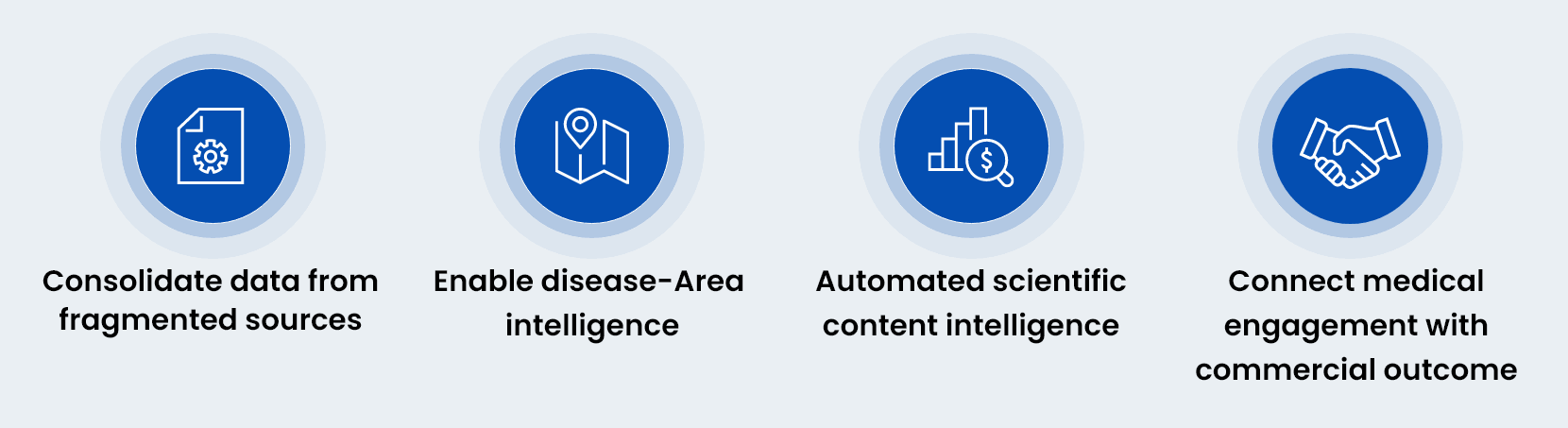
AI-powered medical affairs platforms change this fundamentally. They do four things that traditional reporting cannot.
First, they consolidate data from fragmented sources. A leading biotech working with Infocepts consolidated more than 30 data sources into a unified medical affairs platform on Snowflake. These sources included MSL CRM data, congress attendance records, publication databases, clinical trial registries, and HCP engagement history from multiple therapeutic areas.
Second, they enable disease-area intelligence. Instead of reporting by MSL territory, the platform enables analysis by disease area – showing engagement patterns, scientific trends, and competitive activity for each therapeutic focus. This allowed 70 or more MSLs to access faster, more relevant insights, and user adoption increased by approximately 40 percent.
Third, they automate scientific content intelligence. NLP-powered tools can automatically scan publications, conference abstracts, and regulatory filings to identify emerging scientific themes, competitive data readouts, and potential label expansion opportunities. This surfaces insights that would take a team of medical science liaisons weeks to compile manually.
Fourth, they connect medical engagement with commercial outcomes. When medical affairs data is linked with commercial analytics, organizations can understand how MSL engagement with KOLs influences prescribing patterns in surrounding geographies. This is one of the most valuable cross-functional insights in pharma, and it requires a connected intelligence layer to achieve.
The KOL Intelligence Revolution
KOL identification and segmentation is another area where AI is creating significant value. Traditional KOL identification relies on publication counts, congress presentations, and clinical trial participation – easily available metrics that every competitor can access. AI-powered KOL identification goes deeper, analyzing social network influence, referral patterns, emerging research trajectories, and real-world prescribing behavior.
One specialist consultancy automated KOL identification and segmentation using machine learning across 23 countries. The AI-powered approach achieved 85 percent or higher accuracy, saved $170,000 annually compared to the manual process, and enabled continuous model refresh as new data became available.
Moving Forward
Medical affairs leaders should evaluate three investments. First, consolidate medical affairs data into a unified platform that enables cross-disease-area analysis. Second, deploy NLP-powered scientific content intelligence to automate literature monitoring and competitive landscape analysis. Third, integrate medical affairs data with commercial analytics to understand the downstream impact of scientific engagement.
The medical affairs function that embraces AI-powered intelligence will become a strategic asset for the organization. The one that remains a reporting function will become increasingly marginalized.
Recent Blogs

The Super Bowl, the Olympics, and the Art of Not Losing Your Biggest Revenue Moment
April 6, 2026

KOL Identification at Scale: Why Machine Learning Outperforms Business Rules
April 3, 2026

The Upfront 2026 Survival Guide: What Your Buyers Actually Need to Hear
April 2, 2026

Why Every Point Solution You’ve Bought Is Making Your Revenue Problem Worse
March 31, 2026
Infocepts