



Every year, ad sales leaders prepare for upfronts the same way: reach numbers, audience guarantees, content highlights, deal structure flexibility.
And every year, the publishers who close fastest aren’t the ones with the best reach numbers. They’re the ones who walked into the room with the clearest answers to the questions buyers were actually afraid to ask out loud.
Upfronts 2026 shifted those questions further than most publishers expected. Measurement fragmentation, streaming inventory complexity, and alternative currency negotiation changed the nature of the upfront conversation — and the publishers still walking in with a single-currency, reach-only pitch found themselves negotiating from a weaker position before the meeting even started.
What 2026 Upfront Buyers Are Actually Asking
What This Year’s Upfront Buyers Are Actually Asking
On measurement currency: GroupM has made its alternative currency commitments public, buying against VideoAmp for a meaningful share of its national commitments, and pushing publishers to support multi-currency deal-making as standard practice rather than a special request. Walking in with a single-currency measurement posture — however strong that currency is — starts the conversation from a structural disadvantage. The fix isn’t abandoning an existing measurement partner. It’s arriving with a unified posture: “We can transact against your preferred currency. Here’s how our data supports that, here’s our clean room infrastructure for validation, and here’s a live multi-currency performance view from our current active campaigns.”
On outcome attribution: Omnicom’s media agencies — OMD, PHD, Hearts & Science — have run multi-currency upfront pilots specifically to test whether publishers can connect delivery data to downstream outcomes — not just “did the ad run” but “did it drive something.” This question is what separates the premium tier of the upfront from the rest of it. It requires linking campaign delivery to advertiser outcomes: sales lift, brand equity movement, search response, in-store attribution for retail advertisers — the exact connective work Intelligence Hub is built to do across linear, streaming, and digital in one place. Most publishers have pieces of this story. Few have connected them into one coherent narrative — and the ones who have are commanding premium CPMs because the premium is demonstrated, not promised.
On clean room readiness: IPG’s data and technology arm, Kinesso, has spent several years building clean room infrastructure across its client base, and IPG is now using clean room integration as a technology-readiness signal during upfront negotiations. Publishers don’t need a fully operational data collaboration environment to answer this well — they need to show architectural compatibility, established technical partnerships, and a deployment timeline that puts activation within reach of the coming campaign cycle, the kind of privacy-safe readiness Audience Intelligence Platform is built around. IPG buyers aren’t expecting perfection here. They’re expecting direction.
The Three Measurement Narratives That Close Deals
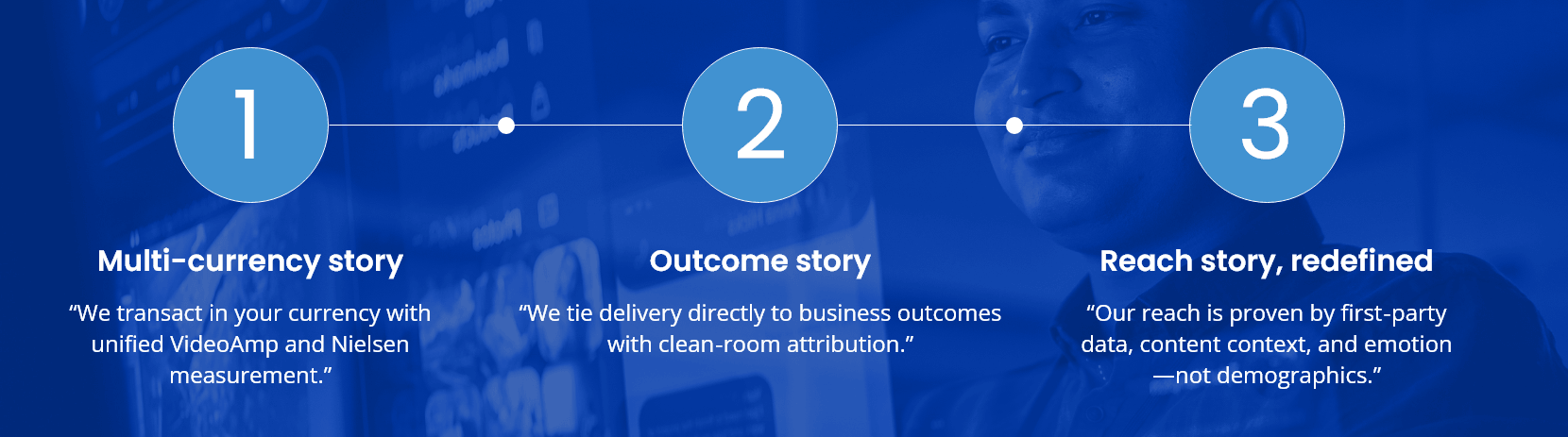
Publishers who close fastest during upfronts are telling one of three specific measurement stories — and the ones telling all three are at the leading edge:
| Story | What It Sounds Like | What It Requires |
|---|---|---|
| Multi-currency | “We can transact against your preferred currency, and here’s a live view of how our campaigns perform against both simultaneously.” | A unified measurement layer, plus the operational confidence to put live numbers on the table |
| Outcome-based | “We can connect delivery data to your advertiser’s business outcomes, with attribution methodology and a comparable case from their category.” | A clean room foundation and outcome-based measurement partnerships |
| Reach, redefined | “Our audience isn’t just large — it’s specifically who your advertiser needs, and here’s the first-party data that proves it.” | Content-context and audience-emotion data (see ContentTagger AI) behind the reach claim, not demographics alone |
Is Your Upfront Strategy Actually Ready?
A few signs it isn’t, worth checking honestly before the first major presentation:
- The measurement story changes depending on which seller is in the room, because there’s no single unified narrative everyone’s working from
- Multi-currency data lives in separate reports that get manually reconciled the night before a client meeting
- Clean room readiness is described in vague terms (“we’re working on it”) rather than a specific state and timeline
- Account directors can talk fluently about content highlights but go quiet the moment a buyer asks a measurement question
- The pitch sounds the same for every holding company, regardless of which specific currency or attribution commitments that buyer has already made public
Any one of these is fixable in six weeks. Two or three together are usually a sign the measurement story needs to be rebuilt before the content story gets polished further.
What Being Unprepared Actually Costs
The cost of walking into an upfront room without a ready measurement answer isn’t abstract — it shows up in three specific ways.
The conversation defaults to price. When a publisher can’t demonstrate multi-currency flexibility, the buyer’s next move is predictable: if the measurement story isn’t differentiated, the only lever left to negotiate on is price. That’s how publishers with genuinely strong content end up settling for standard-tier CPMs instead of the premium tier their content actually justifies.
Premium budget goes to whoever answers first. Holding companies aren’t waiting for every publisher to catch up before allocating premium spend — they’re allocating it now, to whoever can already show clean room readiness and outcome attribution. A publisher who arrives at that answer a cycle late isn’t just behind; they’re negotiating for what’s left after the early movers have already claimed the premium tier.
The gap compounds year over year. A publisher who enters this cycle with a strong measurement story gets more data to build next cycle’s outcome-attribution case. A publisher who enters without one starts the following year’s upfront from the same weak position, because there was never the campaign activity to build a stronger story from.
Where Upfront Prep Typically Goes Wrong
Treating measurement readiness as an IT project instead of a sales asset. The technical work of connecting multi-currency data or building clean room infrastructure often sits entirely with a data team that never talks to the sellers who need to present it. The sellers end up improvising the story in the room instead of presenting something rehearsed.
Over-indexing on content highlights. Content is what gets a meeting scheduled. Measurement readiness is what closes it at the premium tier. Spending the bulk of prep time on the former and treating the latter as an afterthought is the single most common gap year over year.
Building one generic pitch instead of a holding-company-specific one. GroupM, Omnicom, and IPG are asking genuinely different questions — currency flexibility, outcome attribution, and clean room integration, respectively, are each a different primary concern. A publisher walking into all three conversations with the same deck is answering questions nobody in the room actually asked.
The Upfront Readiness Framework
The specific commitments change every year — who’s buying against which currency, which agency is piloting what. The underlying measurement and attribution readiness questions don’t. Use this to score readiness for any upfront cycle, not just this one:
| Readiness Area | Not Ready | Getting There | Ready |
|---|---|---|---|
| Measurement currency | Single-currency story only | Multi-currency data exists but lives in separate reports | Unified, live multi-currency view, rehearsed and ready to present |
| Clean room infrastructure | No integration pathway | Architecturally compatible, partnerships in progress | Established partnerships with a clear deployment timeline |
| Outcome attribution | Delivery data only (“the ad ran”) | Some outcome data exists, not yet connected to delivery | Delivery-to-outcome narrative built, with a comparable case ready |
| Account director briefing | Content-only pitch | Measurement mentioned but not rehearsed | 50-50 content/measurement prep, questions rehearsed |
| Holding-company tailoring | One generic deck for everyone | Some awareness of different priorities | A distinct story built for each major holding company’s specific ask |
Three or more rows in the “Not Ready” column, whatever year it is, means the measurement story needs rebuilding before the content story gets polished further. This table is the fastest way to audit where a publisher actually stands, months before the specific commitments for that year’s cycle are even public.
How This Guide Stays Current
The readiness framework above doesn’t change year to year — what changes is which specific currency, attribution, and clean room commitments are live for a given cycle. This guide is refreshed each year ahead of upfront season with that year’s specific holding-company positions, so the strategic framework stays evergreen while the details stay accurate. Worth a return visit each cycle for whatever’s current then, rather than relying on a single year’s specifics after they’ve aged out.
If there are six weeks before the first major upfront presentation, four things matter more than everything else on the prep list combined:
- Get multi-currency data into a single view. Stitching together separate measurement reports the night before a client meeting costs credibility before a word is said — and it’s the fastest tell that the measurement story isn’t actually rehearsed, just assembled under pressure.
- Have a clean room answer ready — not necessarily a fully operational system, but a clear, confident description of current state and roadmap. Buyers give real credit for direction; they give none for vagueness.
- Brief account directors on the measurement story, not just the content story. Spending 90% of prep time on content highlights and 10% on measurement questions is the most common gap — that ratio needs to be closer to 50-50 this cycle, and account directors need to be able to answer follow-up questions, not just deliver the opening line.
- Tailor the measurement story by holding company. Different holding companies are asking different questions. Publishers closing best have a version of the story built for each one, not one generic pitch adjusted on the fly in the room. Talk to Our Experts
Prepare Your Measurement Story Before the Next Upfront Cycle
Build the multi-currency, clean room, and outcome-attribution readiness that closes deals faster — before buyers ask the question you can't answer yet.
Frequently Asked Questions
Upfronts week is when TV and streaming networks present their upcoming content slate to advertisers and agencies, seeking early, guaranteed ad-spend commitments at locked-in pricing ahead of the broadcast year — the alternative to buying ad time later in the “scatter market” at whatever price demand dictates.Yes. Despite predictions that streaming and programmatic buying would replace the upfront model, major networks and streamers continue to run upfront presentations each year, though the format has shifted to include more streaming-specific inventory and alternative-currency negotiation than it did five years ago.Upfront advertising is committed months in advance at negotiated, locked-in pricing before the broadcast year begins. Scatter advertising is purchased closer to air date, at pricing set by current demand — typically higher when inventory is scarce, lower when it isn’t.GroupM has publicly committed to buying against alternative measurement currencies alongside traditional providers, making multi-currency readiness a baseline expectation rather than a differentiator. Publishers without a multi-currency measurement story are negotiating from a structural disadvantage before the conversation starts.It means being able to show a technically compatible data infrastructure, established partnerships, and a realistic deployment timeline for secure, privacy-safe data collaboration — not necessarily a fully built system on day one. Buyers evaluate direction and momentum, not just current state.The specific currency, attribution, and clean room commitments each holding company is prioritizing shift year to year, but the underlying readiness areas — unified measurement, clean room infrastructure, outcome attribution, and holding-company-specific positioning — stay consistent. A publisher that builds genuine readiness in one of these areas typically carries that advantage into the next cycle rather than starting over.
Recent Blogs



The Enterprise AI & Data Transformation Partner. Delivering measurable business impact globally.
#1 on Gartner Peer Insights · 97.2% client retention