


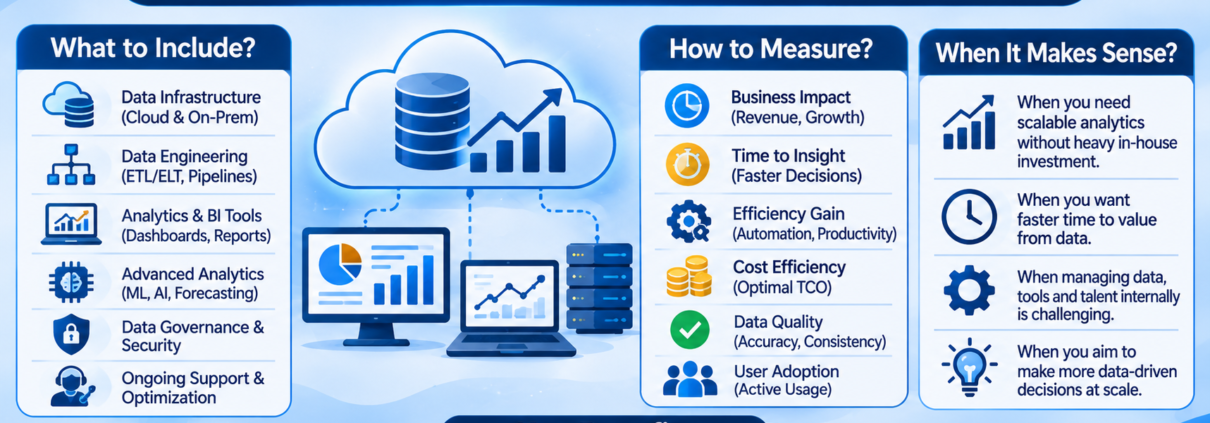
Managed Data and Analytics Services: What to Include, How to Measure and When It Makes Sense
Managed data and analytics services are an arrangement in which a provider takes responsibility for running part or all of an organization’s data platforms, pipelines, reports and analytics operations against agreed service levels. Building a platform is a project. Running it is a permanent job, and the second job is where many data programs quietly lose value.
A new platform goes live, the project team moves on, and the work that remains is unglamorous: pipelines fail overnight, a source system changes its format, a report is slow on the first of the month, costs creep, access requests pile up, and users file tickets that no one owns. If these are not handled well, trust erodes and people return to spreadsheets. This guide explains what managed services cover, the service levels worth defining, the build-operate-transfer model, and how to decide between running operations in-house and using a provider.
What “operations” covers
| Area | Typical activities |
|---|---|
| Platform operations | Monitoring, patching, upgrades, capacity and cost management |
| Pipeline operations | Scheduling, failure handling, reruns, performance tuning |
| Data quality | Rule monitoring, alerting, issue triage and resolution |
| Reporting and analytics support | Report fixes, user support, small enhancements |
| Security and access | Access requests, reviews, audit support |
| Incident and problem management | Detection, response, root cause analysis, prevention |
| Change and release management | Controlled deployment of new pipelines and models |
| Governance support | Catalog upkeep, lineage, glossary, policy checks |
| Continuous improvement | Automation, cost optimization, platform evolution |
Not every organization hands over all of this. A common pattern is to outsource the repetitive and time-critical parts, such as monitoring and incident response, while keeping strategy, domain knowledge and priorities in-house.
Service levels worth defining
Vague promises like “24/7 support” mean little. Specify what is measured and how.
| Service level | Example measure |
|---|---|
| Availability | Percentage of time the platform and key data products are usable |
| Data freshness | Maximum delay for critical datasets to be ready each day |
| Incident response | Time to acknowledge and to restore, by severity |
| Pipeline reliability | Share of scheduled runs completing successfully |
| Data quality | Share of critical data elements passing rules |
| Request fulfillment | Time to complete standard requests such as access or new fields |
| Cost | Platform spend against budget, unit cost trends |
| User satisfaction | Regular survey or feedback score |
Worked example (illustrative)
A critical daily sales dataset must be ready by 7:00 a.m. In a 30-day month, it was late on 2 days.
On-time delivery = 28 ÷ 30 = 93.3 percent
If the agreed level is 98 percent, the provider has missed it. The more useful analysis asks why: were both late days caused by the same upstream source? A recurring cause points to a problem fix, such as an agreement with the source team or a rerun automation, not just a penalty.
Pair service levels with a clear definition of severity, so a failure in a finance close report and one in a low-use dashboard are not treated the same. Also define what is excluded, such as outages caused by a source system under your control.
The build-operate-transfer model
Build-operate-transfer (BOT) is an arrangement in which a provider builds a team or capability, operates it for an agreed period, and then transfers it to the client. It suits organizations that want to establish an internal capability without the delay and risk of building it from scratch alone.
| Phase | What happens |
|---|---|
| Build | Provider sets up the team, processes, tools and knowledge base |
| Operate | Provider runs the work against agreed service levels while the client observes and shapes priorities |
| Transfer | People, knowledge and processes move to the client, with a handover plan and a defined support period |
What makes BOT work:
- A transfer plan agreed at the start, with milestones, not left until the end.
- Documentation and runbooks that are real and used.
- Client staff shadowing during the operate phase.
- Clear terms about people, tools and intellectual property at transfer.
Flexible capacity
Demand for data skills is uneven. A migration, a new regulatory report or an AI initiative can require specialist capacity for months, then not. Elastic capacity models give access to skilled people on a flexible basis, so teams can scale up or down with project demand. This helps avoid both delays from under-resourcing and costs from permanent over-hiring. The trade-off is knowledge continuity, so plan how knowledge is captured when people rotate.
In-house, managed or hybrid
| Factor | Favors in-house | Favors managed |
|---|---|---|
| Strategic importance of the work | Core differentiating capability | Standard operations |
| Skills availability | Strong team, good retention | Hard-to-hire skills, high turnover |
| Coverage needs | Business hours only | Round-the-clock needs across time zones |
| Cost profile | Stable, predictable workload | Variable workload, peaks |
| Control and sensitivity | Highly sensitive data or tight control requirements | Controls can be defined contractually |
| Speed to stabilize | Time available | Need fast improvement |
Most organizations land on a hybrid. The question to ask for each activity is whether it requires deep knowledge of your business or whether it is largely a repeatable technical process.
How to evaluate a provider
- Evidence of running similar environments, including references you can speak to.
- Clear service level proposals and reporting formats.
- Approach to automation: repetitive tasks should shrink over time, with the savings visible to you.
- Security and compliance practices, including access controls, audit and incident handling.
- Knowledge management: documentation, runbooks and handover practices.
- Governance model: named contacts, regular reviews, escalation paths.
- Commercial terms: pricing structure, change processes, exit and transition provisions.
- Cultural fit and communication. The best technical provider will struggle if teams do not talk.
Making the transition work
- Document the current state: platforms, pipelines, known issues, dependencies and on-call practices.
- Define scope and service levels in a way both sides can measure.
- Run a transition period with shadowing, parallel monitoring and a gradual handover of responsibilities.
- Establish governance: weekly operational reviews, monthly service reviews and quarterly strategy discussions.
- Measure and report against service levels, including trends.
- Improve continuously: retire recurring incidents through root cause fixes, automate manual steps and optimize cost.
A severity model that avoids arguments
Agree severity levels before the first incident.
| Severity | Example | Response target (illustrative) |
|---|---|---|
| 1 Critical | Finance close data unavailable; executive reports wrong | Acknowledge within 15 minutes; work continuously until restored |
| 2 High | A key pipeline failed; a business-critical dashboard stale | Acknowledge within 1 hour; restore the same day |
| 3 Medium | A non-critical report slow or incorrect | Acknowledge within 4 business hours; fix within days |
| 4 Low | Cosmetic issue or enhancement request | Prioritized into the backlog |
Targets are illustrative and should be set from your own business impact. Review severity assignments quarterly. If most tickets end up classed as critical, the scale is no longer separating anything. If critical incidents keep recurring, move them to problem management and fix the cause.
Common mistakes
- Handing over a poorly documented platform and expecting stability.
- Measuring activity (tickets closed) instead of outcomes (data ready, users satisfied).
- Leaving no internal owner for the relationship.
- Skipping root cause analysis, so the same incidents recur.
- Defining service levels without agreeing how they are measured.
- Neglecting exit and transition terms.
- Treating the provider as a pure cost line instead of a source of improvement.
Where Infocepts fits
Infocepts lists D&A Operations and Support as a service line, covering managed services, a build-operate-transfer model, elastic capacity and custom support. See the D&A Operations and Support page for details. For the platform work that precedes operations, read about data modernization, and for planning, a data strategy assessment.
FAQ
What are managed data and analytics services?
They are services in which a provider runs and supports an organization’s data platforms, pipelines and analytics under agreed service levels.
What is build-operate-transfer?
A model in which a provider builds a capability, operates it for a period, then hands it over to the client.
What service levels should I ask for?
Common ones include availability, data freshness, incident response times, pipeline reliability and data quality, each with a defined measurement method.
Should we outsource data operations or keep them in-house?
It depends on how strategic the work is, how available the skills are, and how variable the workload is. Many organizations use a hybrid approach.
How do we keep knowledge when working with a provider?
Require documentation and runbooks, involve internal staff, and agree handover terms up front.
How do managed services reduce cost?
Through automation, shared tooling, flexible capacity and fewer recurring incidents, but results depend on the quality of the arrangement and should be tracked.
Recent Blogs



The Enterprise AI & Data Transformation Partner. Delivering measurable business impact globally.
#1 on Gartner Peer Insights · 97.2% client retention