
Walk into any retail store in the morning or late evening, and you might see them: associates or managers with clipboards (or scanning devices) in hand, walking the aisles, checking if everything is in its rightful place. These planogram compliance checks – verifying that products are displayed exactly according to plan – are critical for sales and consistency. Yet, for many retailers, they’re a time-consuming, error-prone chore. When stores deviate from planograms, top-selling products can end up hidden, promotions can be set up incorrectly, and overall shopping experience suffers. The pain point gets worse the more locations you have; maintaining 100% compliance across, say, 500 stores is a monumental task when relying on human effort alone.
Manual audits not only eat up a lot of labor hours (time that could be spent helping customers or fulfilling online orders), but they often fail to catch issues in time. A shelf reset done incorrectly might go unnoticed for days until the next audit, meaning lost sales in the interim. Non-compliance can be costly: products in the wrong place may not sell as well, and promotional funds could be wasted on displays that never got implemented correctly. In short, poor planogram compliance is like having a leaky bucket – you’re dripping potential revenue every day.
Consider a typical scenario: A new endcap display of a high-margin seasonal product is supposed to go up on the first of the month. Due to a communication mix-up or staffing crunch, some stores set it up late or incorrectly – or not at all. For the next week, those locations miss the sales lift the promotion was meant to generate. By the time a field manager or auditor catches the mistake, the promotion window is half over. This is a common reality; it’s estimated that many retailers operate with planogram compliance levels as low as 60-70% in practice, meaning a large portion of stores have significant deviations from the intended shelf plans at any time. Every percentage point drop in compliance can directly impact category sales, as key items might be missing or less visible. Moreover, when planograms aren’t followed, you also get secondary consequences: shelves can have too much of something (leading to overstocks) or too little (causing stockouts), and staff often waste time hunting for misplaced items or re-shuffling layouts mid-season.
The traditional solution – employing armies of auditors, or having managers manually inspect shelves – just doesn’t scale well and is costly. An internal analysis at one retailer found their team spent hundreds of hours per week on manual shelf inspections and compliance reporting, yet still missed many errors until they manifested in poor sales figures. Clearly, a better approach is needed, one that can ensure high compliance without burdening the staff.
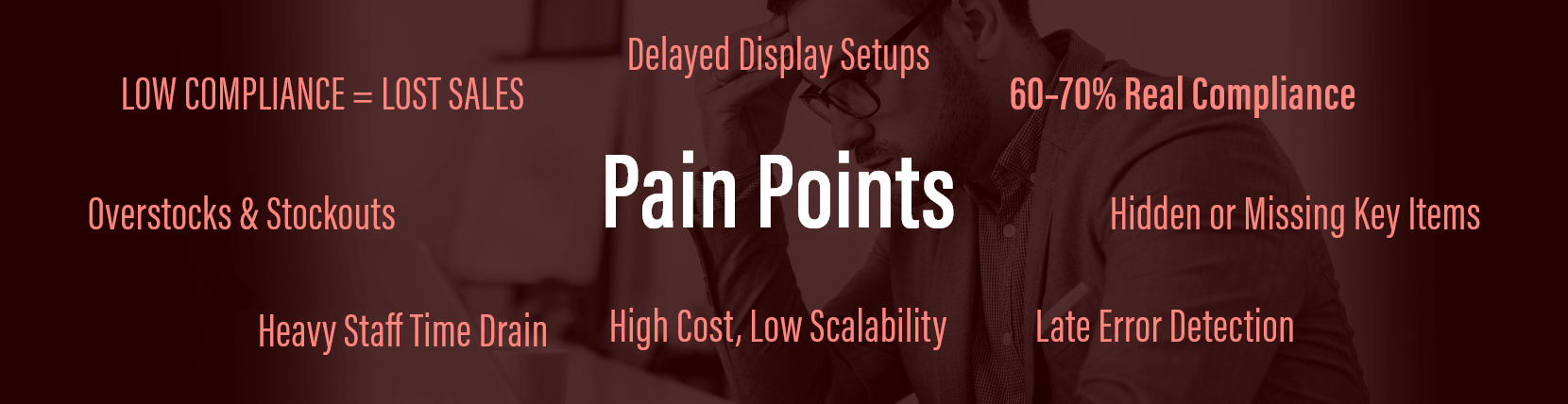
When planogram compliance falters, the negatives ripple through the business:
- Missed Sales Opportunities: The foremost impact is on sales. Products placed in the wrong spot (or not placed at all) simply don’t sell as they should. A famously cited example: a CPG study found that a significant portion of lost sales in certain categories was attributable to products being off-plan – e.g., not on the eye-level shelf or not in the promotional display where they were supposed to be, reducing visibility and impulse buys. In contrast, strong planogram compliance leads to higher sales, as top products get prime placement and shoppers can find what they’re looking for easily. If your compliance is low, you’re leaving money on the table every day. [progressiv…ailsvc.com]
- Higher Labor and Audit Costs: Many retailers combat compliance issues by conducting frequent audits and store visits. But manual audits are notoriously labor-intensive. If each store manager or field auditor spends even 2 hours a week on compliance checks, for a 300-store chain that’s 600 hours weekly – the equivalent of 15 full-time employees focused purely on checking shelves. Despite this effort, things still slip through the cracks. It’s a lot of labor spend for an imperfect solution.
- Inconsistent Customer Experience: One store has a beautiful display that draws customers in; another store (same chain) has a half-empty or incorrect display because of non-compliance. Customers experience the brand differently at different locations. In the age of social media and omnichannel retail, such inconsistency can be glaring. A disappointed customer in one location might assume every store in the chain is poorly kept. Brand standards and promotions are designed centrally, but without compliance, the execution fails to deliver a uniform experience. That erodes brand trust and can send potential loyalists elsewhere.
Retailers who have mastered shelf compliance treat it as a science – and they increasingly leverage technology to assist. This is exactly where OptiStoreAI shines.
OptiStoreAI uses a combination of computer vision, automation, and predictive analytics to revolutionize how planogram compliance is managed:
- Computer Vision Shelf Monitoring: OptiStoreAI employs AI-powered image recognition to essentially “see” your shelves the way a human would – but with tireless attention and speed. High-resolution cameras or even a store associate’s smartphone can capture images of product displays; the system then compares these images against the official planogram in real time. If a product is out of place, missing, or a display isn’t set up as it should be, OptiStoreAI flags the discrepancy immediately. For instance, if a new seasonal coffee blend is supposed to be on the endcap but isn’t present, the system will detect its absence and send an alert to the store manager: “Action needed: Seasonal Coffee Endcap – missing display units.” This automated monitoring can be done as frequently as needed – some retailers run computer vision checks multiple times a day – meaning errors are caught within hours, not weeks.
- Automated Compliance Scoring and Alerts: The platform provides each store (and each department or category within the store) a compliance score in real time, visible on a dashboard. If compliance drops below a certain threshold (say, below 90%), managers and relevant employees get notified. More importantly, OptiStoreAI pinpoints where and what the non-compliance is. Maybe the cereal aisle is perfectly set, but the beverage aisle has multiple issues. The alert will specify: “Beverage Aisle: planogram compliance 72% – 3 items out of place or missing.” This directed alert allows staff to fix the exact problems quickly instead of combing the entire store. One major retailer who piloted this feature saw their chain-wide compliance jump from around 70% to over 95% compliance in a matter of weeks. That means nearly perfect execution of every promotion and display, all the time – a level of consistency impossible to achieve with infrequent manual audits alone.
- Faster Audits – 75% Time Savings: Because OptiStoreAI automates the heavy lifting of checking shelves, the time required for store audits plummets. Auditors or managers no longer need to physically inspect each shelf; instead, they can review the AI’s reports (or just address the exceptions highlighted). Our clients have experienced up to 75% faster audit completion with OptiStoreAI. What used to take a two-hour store walk can now be done in minutes by reviewing a digital dashboard. Plus, central office teams can see compliance data without even visiting the store, allowing them to direct field support where it’s most needed.
- Proactive Correction and Guidance: OptiStoreAI doesn’t stop at identification – it helps solve the problem. The platform can be configured to integrate with task management or workforce apps, creating “tickets” or actionable tasks for store staff. For example, if an endcap is non-compliant, OptiStoreAI can automatically generate a task in the store’s task system for the appropriate department associate to “Set up Endcap for Product X as per planogram – due by end of day.” This ensures accountability and that nothing slips through the cracks. Meanwhile, the system will continue to monitor – once the issue is resolved and the shelf image matches the planogram, the task can be marked complete and the compliance score goes back up. This closed-loop approach means planogram issues are not only detected but also fixed quickly, with a record of when and how they were resolved.

The transformation from manual checks to AI-driven compliance yields substantial benefits:
- Higher Sales from Better Displays: With key products always in the right place at the right time, many OptiStoreAI users have seen a measurable sales lift in the categories where compliance improved. Products on promotional display, for example, sell significantly more when the display is properly executed. One retail chain reported that after achieving near-perfect compliance with the help of OptiStoreAI, their seasonal promotion sales rose by 18% compared to the previous year when compliance was spotty. Shoppers can’t buy what they can’t see – now they see it, and they buy it.
- Massive Time Savings and Labor Reallocation: Recapturing 75% of audit time means managers and employees get hours back every week. That time can be reinvested in customer service, training, or maintaining other store standards. Essentially, OptiStoreAI gives your staff a powerful assist – like having a virtual auditor working 24/7. This reduces burnout and lets your team focus on what humans do best (selling, serving customers) while AI handles the drudgery of inspection.
- Continuous Improvement and Accountability: The detailed compliance data collected helps identify chronic problem areas. Maybe one category is always struggling with compliance in a certain region – perhaps indicating a training need or an issue with how planograms are delivered. OptiStoreAI’s analytics can highlight these patterns so you can take strategic action (e.g., additional training for store teams, simplifying a complex display, or giving feedback to a supplier about packaging that doesn’t fit well on shelves).
All told, the outcome is smooth, attractive stores where everything is in its right place – which customers appreciate subconsciously (ever walk into a messy store and walk right out?). Well-executed stores not only sell more; they also reinforce your brand’s reliability and quality. That’s the kind of experience that drives shoppers to return.
Manually chasing planogram compliance is like playing whack-a-mole – exhausting and never-ending. But with AI, you can finally get ahead of the game. OptiStoreAI ensures every shelf in every store is set the way it’s supposed to be, day in and day out, with a fraction of the effort. The payoff is higher sales, lower labor costs, and a consistent brand experience. Ready to see it in action? Request a demo of OptiStoreAI’s computer vision shelf audit capabilities and discover how you can achieve near 100% planogram compliance across your stores.
Recent Blogs

From Overstock to Optimized – Cutting Excess Inventory with AI
February 19, 2026

End Stockouts for Good – How AI Keeps Retail Shelves Full
February 18, 2026

AI Isn’t Optional for Retail Supply Chains—It’s Survival by 2027
January 23, 2026

Breaking Free from Legacy ETL: How Retailers Are Modernizing Batch Processing with Databricks
January 14, 2026
Infocepts