



Your SIEM, XDR, and GRC platforms each answer an important question. None of them answers whether the security controls you already paid for are switched on and tuned right now. That is the job of security control validation, and the gap it fills is usually bigger than teams expect. Infocepts reports that when posture moved from periodic to continuous assessment, surfaced findings grew from about 60,000 to more than 500,000 [confirm: one client or an aggregate, and over what period]. The environment had not suddenly gotten worse. Security configuration drift had been there all along, hidden between quarterly reviews.
So when we introduce Cyber Vigilance 360 from Infocepts to a CISO, the first question is a fair one: how is this different from what I already own? Here is our answer, category by category, with a side-by-side comparison at the end.
Why can’t the stack grade itself?
Every major security product reports on itself. Your EDR console covers endpoints, your email gateway covers email, and your identity platform covers identity. Each defines coverage its own way, and none reports on whether the others are configured properly. It is no surprise, then, that few leaders rate their readiness highly. PwC’s 2026 Global Digital Trust Insights survey of 3,887 executives found that only 6% say their organization is very capable across all the cyber resilience areas surveyed (PwC).
Consolidating vendors narrows the list, as we covered in [Must-Have or Nice-to-Have?]([link to Blog 2]), but it does not change the basic problem. A console built to manage its own product is not designed to show you that a control was switched off three weeks ago.
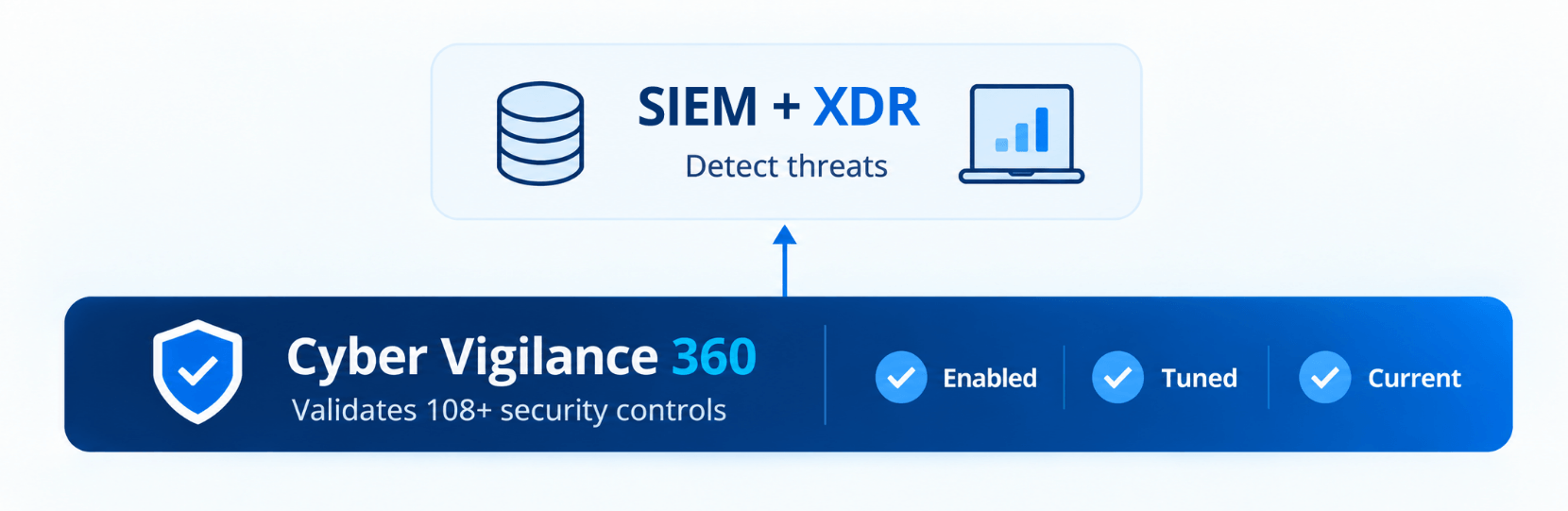
Difference 1: SIEM vs XDR vs control validation
A SIEM collects and correlates events. An XDR correlates detections across endpoints, networks, and cloud. Both depend on the controls underneath them working as designed. When an EDR policy slips into audit-only mode or an email protection rule gets disabled, the SIEM simply receives fewer signals. Nothing alerts on the silence.
Cyber Vigilance 360 works one layer down. It connects through APIs to more than 108 tools across EDR, email security, identity, web, and vulnerability management, and it checks continuously that each control is enabled, tuned, and current. That makes it a complement to SIEM and XDR, not a rival. The detection tools you depend on become more trustworthy, and you add no new stream of alerts.
Difference 2: One neutral view across every vendor
Native dashboards are good at managing their own product. They are not built to compare themselves with the rest of your environment or to report how their settings hold up alongside other vendors’ tools.
Cyber Vigilance 360 normalizes configuration data across vendors into a single view, so coverage means the same thing for every tool and every business unit. Security architects see overlapping controls and unused licenses side by side. That matters because tool optimization keeps stalling on the same barriers. In Gartner’s 2026 survey of more than 1,600 CISOs, 40% named budget and 36% named technical debt as obstacles to optimizing security tools and services (Evanta, a Gartner company). It is hard to retire technical debt you cannot see.
Difference 3: Vulnerabilities tied to real exposure
Vulnerability management tools are very good at listing weaknesses. The trouble is volume. As we showed in [Is Half Your Security Stack Switched Off?]([link to Blog 1]), only about a quarter of known exploited vulnerabilities were fully fixed last year. Teams aren’t ignoring the list. They can’t fix everything, and a severity score alone doesn’t say where to start.
Cyber Vigilance 360 correlates vulnerability findings with control effectiveness. A critical flaw on an asset with active, well-tuned compensating controls is a different risk from the same flaw on an asset whose EDR agent stopped reporting. AI-driven risk scoring combines those signals across tools, assets, departments, and human risk, with the reasoning attached. That is exposure management in practice.
Difference 4: Compliance as a live query, not a quarterly rebuild
GRC platforms manage policies, attestations, and workflows. They rely on someone gathering technical evidence and feeding it in, and in most enterprises that evidence is rebuilt for each audit.
Cyber Vigilance 360 maps control status continuously to MITRE ATT&CK, CIS Controls, and threat-actor techniques, and it feeds that evidence to the people who need it. Your GRC platform keeps doing its job. It simply works from current data instead of a snapshot taken weeks earlier. That matters more each year: Gartner names global regulatory volatility as one of its top cybersecurity trends for 2026, which makes stale evidence a bigger risk (Gartner).
Difference 5: Value inside a day, run by someone else
Large security deployments often take quarters to show value, and few teams have the people to run another one. IANS Research found that security staffing growth slowed to 7% in 2025, its lowest level in four years (IANS Research).
Cyber Vigilance 360 takes about four hours to configure, and first results arrive inside a day. Infocepts runs it as a fully managed service with 24×7 monitoring. It is cloud-native and lakehouse-ready, and sensitive data stays inside your environment. [Customer proof point to confirm: what a named or anonymized North American enterprise found in its first week.]
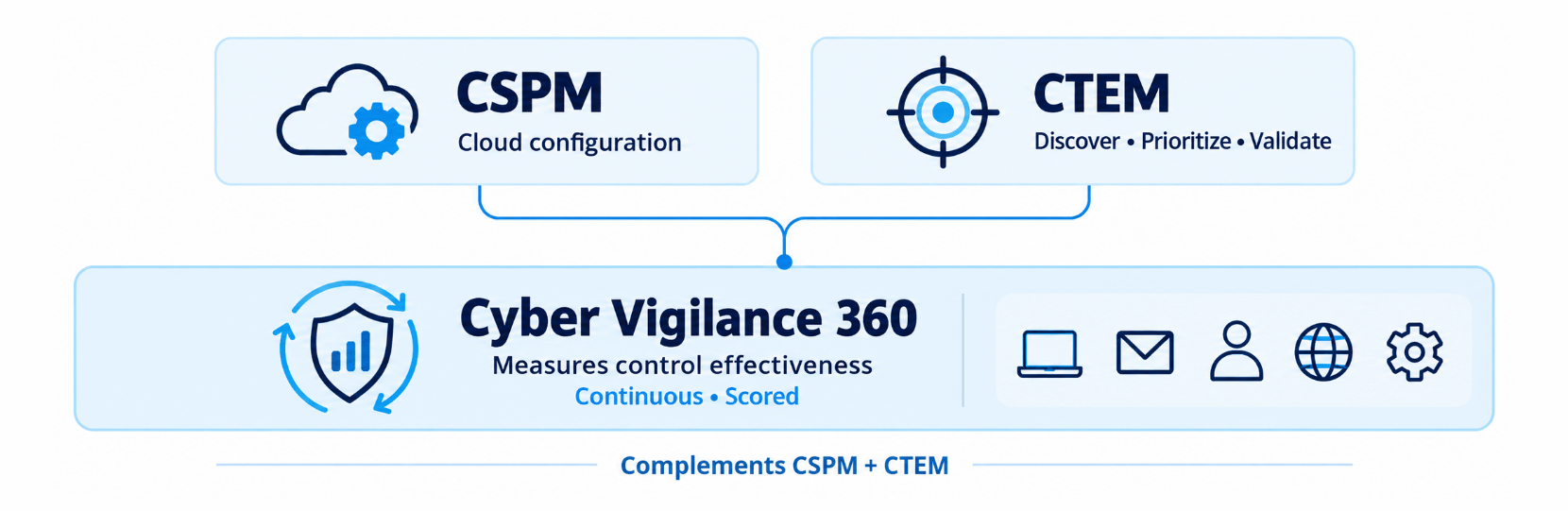
Where do CSPM and CTEM fit?
Cloud security posture management focuses on the configuration of cloud infrastructure. Continuous threat exposure management (CTEM) is a program for discovering, prioritizing, and validating exposures across the attack surface. Both are valuable, and neither replaces the other.
Cyber Vigilance 360 covers a surface that both tend to leave thin: the effectiveness of the security controls themselves across endpoint, email, identity, web, and vulnerability tools. For many enterprises it becomes the measurement layer that makes a CTEM program work, because it supplies a continuous, scored view of which defenses are actually in place.
The comparison at a glance
| Category | What it answers | What it can’t tell you | How Cyber Vigilance 360 fits |
| SIEM | What events happened, and are they related? | Whether the controls producing events are on | Validates the controls that feed it |
| XDR | Which detections point to an attack? | Whether agents and policies are configured as intended | Flags disabled or mistuned controls |
| Vulnerability management | Which weaknesses exist? | Which ones are covered by working controls | Ranks vulnerabilities by real exposure |
| GRC | Are policies and attestations in place? | Whether technical evidence is current | Supplies live MITRE ATT&CK and CIS mapping |
| CSPM and CTEM | Are cloud settings and attack paths exposed? | Whether endpoint, email, identity, and web controls work | Adds a scored control-effectiveness layer |
Why visibility decides outcomes in manufacturing
In industrial environments, the cost of not seeing a gap is measured in downtime. Dragos found that organizations with comprehensive OT visibility detected and contained OT ransomware in an average of 5 days, against an industry-wide average of 42 days (Dragos).
Cyber Vigilance 360 does not monitor plant systems directly. It covers the IT controls that guard the way in: identity, endpoint, email, and web. Manufacturers already run their plants from one trusted view of many systems, which is what industrial manufacturing analytics gives operations leaders across lines and sites. Security leaders deserve the same single, scored view of the defenses that protect those sites.
“[Quote from an Infocepts security leader or a CISO customer on what continuous validation revealed that their existing tools did not.]” [Name, title]
Register for the CISO Roundtable in New York
If you are weighing where control validation fits in your stack, have that conversation with peers who are doing the same. Infocepts and Discern Security are hosting a CISO roundtable and dinner on October 28, 2026, from 6:00 to 9:00 PM at Tamarind Tribeca, 99 Hudson Street, New York. [One line on who Discern Security is and why it is co-hosting.] The discussion runs in a single private room, so seats are limited. Bring your stack map and leave knowing which of your controls you can actually prove.
Register for the CISO Roundtable – Let’s connect!
Can’t make it to New York? Book a 30-minute posture briefing with Infocepts. It is a working session, not a demo, and you will see which of your controls are switched off today.
[Web team: after October 28, swap the roundtable section for the posture briefing CTA or a roundtable recap.]
Frequently asked questions
What is security configuration drift?
Security configuration drift is the gradual change of a security control away from its intended settings, through upgrades, troubleshooting, or emergency changes, often without any alert.
Does security control validation replace a SIEM or XDR?
No. A SIEM and an XDR analyze events and detections. Security control validation confirms that the controls generating those signals are enabled and tuned, so it makes both more reliable.
How does security control validation support CTEM?
CTEM depends on knowing which defenses are really in place. Continuous control validation supplies that view, so new exposures are prioritized against actual protection rather than assumed protection.
Can You Prove Your Security Controls Are Working Today?
Infocepts Cyber Vigilance 360 helps organizations identify configuration drift, validate control effectiveness, and gain continuous visibility across identity, endpoint, email, web, and vulnerability management ecosystems.
Infocepts Cyber Security COE helps organizations strengthen their security posture through data-driven cybersecurity solutions and advanced threat intelligence. The team specializes in cyber risk management, security analytics, threat detection and response, compliance reporting, and AI-powered security operations, enabling businesses to proactively defend against evolving cyber threats.
Read Full BioRecent Blogs




The Enterprise AI & Data Transformation Partner. Delivering measurable business impact globally.
#1 on Gartner Peer Insights · 97.2% client retention