



The cybersecurity trends that will define 2027 are already visible in the data: agentic AI security, the AI-driven SOC, third-party exposure, postquantum deadlines, and boards that want security measured like any other investment. Spending is moving to match. Gartner expects spending on securing AI to reach almost $4.8 billion in 2027, up 68.7% from 2026, and nearly $7.7 billion in 2028 (Gartner).
Our view at Infocepts is that these five trends share a weak point. Each one assumes the controls you already own are working. Agents need governed identities, AI-driven SOCs need reliable signals, and boards need proof. None of that holds if a policy was quietly switched off last month. Here is what to watch through 2028 and what each trend asks of your security posture.
Trend 1: Agentic AI security becomes an identity problem
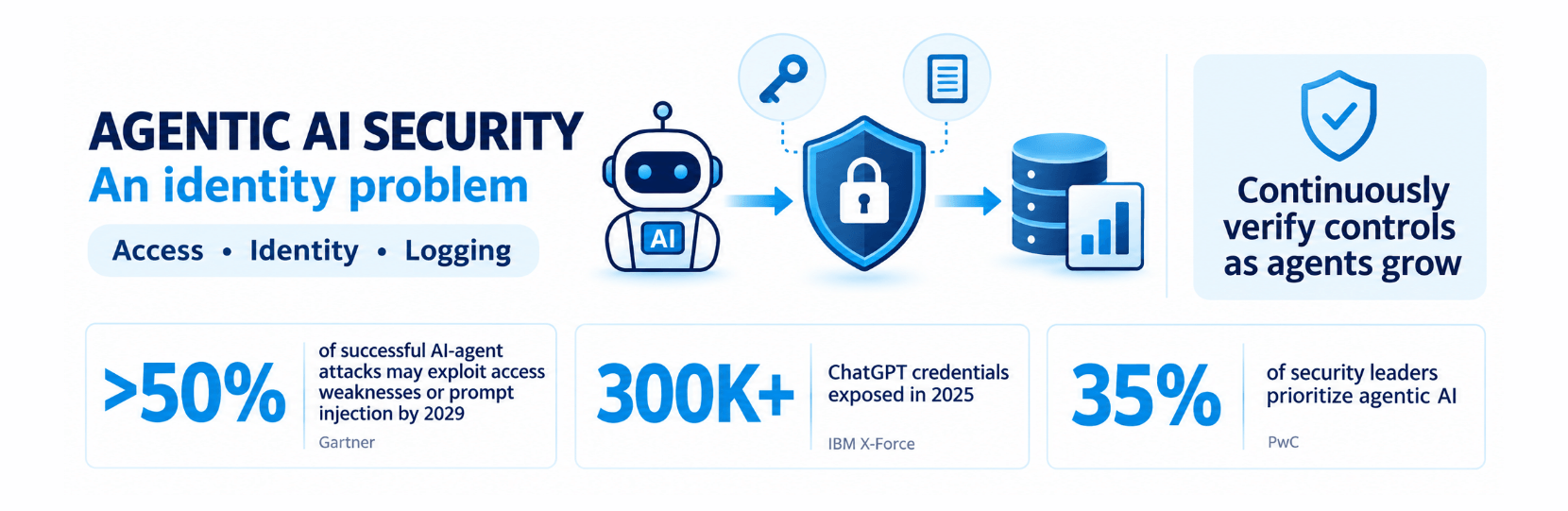
Gartner put agentic AI at the top of its 2026 cybersecurity trends. Director Analyst Alex Michaels said that “cybersecurity leaders must identify both sanctioned and unsanctioned AI agents,” and Gartner flagged that identity and access management must adapt to AI agents (Gartner). Its newer forecast goes further: by 2029, Gartner expects over half of successful cyberattacks on AI agents to exploit access control weaknesses and prompt injections (Gartner).
Attackers are already harvesting AI access. IBM X-Force found that infostealer malware exposed more than 300,000 ChatGPT credentials in 2025 (IBM X-Force). PwC found that 35% of security leaders already rank agentic AI among their budget priorities (PwC). As agents gain permission to read data and act for users, conditional access rules, identity policies, and logging become AI controls. CISOs will need continuous proof that those controls stay on as the number of agents grows.
Trend 2: The AI-driven SOC changes the job, not just the tools
Gartner warns that AI-driven SOC solutions are destabilizing operational norms, and it urges leaders to “prioritize people as much as technology,” with human-in-the-loop checks built into AI-supported processes (Gartner). PwC found that 48% of security leaders are prioritizing AI-powered threat hunting (PwC). The people side is the harder part. In Gartner’s 2026 CISO survey, 52% of leaders working on AI named a lack of skills as a challenge, and 56% named the speed of change (Evanta, a Gartner company).
An AI-driven SOC also depends on what it can see. If an endpoint agent stops reporting or an email rule is disabled, the AI receives less data and concludes less, without saying so. The SOC teams that get the most from AI through 2028 will be the ones that validate the controls feeding it, and that can see why the AI reached each conclusion.
Trend 3: Third-party exposure grows into a top attack path
The 2026 Verizon Data Breach Investigations Report found that third parties were involved in 48% of breaches, a 60% increase (Verizon). IBM X-Force counted a 49% year-over-year surge in active ransomware and extortion groups (IBM X-Force). The World Economic Forum’s Global Cybersecurity Outlook 2026 found that CISOs remain most concerned about ransomware and supply chain resilience (World Economic Forum).
Those numbers will push continuous threat exposure management from a framework on a slide to an operating requirement. Partner access runs through identity, email, and web controls, which are exactly the controls that drift when vendors are onboarded in a hurry. Prioritizing new exposures only works if you know which defenses are really in place.
Trend 4: Postquantum cryptography and regulation compress planning cycles
Gartner warns that quantum computing could make the asymmetric cryptography organizations rely on unsafe by 2030, and it names global regulatory volatility as a defining trend (Gartner). Preparation lags. PwC found that 49% of organizations have not yet considered or started implementing quantum-resistant security measures (PwC).
For North American enterprises with global operations, 2030 is closer than it looks. Cryptography inventories, vendor commitments, and migration plans take years. Meanwhile, auditors and regulators will expect current, framework-mapped evidence of control status, not a binder assembled once a year. Cyber Vigilance 360 does not inventory cryptography. Its role here is narrower and still useful: continuous mapping to MITRE ATT&CK and CIS Controls turns that evidence expectation into a routine query.
Trend 5: Security gets measured like any other business investment
Budgets are still growing in most companies. PwC found that 78% of organizations expect their cyber budget to rise over the next 12 months (PwC). But security is losing ground inside IT: IANS Research found that security’s share of IT spending fell from 11.9% to 10.9% in 2025 (IANS Research).
There is also a gap in what leaders worry about. The World Economic Forum found that CEOs rank cyber-enabled fraud as their top concern, while CISOs focus on ransomware and supply chain risk (World Economic Forum). Closing that gap takes board-ready security reporting that ties posture, coverage, and license use to business risk in terms both sides recognize. Cyber posture intelligence, meaning a continuous, scored view of whether defenses work, is how CISOs will make that case.
Your 2027 readiness plan
| Trend | What to do by mid-2027 | What to measure |
| Agentic AI security | Inventory sanctioned and unsanctioned agents; apply identity policies to them | Share of agents under governed identity |
| AI-driven SOC | Add human-in-the-loop review; validate the controls feeding the SOC | Controls verified as reporting and tuned |
| Third-party exposure | Map partner access across identity, email, and web | Third-party access paths with validated controls |
| Postquantum and regulation | Start a cryptography inventory; keep framework evidence current | Systems inventoried; evidence age in days |
| Security as investment | Report posture, coverage, and license use to the board | Posture trend and stack ROI by quarter |
What these trends mean for manufacturers
Manufacturers face all five trends with less margin for error. Dragos tracked 119 ransomware groups targeting industrial organizations in 2025, up from 80 the year before, affecting about 3,300 organizations. Manufacturing accounted for more than two-thirds of all victims, and Dragos identified three new OT threat groups (Dragos). IBM X-Force found that data theft was the most common type of incident in manufacturing (IBM X-Force).
As plants add AI agents, connected equipment, and new data pipelines, IT and OT keep converging. Infocepts already helps manufacturers turn plant, quality, and supply chain data into decisions through industrial manufacturing analytics. Cyber Vigilance 360 brings the same discipline to the identity, endpoint, email, and web controls that sit between the enterprise network and production.
How Cyber Vigilance 360 supports the plan
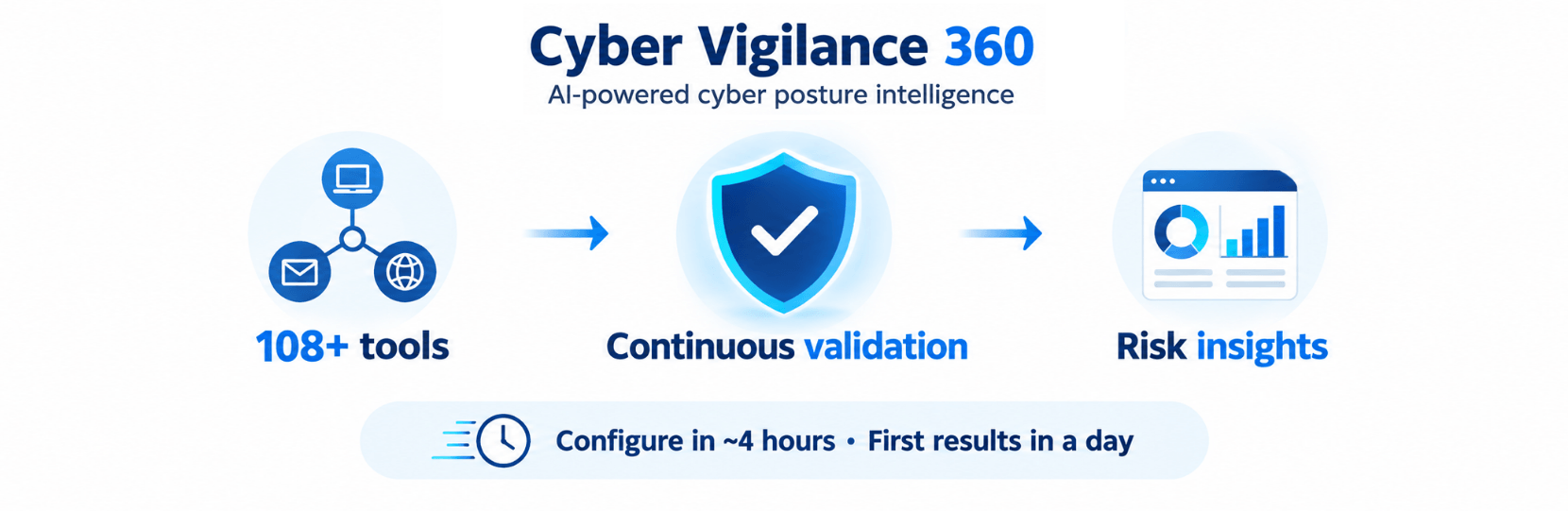
Cyber Vigilance 360 from Infocepts is AI-powered cyber posture intelligence. It connects to more than 108 tools across EDR, email security, identity, web, and vulnerability management. It checks continuously that each control is on and tuned, scores risk with the reasoning attached, maps controls to MITRE ATT&CK and CIS, and reports to the board from live data. It is fully managed, takes about four hours to configure, and delivers first results inside a day.
[Customer proof point to confirm: how a named or anonymized North American enterprise used continuous validation in its 2027 planning.]
“[Quote from an Infocepts security leader on which of these five trends CISOs are least prepared for.]” [Name, title]
Register for the CISO Roundtable in New York
These trends are easier to plan for in a room with peers facing the same decisions. Infocepts and Discern Security are hosting a CISO roundtable and dinner on October 28, 2026, from 6:00 to 9:00 PM at Tamarind Tribeca, 99 Hudson Street, New York. [One line on who Discern Security is and why it is co-hosting.] Bring your questions on agentic AI security, control validation, and building a 2027 budget the board will fund. The evening runs in one private room, so seats are limited.
Register for the CISO Roundtable – Let’s connect!
Can’t make it to New York? Book a 30-minute posture briefing with Infocepts and see what a snapshot of your own environment reveals while your 2027 roadmap is still being written.
[Web team: after October 28, swap the roundtable section for the posture briefing CTA or a roundtable recap.]
Frequently asked questions
What are the top cybersecurity trends for 2027? Agentic AI security, the AI-driven SOC, third-party exposure, postquantum cryptography planning, and pressure to measure security as a business investment.
How should CISOs prepare for agentic AI security? Inventory sanctioned and unsanctioned agents, bring them under identity and access policies, and continuously validate that those policies stay enabled.
What is cyber posture intelligence? Cyber posture intelligence is a continuous, scored view of whether your security controls are on, tuned, and reducing risk. Cyber Vigilance 360 from Infocepts delivers it across more than 108 tools.
Is Your Security Strategy Ready for 2027?
Continuously validate controls, strengthen resilience, and gain confidence in your cybersecurity investments.
Infocepts Cyber Security COE helps organizations strengthen their security posture through data-driven cybersecurity solutions and advanced threat intelligence. The team specializes in cyber risk management, security analytics, threat detection and response, compliance reporting, and AI-powered security operations, enabling businesses to proactively defend against evolving cyber threats.
Read Full BioRecent Blogs




The Enterprise AI & Data Transformation Partner. Delivering measurable business impact globally.
#1 on Gartner Peer Insights · 97.2% client retention