


The Industry’s Biggest Commercial Challenge Isn’t What Most Leaders Think
At the 4th Annual Pharma Commercial and SFE Summit in Budapest, I had the opportunity to engage with leaders across Commercial Excellence, Medical Affairs, Sales Force Effectiveness, Omnichannel, Data & Analytics, and AI.
While discussions ranged across markets, functions, and transformation priorities, one theme surfaced consistently: pharmaceutical organizations have more data, more content, more channels, and more customer intelligence than ever before, yet many still struggle to convert that abundance into better decisions and measurable customer outcomes.
Over the past decade, the industry has invested heavily in commercial analytics, customer 360 initiatives, omnichannel engagement, cloud platforms, and artificial intelligence. These investments have dramatically improved access to information. But access to information and the ability to act on it are two very different things.
The challenge is no longer collecting data.
The challenge is connecting the dots.
And increasingly, I believe the next source of competitive advantage will not come from more technology or more analytics. It will come from an organization’s ability to consistently make better decisions and execute on them faster than its competitors.
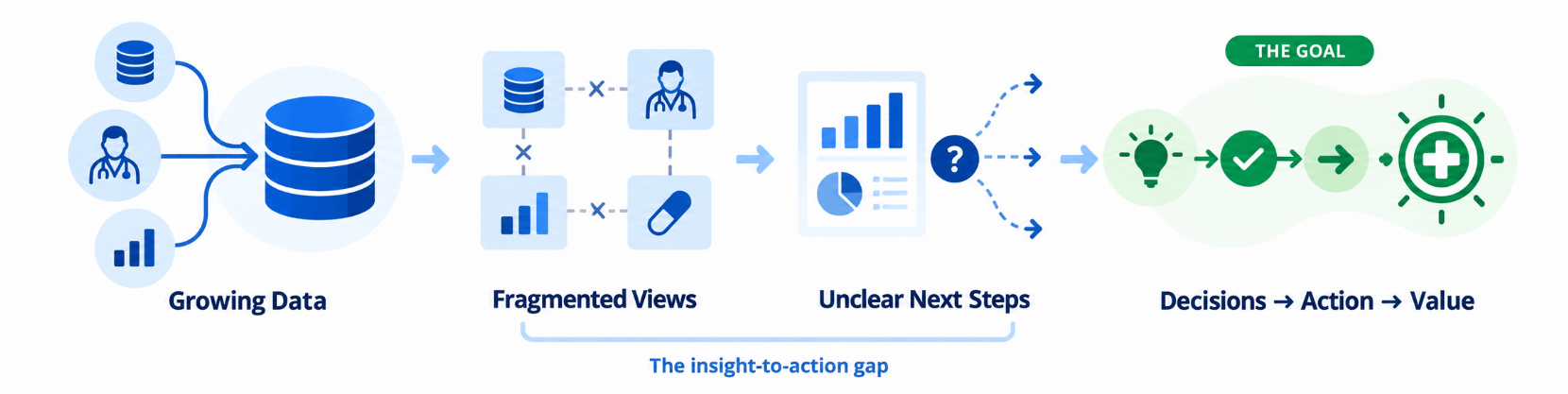
The Strategic Challenge: Converting Data Investments into Business Outcomes
Most life sciences organizations have built impressive digital capabilities. Commercial teams have access to sophisticated CRM platforms. Medical Affairs teams have deeper engagement insights. Data and analytics teams can process more information than ever before. AI can identify patterns at a scale that was unimaginable only a few years ago.
Yet despite these advances, many organizations continue to face a familiar challenge.
Every healthcare professional interaction generates data. Every omnichannel campaign produces engagement signals. Every field activity creates performance metrics. Every medical conversation contributes valuable context. Every touchpoint adds another layer of customer intelligence.
The volume of information continues to grow, but business value does not automatically grow with it.
In many organizations, customer data remains fragmented across systems. Commercial and Medical Affairs teams often operate from different views of the customer. KPI definitions vary across functions. Teams receive a growing number of reports, alerts, and recommendations, yet still struggle to determine what action should happen next.
As a result, organizations spend enormous effort generating insights but significantly less effort operationalizing them. The issue is not a lack of intelligence. The issue is the inability to consistently translate intelligence into decisions and decisions into action.
Why Traditional Commercial Operating Models Are Reaching Their Limits
The commercial environment has changed dramatically. Healthcare professionals expect more personalized engagement. Stakeholders expect greater value from every interaction. Digital channels continue to expand, while AI is reshaping expectations around responsiveness, productivity, and decision-making.
Many operating models, however, were designed for a simpler era. An era with fewer channels, fewer data sources, and less complexity.
Today, organizations are expected to coordinate across Commercial, Medical Affairs, Market Access, Customer Engagement, Analytics, and Field Teams while maintaining governance and compliance requirements. That level of coordination becomes difficult when information remains scattered across functions and systems.
This challenge becomes especially visible when organizations attempt to scale AI. Many companies have successfully launched pilots, predictive models, and Generative AI initiatives. Some are generating impressive insights. Yet relatively few have embedded those capabilities into workflows that consistently influence business outcomes.
The gap is no longer technology adoption.
The gap is intelligence adoption.
The Shift from Measuring Activity to Accelerating Customer Value
One of the most significant shifts I observed during the summit was how organizations are redefining commercial excellence.
Historically, performance was measured through activity. Teams tracked calls completed, meetings conducted, emails opened, and campaigns executed. These metrics remain important, but they no longer provide a complete picture of success.
Leading organizations are increasingly asking a different question: What changed because the interaction happened?
Did the healthcare professional receive more relevant information? Did the engagement strengthen trust? Did it address an unmet need? Did it improve decision-making? Did it move the customer journey forward?
This shift changes how organizations think about customer engagement, commercial strategy, and AI investments. It moves the conversation away from activity volume and toward customer value creation.
Commercial excellence is no longer about maximizing interactions. It is about maximizing impact.
Why Connected Intelligence Is Becoming a Strategic Imperative
For many organizations, the default response to complexity is another dashboard, another report, or another analytics tool. But the industry does not suffer from a shortage of reports. Most organizations already have access to extensive analytics and performance data.
The problem is that insights often remain disconnected.
Commercial insights sit in one system. Medical insights sit in another. Customer engagement data exists elsewhere. AI recommendations are delivered through separate platforms. Business context frequently resides within individual teams.
The result is fragmented intelligence.
This is why connected intelligence is becoming a business imperative. Connected intelligence brings together data, business context, customer engagement, AI recommendations, governance, and execution into a common framework.
It creates a shared understanding of customers, priorities, opportunities, and risks. It reduces friction between teams. It increases trust in decision-making. Most importantly, it helps organizations move from insight generation to coordinated action.
Scaling AI Beyond Pilots to Enterprise Value
AI was one of the most discussed topics throughout the summit, and rightly so. From Generative AI and intelligent agents to predictive analytics and decision intelligence, organizations are actively exploring how AI can enhance customer engagement, commercial effectiveness, and field productivity.
However, many leaders are reaching the same conclusion.
The challenge is no longer experimentation.
The challenge is scale.
Most organizations can launch pilots. Many can demonstrate compelling use cases. Far fewer can create enterprise value.
The organizations seeing the greatest success with AI are focusing less on generating more insights and more on improving decision quality. They are embedding intelligence into existing workflows. They are helping teams prioritize actions rather than adding more alerts. They are simplifying complexity rather than contributing to it.
Most importantly, they are treating AI as a business transformation initiative rather than a technology implementation project.
Building Trust: The Foundation of AI Adoption in Life Sciences
A recurring theme throughout many conversations in Budapest was trust.
Trust in data.
Trust in recommendations.
Trust in governance.
Trust in outcomes.
Without trust, adoption slows. Without adoption, value creation becomes difficult. This is particularly important in life sciences, where explainability, compliance, transparency, and accountability are essential.
Organizations cannot simply deploy AI and expect users to follow recommendations. Teams must understand how decisions are being informed. Leaders must trust the quality of the data. Medical Affairs teams must trust governance processes and compliance controls.
This is why trusted data foundations, common business definitions, and transparent decision frameworks are becoming strategic priorities. The organizations that establish this foundation will be far better positioned to accelerate AI adoption while reducing risk.
Human judgment will remain central to that success. AI can identify patterns and surface opportunities, but people provide context, experience, accountability, and decision-making expertise.
The future is not about replacing human intelligence. It is about amplifying it.
Moving from Insights to Decisions: The New Source of Competitive Advantage
Throughout the summit, I found myself returning to a simple framework:
Signals → Insights → Decisions → Actions → Outcomes
Most organizations have become highly effective at generating signals. Many have become increasingly sophisticated at generating insights. Far fewer have mastered the transition from insight to decision. Even fewer can consistently connect those decisions to measurable business outcomes.
This is where the next competitive advantage will emerge.
The organizations that lead over the next decade will not necessarily have more data than their competitors. They will simply be better at acting on it. They will make decisions faster, align teams more effectively, and execute with greater consistency.
The future belongs to organizations that can shorten the distance between knowing and doing.
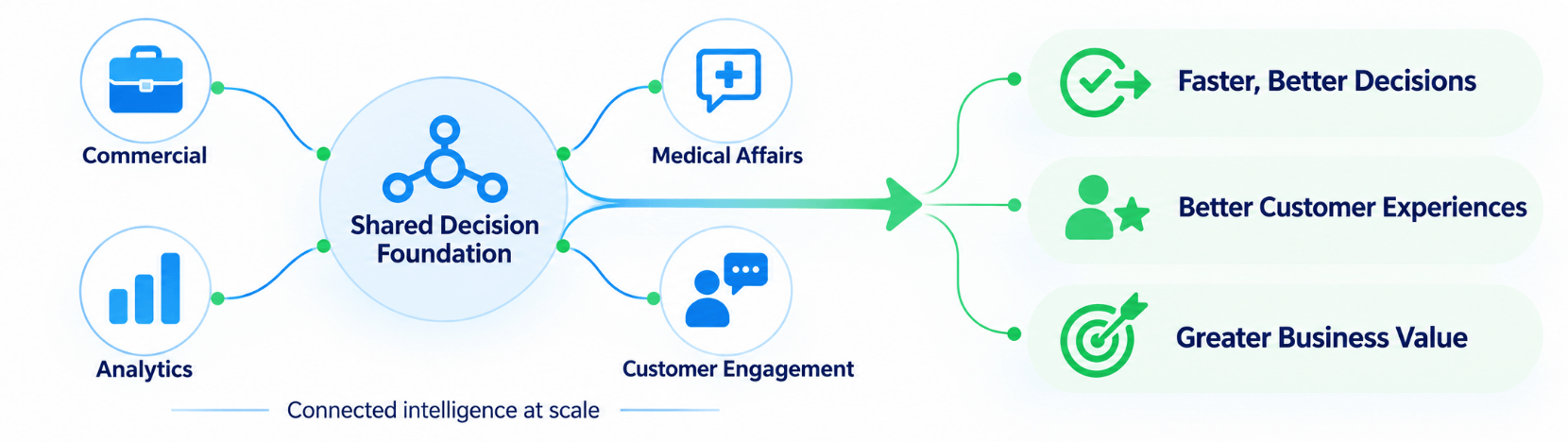
The Next Era of Commercial Excellence
The future of commercial excellence is not about generating more information. It is about creating more value from the information organizations already possess.
As AI adoption accelerates and customer expectations continue to rise, pharmaceutical organizations must move beyond fragmented insights, isolated transformation initiatives, and activity-based thinking. They must build operating models that connect data, people, business context, and execution.
The next generation of leaders will be defined by their ability to transform intelligence into action faster and more consistently than their competitors. They will connect Commercial, Medical Affairs, Analytics, and Customer Engagement through a common decision-making foundation. They will create connected intelligence at scale.
Those organizations will make better decisions. They will create better customer experiences. And they will define the future of commercial excellence in life sciences.
Ready to Unlock Enterprise Value from Your AI and Data Investments?
Every pharmaceutical organization is investing in AI, analytics, customer engagement, and digital transformation. The differentiator is no longer access to technology. It is the ability to connect data, people, decisions, and execution around measurable business outcomes.
At Infocepts, we help life sciences organizations build the trusted data foundations, connected intelligence capabilities, governance frameworks, and adoption strategies needed to transform insights into action and action into measurable value.
The organizations that lead the next decade of pharmaceutical innovation will not be those that generate the most data. They will be those that make the best decisions.
Build the Foundation for Commercial Excellence
Unify customer intelligence, medical insights, analytics, and AI recommendations to empower teams with a single source of decision confidence.

Bashdar Ismaeel brings over 25 years of experience across life sciences and healthcare, working at the intersection of data, AI, and advanced analytics. He partners with pharmaceutical and healthcare organizations to design and deliver intelligent, scalable solutions that connect R&D, medical...
Read Full BioRecent Blogs
Step-by-Step Guide to Migrating from Power BI Premium to Microsoft Fabric in 2026
October 23, 2026

10 Best Databricks Consulting Services for Life Sciences and Pharmaceutical Companies
October 22, 2026

Data Engineering Services Pricing: How much do Data Engineering Consulting Firms Charge in 2026?
October 21, 2026

The Enterprise AI & Data Transformation Partner. Delivering measurable business impact globally.
#1 on Gartner Peer Insights · 97.2% client retention