
Ask a media buyer what they mean by “brand safety,” and most of them will give you a version of the same answer: we don’t want our client’s ad running next to something inappropriate.
That’s a reasonable baseline. But brand safety as a negative filter – a list of things to avoid – is an increasingly thin value proposition in a market where every major publisher is claiming it.
The publishers redefining the conversation right now are the ones who have moved beyond “we don’t have brand safety problems” to “we have positive brand alignment opportunities.” They’re not just telling advertisers what their content isn’t. They’re telling advertisers what their content makes their audience feel.
That’s a different conversation. And it commands a different price.
The Emotion in the Room
Here’s a simple experiment that illustrates the point. Take two advertising placements. Both run against a household-income-skewed audience. Both run in primetime. Both clear the standard brand safety filters.
The first runs in a crime procedural. The narrative at the break point is tense. The character the viewer has been following for 45 minutes is in danger. The emotional state of the viewer at the moment the ad appears is elevated stress and heightened uncertainty.
The second runs in a prestige cooking competition. The narrative at the break point is triumphant. A contestant the viewer has invested three episodes of emotional energy in has just won a challenge. The emotional state of the viewer at the moment the ad appears is positive, warm, and anticipatory.
Both placements are “brand safe.” Neither one is the same. And for a brand whose message is built on warmth, family, and positive aspiration – a food brand, an insurance brand, a family car – the emotional context of the second placement is worth meaningfully more than the first.
Advertisers know this intuitively. They’ve been trying to buy it manually for decades. SentimentVista AI makes it systematic.
What Sentiment Intelligence Actually Measures
SentimentVista AI analyzes content at a granular level – program, episode, segment, and break position – to produce a sentiment profile that describes the emotional arc of the content and the likely emotional state of the viewer at specific moments.
The analysis covers several dimensions. Emotional valence: is the content producing positive, negative, or neutral emotional states? Intensity: how strongly is the emotional response likely to be felt? Stability: is the emotional arc consistent through the program, or does it shift dramatically at key narrative moments? Brand affinity index: how well does the emotional context align with the emotional positioning of specific advertiser categories?
The output is not a binary “safe/unsafe” flag. It’s a rich emotional profile that tells an advertiser not just that a placement is clean, but that it’s emotionally optimal for their campaign.
What This Does to CPM
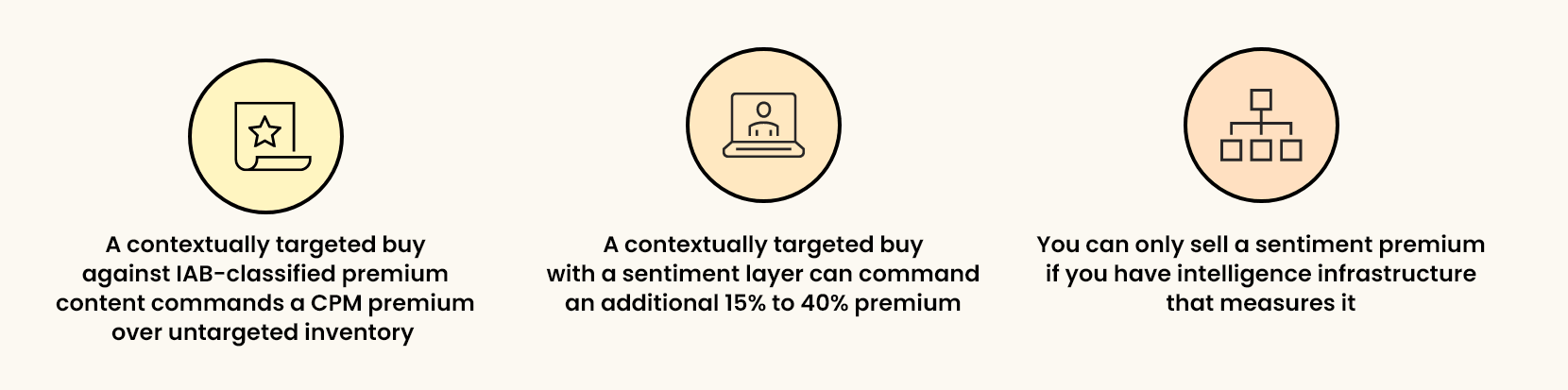
A contextually targeted buy against IAB-classified premium content commands a CPM premium over untargeted or remnant inventory. That’s the baseline of contextual advertising.
A contextually targeted buy that adds a sentiment layer – “this content generates high positive emotional engagement among your target audience, with a brand affinity index specifically aligned to your campaign messaging” – commands an additional premium on top of that baseline. We’ve seen this premium range from 15% to 40% in markets where publishers have been able to sell it.
But you can only sell a sentiment premium if you can quantify the sentiment. And you can only quantify the sentiment if you have intelligence infrastructure that produces it at scale across your content library.
Most publishers can tell an advertiser their content is “premium.” Fewer can tell an advertiser that their content produces a specific emotional state in a specific audience segment at a specific point in the narrative arc.
The ones who can are having a fundamentally different conversation with their top accounts.
Brand Safety as a Positive Story
The traditional brand safety conversation is defensive. “We have processes in place to prevent your ad from running near problematic content.” Advertisers expect this. It doesn’t differentiate you.
The sentiment intelligence conversation is offensive. “We can place your campaign in content environments that actively produce the emotional response you want your brand associated with. We can prove it before the campaign starts and measure it during and after.”
For financial services brands, that might mean content that produces confidence and security. For consumer goods brands, warmth and aspiration. For automotive brands, ambition and desire.
These aren’t abstract positioning concepts. They’re measurable content characteristics that SentimentVista AI can identify, quantify, and package into targeting parameters your direct sales team can sell and your programmatic pipes can execute.
The Cookie less Future Is an Emotional Future
As cookie-based targeting continues to erode, the advertising premium is moving toward two things – verified audience data and verified content context.
Publishers who have both are building a competitive moat that technology companies can’t replicate. Google and Meta have audience data. They do not have premium editorial context. They do not have the emotional intelligence that comes from understanding how your specific audience feels in the moments surrounding an ad placement.
That’s a unique value proposition. The publishers who can articulate it – and demonstrate it with data – are the ones who will hold CPM while others race to the bottom.
Sentiment intelligence is the infrastructure that makes that articulation possible. Not in theory. In the next agency meeting.
Recent Blogs

The Data Platform Modernization Playbook for Life Sciences: Cloud, Governance, and AI Readiness
April 8, 2026

The Super Bowl, the Olympics, and the Art of Not Losing Your Biggest Revenue Moment
April 6, 2026

KOL Identification at Scale: Why Machine Learning Outperforms Business Rules
April 3, 2026

The Upfront 2026 Survival Guide: What Your Buyers Actually Need to Hear
April 2, 2026
Infocepts