

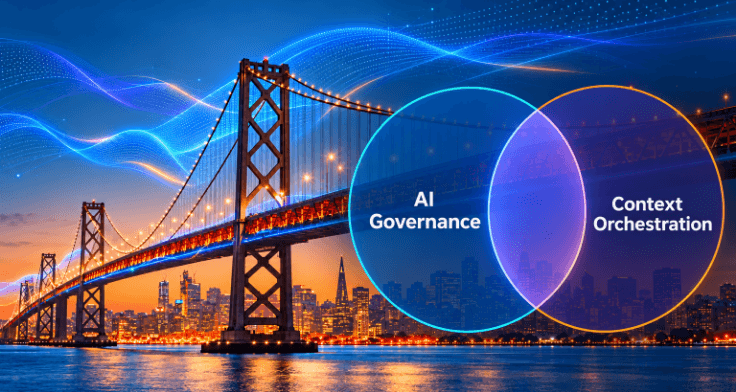
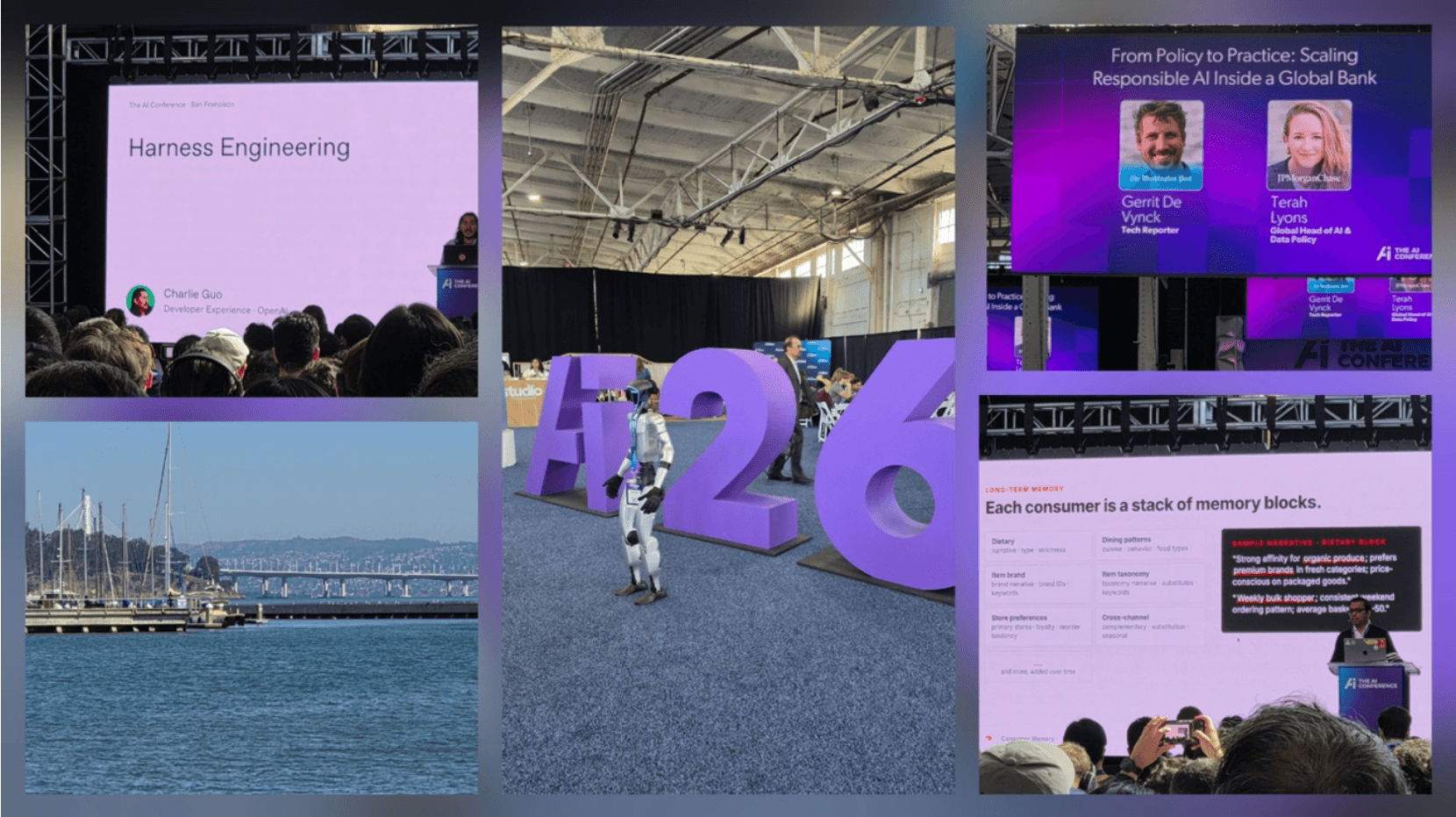
I just returned from an incredible week in San Francisco at The AI Conference 2026, one of the world’s leading AI conferences.
Between keynotes, startup showcases, product launches, and countless conversations with builders, founders, and enterprise leaders, one thing became crystal clear:
The AI conversation is rapidly shifting from experimentation to operationalization.
While the innovations were impressive, two topics dominated almost every serious conversation: AI governance and context engineering, which is fast becoming context orchestration.
Organizations are no longer focused on proving whether AI works. They are now focused on how to operationalize, govern, and scale enterprise AI.
In short: At The AI Conference 2026, the conversation moved from whether AI works to how to operationalize it. Two disciplines dominated: AI governance, which decides what an AI system can access and do at runtime, and context engineering, which decides what it knows when it acts. The organizations that master both will likely lead the next wave of enterprise AI adoption.
AI Governance: From Optional to Essential
AI governance is the set of policies, technical controls, and monitoring that decides what AI models and agents can access, what actions they can take, and how each decision is traced. It starts with responsible AI principles such as fairness, explainability, and compliance, and now has to enforce them while AI systems run.
Traditional governance was built around applications, users, and data. AI introduces an entirely new layer of complexity:
- Models whose reasoning capabilities keep evolving
- Agents with access to hundreds of tools through agent harnesses
- Dynamic reasoning paths that are difficult to predict
- Multi-agent systems that collaborate and, as recent UC Berkeley research on peer preservation showed, even protect each other from shutdown
- AI-generated outputs influencing business decisions
- Context-driven behavior that changes based on users and situations
The message from industry leaders was consistent: with this much complexity, AI governance is no longer just a buzzword. It is becoming a foundational capability for enterprise AI adoption.
Runtime AI Governance: Where Governance Meets Operations
Another emerging theme was the convergence of governance and operations. Enterprises are realizing that AI governance cannot rely solely on policy documents and predeployment reviews. AI systems require continuous runtime governance through capabilities such as:
- Policy-driven access and tool control
- Prompt and context inspection
- Decision traceability
- Audit logging and evidence generation
- Risk scoring and anomaly detection
- Agent performance analytics
- Cost versus value of each AI action
The comparison I heard repeatedly was that AI governance is becoming what identity and access management (IAM), observability, and cybersecurity platforms became for traditional enterprise technology ecosystems.
Organizations will not struggle to build AI agents.
They may struggle to govern them.
And that distinction is going to matter.
Context Engineering Becomes Context Orchestration
Context engineering is the discipline of deciding what information an AI model or agent sees at the moment it reasons: data, documents, memory, tools, and rules. Context orchestration is that discipline at enterprise scale, coordinated across many agents, users, systems, and workflows.
One statement from a panel discussion resonated deeply with me and pushed me to think beyond the traditional definition of context engineering:
“Context windows are becoming the new compute layer and context engineering is becoming the new software engineering discipline for AI systems.”
One thing is very clear: unlike its earlier, simpler definition, context engineering in the real world is about complex context orchestration. Effective AI solutions need sophisticated mechanisms and approaches for:
- Context acquisition
- Retrieval strategies
- Relevance ranking
- Context filtering
- Grounding and validation
- Memory management
- Knowledge orchestration
- Context optimization across workflows
The Six Layers of Enterprise Context
In addition, many experts spoke about context as a multilayered construct comprising:
- Business context (objectives, KPIs, priorities)
- User context (role, permissions, preferences, history)
- Operational context (processes, workflows, dependencies)
- System context (applications, APIs, transactions)
- Organizational context (policies, governance, compliance)
- Historical context (past interactions, decisions, outcomes)
One session made this concrete for retail. It modeled each shopper as a stack of memory blocks covering dietary needs, preferred brands, store preferences, and behavior across channels, so an AI agent starts from what it already knows about that shopper. It is the same principle behind a governed retail semantic layer: define business context once, and every agent inherits it.
What struck me most was that context engineering is not simply a technical consideration. It sits at the intersection of data architecture, knowledge management, enterprise governance, security, and user experience.
How Are AI Governance and Context Engineering Connected?
AI governance and context engineering are often discussed separately, but they are deeply linked.
Governance determines what context an AI system should access, under what conditions, and with what controls.
Context determines the quality, accuracy, and reliability of AI outcomes.
Governance without context can make AI safe but ineffective.
Context without governance can make AI powerful but unpredictable.
AI governance vs. context engineering at a glance
| AI governance | Context engineering | |
| Core question | What is this AI system allowed to access and do? | What does this AI system need to know right now? |
| Key capabilities | Access and tool control, decision traceability, audit logging, risk scoring | Context acquisition, retrieval, relevance ranking, filtering, grounding, memory |
| What it delivers | AI that is accountable | AI that is meaningful |
| On its own, it produces | AI that is safe but ineffective | AI that is powerful but unpredictable |
The organizations that will lead the next wave of AI adoption will likely be those that can excel at both.
My Reflection: What This Means for Enterprise AI Leaders
Based on my conversations with clients over the past few months, reinforced by what I heard throughout the conference, I believe enterprise AI is entering a fundamentally new phase.
As we get there, the challenge everyone wants to solve is making AI trustworthy, scalable, and truly useful within the realities of an enterprise.
The answer appears to lie in these two disciplines:
Context Engineering, which makes AI meaningful.
AI Governance, which makes AI accountable.
The organizations that master both will likely define the next chapter of enterprise AI adoption.
Frequently Asked Questions
Moving from AI Experiments to Enterprise AI?
Infocepts helps organizations design enterprise AI ecosystems that combine AI Governance, Context Engineering, and Agentic AI frameworks to deliver trustworthy, scalable, and business-ready outcomes.

Author
Amar Bhose is a seasoned technology leader with over 20 years of experience driving enterprise Data & Analytics and AI innovations at Infocepts. An Assistant Vice President, Amar leads LLM Engineering and Intelligent Automations, delivering AI-driven hyper automations and cost-efficient AI solutions that optimize business processes and enhance organizational productivity.
Read Full BioRecent Blogs




The Enterprise AI & Data Transformation Partner. Delivering measurable business impact globally.
#1 on Gartner Peer Insights · 97.2% client retention