
AI-Driven Retail: Humpty Dumpty had a good fall?
Half the room exchanged glances. I had just suggested that we must use AI to rethink how we visualize supply chain performance. In a space filled with seasoned business leaders—chiefs of logistics, procurement heads, and supply chain experts—my optimism for machine-led insight clashed with a wall of wary tradition.
This wasn’t just any audience. These were the leaders who’ve seen trends come and go—and who now hold the keys to whether AI becomes a game changer or just another buzzword.
They do not loathe AI. But they are not sold on its promises either. They are the stewards of legacy systems, the gatekeepers of billion-dollar flows, now facing a future they couldn’t fully control.
It is not resistance—just uncertainty. And maybe that hesitation explains why, according to Gartner, only 23% of supply chain businesses had a formal AI strategy this year. It’s not that the rest reject AI outright—they’re still figuring out where it fits.
2025 was expected to be the year retail AI truly accelerated—and in many ways, it delivered. 2025 also became a cautionary tale—a reminder that technology without alignment is just noise. Despite the hype and investment, many retail giants underperformed or gave up.
Here’s where things unravelled:
1. Generative AI Pilots Stuck in “Pilot Purgatory.”
The promise was dazzling: GenAI chatbots, automated content, personalized campaigns. The reality? Nearly 95% of pilots never left the sandbox. Integration costs ballooned, data pipelines cracked, and governance was an afterthought.
2. Personalization Gone Wrong
Customers received irrelevant recommendations—think winter coats pushed to shoppers in tropical regions or luxury upsells to budget buyers. Hyper-personalization sounded like magic. But when built on fragmented data, it became a mess. Customers received irrelevant recommendations, eroding trust. The culprit? Data silos and inconsistent KPIs across departments.
3. Unrealistic ROI Expectations
Too many leaders treated AI as a silver bullet. Projects were scoped around features—“Let’s build an AI chatbot”—instead of business outcomes like reducing cart abandonment or improving inventory turns.
4. Over-Reliance on Agentic AI
Bias checks? Explainability? Too often skipped. The result? Pricing errors that shook trust—luxury items discounted below cost, essentials priced unfairly. Some retailers even hit pause midstream to avoid compliance fallout.
And then came the autonomy gamble. Bots negotiated supplier terms without context, locking in unfavourable clauses and creating long-term liabilities. Demand signals were misread, stockouts surged, overstocking followed, and margins bled.
The lesson? Blind trust in AI is costly. Governance isn’t a box to tick—it’s the backbone of trust and resiliency.
AI without human oversight isn’t efficiency—it’s chaos.
2025 didn’t fail retail because AI lacked potential. It failed because ambition outpaced readiness. The real lesson? Technology doesn’t transform businesses—alignment, governance, and strategy do!
AI-Driven Retail: The Future Belongs to the Curious, Not the Certain
Retail Supply Chain management is caught in a balancing act—cost efficiency on one side, market responsiveness on the other. For years, companies leaned toward one or the other. But today’s reality—pandemics, geopolitical shifts, unpredictable consumer behaviour—demands something more: resilience that doesn’t compromise efficiency.
AI is part of that answer. But only if we learn from past mistakes. In 2026, retail leaders need more than technology—they need strategic partners.
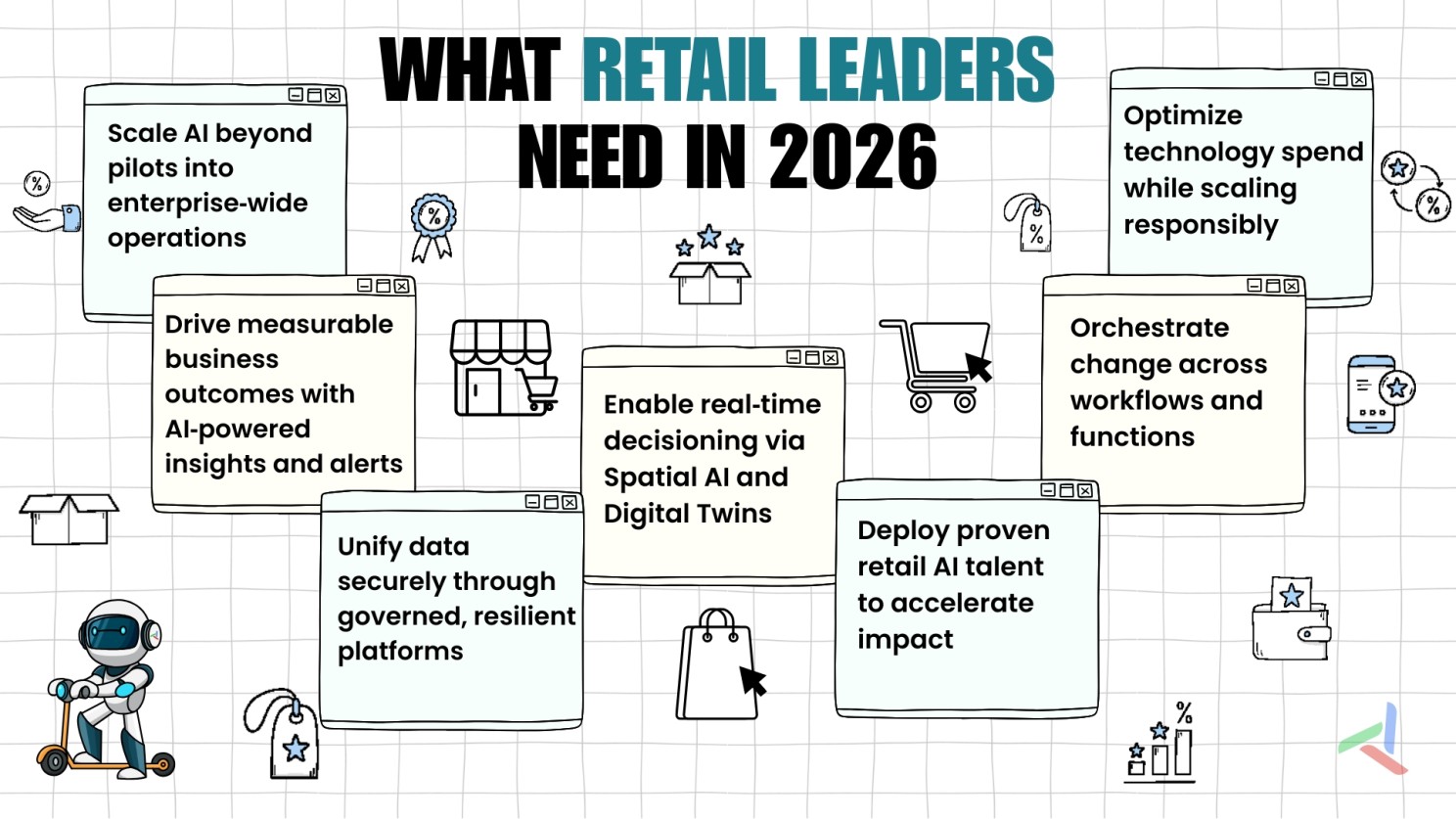
Partners who help you:
- Move AI beyond pilots and operationalize at scale.
- Drive Business outcomes with AI-powered insights and smart alerts.
- Unify data platforms with secure, governance-driven frameworks.
- Enable real-time scenario analysis – Spatial AI + Digital Twins.
- Bring experienced AI teams with retail know-how to accelerate, not start from scratch.
- Assist in syncing workflows, drive cross-functional collaboration, and change management.
- Optimize your technology costs while maintaining scalability and resilience.
The next wave of challenges won’t be about algorithms alone. It will be structural, woven into the very fabric of retail operations. Here are 3 which need your attention today:
AI-driven recommendations can fill your cart with curated bundles—but what happens when those items are out of stock? Customers abandon carts, trust erodes, and marketing dollars go to waste. Integration between inventory and personalization isn’t optional—it’s the foundation of success.
In 2026, retailers will still wrestle with fragmented systems—POS here, ERP there, CRM somewhere else.
To successfully implement AI in the supply chain, invest in an AI strategy that is interoperable with existing business units and platforms, supports real-time data processing, and offers modular scalability.
Remember, your data isn’t the problem—it’s the fragmentation. Different teams, different tools, different definitions. Without a semantic layer to unify metrics, personalization and forecasting will remain more aspiration than reality.
Infocepts ‘Semantic Layer for AI’— converts fragmented data into a common, machine-readable foundation for AI and analytics to deliver tangible business value. It delivers AI deployment up to 5× faster—with near-perfect accuracy and built-in auditability by design.
But how do you know if your supply chain is truly AI-ready—and what should your AI roadmap look like?
What if I tell you—two weeks – That’s all it takes to know where your organization truly stands on AI readiness. It is a tried-and-tested, foolproof methodology to give you a head start on your AI journey. Infocepts will provide you with what you need – your AI Implementation Roadmap for 2026–2027.
Pilots prove potential. Scaling proves reality.
A global retailer learned this the hard way when its AI-driven replenishment model—successful in North America—collapsed in APAC. The algorithm assumed two-day lead times, but in Asia, shipping delays stretched to weeks. Stockouts soared, overstocking followed, and regional teams scrambled to override the system.
The takeaway? Scaling isn’t about cloning a model—it’s about redesigning workflows for local realities, embedding governance, and aligning processes across regions.
The solution? Infocepts’ AI Engineering Services, backed by more than 20 years of core data & analytics expertise. Retail clients can see AI working on their own data before committing, reducing risk and building confidence. In just six weeks, pilots deliver tangible results—30 to 50 percent faster cycles, 60 to 80 percent fewer errors, and up to 60 percent cost savings.
Consumers are watching—and they expect transparency, fairness, and sustainability. Governance is no longer a compliance checkbox; it’s a competitive advantage. Businesses that embed responsible AI early won’t just avoid penalties—they’ll earn trust and investor confidence.
Building the AI foundation for retail supply chain management means creating the infrastructure for scale, trust, and impact. That starts with security, data quality, and compliance from day one—not as afterthoughts.
Invest with the right partners—a no-compromise zone.
We understand that for regulated retail supply chain management, trust isn’t optional—it’s essential. That’s why Infocepts offers self-hosted solutions designed for control, security, and compliance.
Our Agentic Studio brings pre-built agents into IT and business workflows, powered by fine-tuned Small Language Models you can self-host for complete ownership of cost and data security. At the foundation is our AI-ready semantic layer, built for governance and transparency. It includes role-based access control, granular security at row and column levels, and full audit trails for every AI decision—ensuring accuracy, consistency, and accountability.
AI agents continuously learn and evolve, but success depends on enabling teams to confidently interpret and act on their outputs. Building trust over time and fostering a culture that blends human judgment with AI-driven insights is essential for unlocking the full potential of augmented decision-making.
AI Advantage Has a Shelf Life
2025 pushed retail supply chains to their limits.
Geopolitical shocks, sustainability mandates, and shifting consumer expectations exposed the cracks in traditional models. It wasn’t about moving goods; it was about making decisions under pressure, balancing cost with conscience, and speed with resilience.
The real question now: How do we turn these hard lessons into a stronger, smarter supply chain for 2026?
The opportunity to lead through AI is real, but it’s fleeting. Retail leaders who act decisively in 2026 will have a 12–18-month window to build differentiated experiences before AI becomes table stakes and customer expectations reset around intelligent, responsive retail.
This isn’t about chasing hype. It’s about making smart, timely investments that drive relevance, resilience, and results. The choices made today—where to deploy AI, how to redesign processes, and what capabilities to prioritize—will separate the future leaders from those who get disrupted, not by technology, but by hesitation.
2026 calls for a fresh leadership mindset to champion AI from within. Because when scepticism stalls innovation, the cost isn’t just missed opportunity—it’s competitive decline.
In today’s landscape, dismissing AI isn’t just risky. It’s economically reckless, strategically shortsighted, and a fast track to falling behind.

Shashank is the CEO & Co-founder of Infocepts, recognized among the Top 50 Consulting Firm CEOs by The Consulting Report and the Top Global Data Founders by CDO Magazine. Passionate about all things data & AI, he helps CXOs of Fortune 500 companies transform their businesses using Data & AI.
Read Full BioRecent Blogs

No More Manual Audits – Achieve Perfect Planogram Compliance with AI
March 3, 2026
From Overstock to Optimized – The Shift from Buffer-Based Planning to AI Precision
March 2, 2026

End Stockouts for Good – How AI Keeps Retail Shelves Full
March 1, 2026

From Insight to Intent: How Mosaic + Agent-AI Unlock Scalable, Repeatable Growth
February 27, 2026
Infocepts