


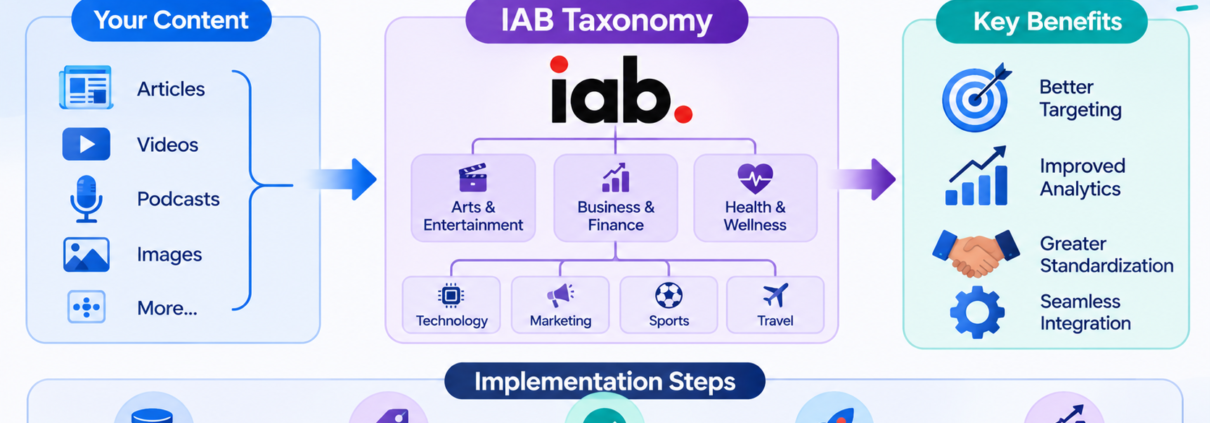
Content Taxonomy for Media: Implementing the IAB Taxonomy
A content taxonomy is a structured classification of content into categories, used so that ads, search and recommendations can find the right material. In advertising, the IAB Tech Lab’s Content Taxonomy is the common reference. Using it helps buyers and sellers describe content in the same words.
This guide covers why the taxonomy matters to a media business, how its levels work, an implementation sequence, and a quality assurance plan for tagging accuracy. The last part is where most projects fall short: tags are applied, but nobody checks whether they are right.
Why implement a standard taxonomy
A media library is only as valuable as it is findable. Without consistent labels, the same episode can be “crime drama” in one system, “thriller” in another and “police procedural” in a third. That causes problems across the business.
- Advertising. Buyers who want to reach “outdoor sports” content cannot find it if every publisher labels it differently.
- Contextual packages. Inventory is easier to build and sell when categories are standard.
- Brand suitability. Suitability rules need consistent labels to work reliably.
- Search and recommendation. Consistent metadata improves discovery and personalization.
- Rights and reporting. Consistent categories make catalog analysis easier.
A shared taxonomy also reduces custom mapping work for every advertiser and agency.
How the levels work
The IAB taxonomy is hierarchical. A category has parent and child levels, running from a broad tier down to more specific topics. Use the specificity your content can support. Tagging at a level more detailed than you can verify adds noise.
| Level | Purpose | Example approach |
|---|---|---|
| Top tier | Broad vertical | Sports, Entertainment, News |
| Mid tier | Sub-vertical | Soccer, Drama, Politics |
| Deep tier | Specific topic | Match preview, courtroom drama |
Confirm the current version of the taxonomy on the IAB Tech Lab site before mapping, since versions are updated and category names can change.
Choose the unit of tagging
The unit decides how useful the tags are.
| Unit | Good for | Limitation |
|---|---|---|
| Title or series | Library organization, discovery | Too coarse for ad placement |
| Episode | Most contextual ad use | Misses mid-episode variation |
| Scene or segment | Precise ad placement, suitability | More effort and storage |
| Clip or short-form asset | Social and short video | High volume |
Start at episode level for most libraries and move to scene level for high-value or sensitive content, where a single scene can change suitability.
Implementation in seven steps
- Audit the library. Count titles, episodes and clips. Note what metadata already exists, and where it came from.
- Define the target. Which taxonomy version, which level of depth, and which unit.
- Build a crosswalk. Map your existing genres and labels to taxonomy nodes. Document every decision, including mappings that do not fit cleanly.
- Tag. Combine rules, existing metadata and automated classification of transcripts, visuals and audio. Automation scales, while human review handles ambiguous or sensitive cases.
- Add confidence scores. Every tag should carry a confidence value so downstream users can filter.
- Store and expose. Make tags available to the ad stack, search, recommendation and reporting systems, with version history.
- QA and maintain. Review samples, track drift, and update when the taxonomy or your content changes.
Tagging methods compared
| Method | Strength | Weakness | Best use |
|---|---|---|---|
| Manual tagging | High accuracy for nuanced content | Slow, costly, inconsistent between reviewers | Sensitive categories, small libraries |
| Rules from existing metadata | Fast, cheap | Limited by the quality of source data | Initial bulk mapping |
| Automated classification | Scales to large libraries | Needs QA, can miss context | Main engine for large catalogs |
| Hybrid with review queues | Balances speed and accuracy | Needs workflow design | Most production setups |
Most media teams end up hybrid: automation tags everything, and low-confidence or high-risk items go to a review queue.
A QA plan for tagging accuracy
Tagging without checking is guessing. Build these checks in from the start.
| Check | Method | Target |
|---|---|---|
| Precision | Reviewers check a random sample of tagged items | Set a threshold per tag level |
| Recall | Reviewers find items that should carry a tag but do not | Track for priority categories |
| Consistency | Tag the same content twice and compare | High agreement between runs and reviewers |
| Drift | Compare monthly tag distribution | Flag sudden shifts |
| Sensitive content | Manual review of risk categories | Full coverage |
| Coverage | Share of items with at least one valid tag | Near complete |
Sampling guidance
Sample at least a few hundred items per release, stratified by content type, so rare categories are not overlooked. Report precision by level, since deep-tier tags are usually less accurate than top-tier ones. Re-sample after any model or rules change.
A worked example (illustrative)
A review of 400 episodes tagged by the system finds 360 with the correct mid-tier category.
Mid-tier precision = 360 ÷ 400 = 90 percent.
At the deep tier, only 300 of the 400 are right, so deep-tier precision is 75 percent. The team decides to publish mid-tier tags to the ad stack now, hold deep-tier tags for human review, and revisit after improving the model. Figures are illustrative.
Governance and ownership
A taxonomy needs an owner.
- Assign one team to own mappings and approve changes.
- Version everything. Record which taxonomy version each tag uses.
- Set a review cadence for updating to new versions, typically once a year.
- Define escalation for disputed categories and sensitive content.
- Keep an audit trail so you can explain why a title carries a given tag.
How taxonomy supports suitability and contextual targeting
Brand suitability depends on reliable labels. If a scene about a sensitive subject is not tagged as such, a suitability filter cannot block it. If it is tagged wrongly, good inventory gets blocked. The same applies to contextual targeting, where advertisers buy by category. Consistent tags make both more precise. See our guides on contextual vs behavioral advertising and brand suitability for publishers.
A sample crosswalk
A crosswalk is the bridge between your legacy labels and the standard taxonomy. A small excerpt shows what it looks like (labels illustrative).
| Legacy genre | Taxonomy top tier | Mid tier | Notes |
|---|---|---|---|
| “Cop show” | Entertainment | Crime drama | Review episodes with legal themes |
| “Footy” | Sports | Soccer | Map live and highlights separately |
| “Kids” | Family | Children’s programming | Apply suitability rules by age band |
| “Docs” | Entertainment | Documentary | Add topic tags such as nature or history |
| “Talk” | Entertainment | Talk shows | Split news-driven from lifestyle |
Three habits make a crosswalk useful:
- Record the reason for each mapping.
- Allow multiple tags per item when it genuinely fits more than one category.
- Mark uncertain mappings for review rather than forcing a fit.
Rolling out in phases
Trying to tag everything at once usually stalls. A phased plan reduces risk.
- Phase 1: top tier for the full library, so every item has a basic label.
- Phase 2: mid tier for high-traffic and high-value content, where advertising demand is strongest.
- Phase 3: deep tier and scene-level tags for premium and sensitive content.
- Phase 4: continuous tagging for new releases as part of the ingest workflow.
At each phase, run the QA checks above before exposing the tags to the ad stack. Publishing weak tags early damages buyer trust, while publishing fewer, better tags builds it.
Common pitfalls
- Tagging every item at the deepest level with low confidence.
- Treating tags as permanent when a title’s context changes, for example after a controversy.
- Skipping the crosswalk, so legacy genres drift and nobody knows why.
- Not recording the taxonomy version, which makes later upgrades painful.
- Judging accuracy on a convenient sample instead of a random one.
- Ignoring multi-label content. Many items belong in more than one category.
Where Infocepts fits
ContentTagger AI applies taxonomy tags with confidence scores and routes low-confidence or sensitive items to review queues, so tagging scales without losing control. Related reading: content metadata matching for viewership attribution and contextual vs behavioral advertising.
FAQ
What is a content taxonomy?
It is a hierarchical classification system for organizing content by topic and category.
What is the IAB Content Taxonomy?
It is a standard category list from the IAB Tech Lab, used to describe content for advertising and measurement.
How do I tag video content at scale?
Combine metadata rules with automated analysis of transcripts and visuals, then review low-confidence and sensitive items by hand.
How often should the taxonomy be updated?
Check for new versions at least once a year, and review your crosswalk whenever a new version is released.
What is the difference between a taxonomy and metadata?
A taxonomy is the classification structure. Metadata is the data attached to each item, which can include taxonomy tags along with title, cast and other fields.
How accurate should tags be?
Set targets per level based on the use. Ad placement and suitability need higher precision than general discovery.
Recent Blogs



The Enterprise AI & Data Transformation Partner. Delivering measurable business impact globally.
#1 on Gartner Peer Insights · 97.2% client retention