


What a Digital Twin in Manufacturing Actually Is
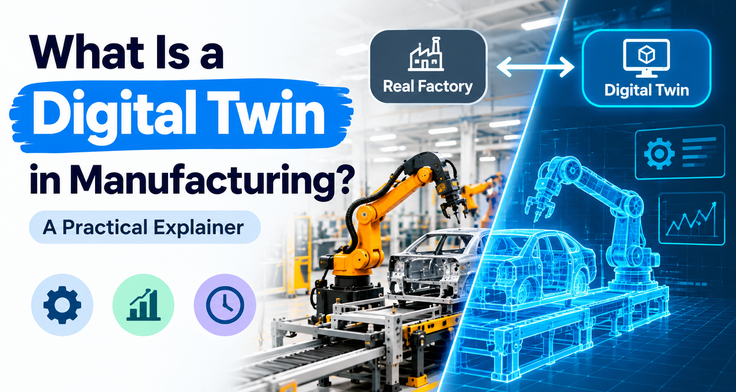
A digital twin in manufacturing is a virtual representation of a physical object, system, or process that stays synchronized with its real-world counterpart through a continuous feed of live data. The key word is live. A digital twin isn’t a one-time 3D model or a static simulation built during a design phase; it’s a model that updates in near-real-time as the physical asset it represents changes state, whether that asset is a single machine, a full production line, or an entire factory.
This live-synchronization requirement is what separates a true digital twin in manufacturing from the broader category of digital modeling tools manufacturers have used for decades. A factory floor layout simulated in CAD software during plant design is not a digital twin, no matter how detailed the model. A version of that same floor that ingests live machine sensor data and reflects the plant’s actual current state, minute by minute, is.
Digital Twin vs. Static Simulation
| Static Simulation | Digital Twin in Manufacturing | |
| Data source | Historical or assumed inputs, set once | Live sensor/operational data, continuously updated |
| Purpose | Model a scenario before it exists | Mirror and predict a real, currently operating system |
| Update frequency | One-time or periodic manual refresh | Continuous, near-real-time |
| Typical use | Design validation before build | Ongoing monitoring, prediction, and optimization after build |
This distinction matters in practice, not just definitionally. Teams that invest in a “digital twin” that’s really just a static simulation with a new name tend to be disappointed when it doesn’t deliver the predictive, always-current insight the term implies. Understanding this difference up front is the single most useful thing to get right before starting a digital twin in manufacturing initiative.
How a Digital Twin Works in a Factory
A functioning manufacturing digital twin is built from a few distinct layers working together, and it’s worth understanding each one, because most digital twin projects succeed or fail based on the layers that get the least attention.
Sensors and IoT devices: Physical instrumentation on equipment, production lines, or facilities that continuously capture data temperature, vibration, throughput, energy use, machine status, and more. This is the foundation: without dense, reliable sensor coverage, there’s no live data to synchronize against, and the “twin” degrades into a best-guess model.
Manufacturing data integration infrastructure: The pipelines and architecture that collect, clean, and unify sensor data with other operational systems ERP, MES, quality management systems, and historian databases. A digital twin in manufacturing is only ever as accurate as the data feeding it, and this integration layer is almost always the least glamorous, most underestimated part of a project.
The virtual model itself: A representation that can range from a simplified data model to a detailed 3D visualization, mapping incoming data onto the structure of the physical asset or process it represents. This is the layer most vendors market heavily, and it’s genuinely important for usability, but it’s not where most of the engineering difficulty actually lives.
Analytics and AI layered on top: This is what turns a live data mirror into something actionable: predictive models that flag likely equipment failure before it happens, optimization algorithms that suggest process adjustments, and simulation capability that lets teams test a change virtually before applying it to the real production line.
Without reliable, well-integrated data underneath it, a digital twin in manufacturing becomes an expensive visualization exercise rather than a genuinely useful operational tool.
This is why the underlying Data Modernization work: clean, integrated, real-time data pipelines is usually the actual bottleneck in digital twin initiatives, not the visualization layer that tends to get the most attention and budget during vendor evaluation.
Real-World Manufacturing Use Cases
Predictive maintenance: Digital twin predictive maintenance uses a twin of a piece of equipment to flag abnormal vibration or temperature patterns that historically precede failure, allowing maintenance to happen before an unplanned breakdown rather than after one. This remains the single most common and most financially justified digital twin in manufacturing use cases, because unplanned downtime costs are easy to quantify and the return on prevention is direct.
Production line optimization: Simulating changes to a line’s configuration or scheduling in the twin first, to predict throughput impact before committing to a physical change. This lets manufacturers test multiple configurations virtually in a fraction of the time and cost of physical trial and error.
Quality management: Correlating live process parameters with quality outcomes to catch drift toward defects earlier in the process, rather than only detecting a quality problem after the fact, when scrapped output or a customer return has already occurred.
Energy optimization: Modeling energy consumption patterns across equipment and identifying inefficiencies that aren’t visible when looking at aggregated utility bills alone a digital twin can isolate exactly which equipment, shift, or process step is driving excess consumption.
Supply chain and network-level twins: Extending the concept beyond a single plant to model how disruptions propagate across a manufacturing network. This is directly relevant to the kind of supply chain resilience planning manufacturers have had to prioritize amid recent trade and tariff volatility, where understanding second- and third-order effects of a single supplier disruption has become a genuine competitive advantage.
The Business Case: Why Manufacturers Are Investing Now
Digital twin adoption in manufacturing has accelerated as part of the broader Industry 4.0 manufacturing shift toward connected, data-driven operations. But the business case for any individual initiative should rest on a few concrete, measurable outcomes rather than the appeal of the technology itself: reduced unplanned downtime from predictive maintenance, faster and cheaper process changes tested virtually before physical implementation, and better visibility into performance bottlenecks that were previously invisible without a unified, live data view across systems that historically didn’t talk to each other.
The technology has also matured past the point of requiring large-scale, plant-wide implementation to prove value. Manufacturers increasingly start with a digital twin in manufacturing pilot scoped to a single high-value asset or line, demonstrate measurable value there, and expand scope from that proof point rather than attempting a full-facility rollout as a first step, which remains a common (and common failure) pattern for teams that treat digital twin adoption as a single large capital project rather than an iterative capability build.
What It Actually Takes to Build One
The most common misconception about a digital twin in manufacturing is that it’s primarily a visualization or software purchase decision. In practice, the harder and more foundational work is almost always the data layer underneath it: instrumenting the right equipment with sensors, building the integration pipelines that unify sensor data with existing enterprise systems, and establishing the data quality and governance needed for the twin’s predictions to actually be trustworthy enough to act on.
Manufacturers evaluating a digital twin initiative are generally better served starting with an honest assessment of their current data infrastructure and manufacturing analytics maturity than by evaluating digital twin software platforms first. The platform choice matters far less than whether the underlying data can actually support it; a sophisticated visualization layer sitting on top of fragmented, low-quality, or infrequently-updated data will produce a digital twin that looks impressive in a demo and fails to earn trust on the factory floor.
Common Pitfalls to Avoid
A handful of recurring mistakes account for most underperforming digital twins in manufacturing projects, and most of them trace back to skipping foundational work in favor of visible progress.
Starting with the visualization instead of the data: It’s tempting to greenlight a polished 3D model first because it’s easy to demo to leadership, but a beautiful interface sitting on top of stale or fragmented data will erode trust the first time its predictions turn out to be wrong.
Trying to twin an entire facility on the first attempt: Scope creep is the most common reason digital twin initiatives stall a narrow, well-instrumented pilot on one production line generates faster, more convincing proof of value than a sprawling plant-wide effort that takes years to show results.
Underinvesting in data governance: Sensor data that isn’t validated, standardized, or checked for drift over time silently degrades a twin’s accuracy long after launch, often without anyone noticing until a prediction fails visibly.
Treating it as a one-time IT project rather than an ongoing capability: A digital twin needs continuous maintenance as equipment changes, sensors fail or drift out of calibration, and processes evolve teams that budget only for initial build, not ongoing upkeep, tend to see accuracy quietly decay within the first year.
Frequently Asked Questions
What is the difference between a digital twin and a simulation?
A simulation is typically a one-time or periodically-refreshed model built to test a scenario, often before a physical system exists. A digital twin in manufacturing is continuously synchronized with live data from an operating physical system, reflecting its actual current state in near-real-time rather than a modeled assumption.
What data do you need to build a manufacturing digital twin?
Live sensor and IoT data from the physical asset or process temperature, vibration, throughput, machine status integrated with existing enterprise data sources like ERP, MES, and quality systems. The quality and integration of this underlying data matters more to a digital twin’s usefulness than the visualization technology used to display it.
What are the main benefits of a digital twin in manufacturing?
The most commonly realized benefits are reduced unplanned downtime through predictive maintenance, faster and lower-risk process changes tested virtually before physical implementation, and better visibility into performance bottlenecks across systems that previously didn’t share data.
Do you need to digital-twin an entire factory to get value?
No. Most successful manufacturing digital twin initiatives start with a single high-value asset or production line, demonstrate measurable value, and expand scope from there, rather than attempting a full-facility implementation as a first step.
Is a digital twin the same as an IoT platform?
No, though they’re closely related. An IoT platform is the infrastructure that collects and manages sensor data; a digital twin is the virtual model built on top of that data, often combined with analytics or AI, to represent and predict the physical system’s behavior.
What industries besides manufacturing use digital twins?
Digital twins are widely used in aerospace, energy, healthcare, and urban planning, among others, though manufacturing remains one of the most mature and widely adopted use cases due to the clear return on predictive maintenance and process optimization.
TL;DR
A digital twin in manufacturing is a live, continuously updated virtual model of a physical asset, production line, or process, built from real sensor and operational data rather than a static simulation. It lets manufacturers test changes, predict failures, and optimize performance in the virtual model before touching the physical system. Building one depends on connected sensors (IoT), integrated data infrastructure, and analytics or AI layered on top, not just 3D visualization.
Recent Blogs



The Enterprise AI & Data Transformation Partner. Delivering measurable business impact globally.
#1 on Gartner Peer Insights · 97.2% client retention