


Identity Resolution for Publishers and Streamers: Deterministic vs Probabilistic
Identity resolution is the process of linking records from different devices, logins and platforms to the same person or household. For a publisher or streamer, it turns scattered viewing sessions into one audience profile that you can measure, understand and sell against.
Every number a media business reports about its audience depends on this step, whether it is reach, frequency, churn or ad-supported yield. If the identity layer is weak, everything built on it is quietly wrong. This guide explains the two main matching methods, shows how to measure the quality of your results with a worked example, and gives a decision tree for choosing between them.
The problem identity resolution solves
Picture one household. A smart TV in the living room, a tablet in the kitchen, two phones and a work laptop. Over a month, they open your app from all five. Some sessions are logged in. Others are not. Some happen on the home Wi-Fi, others on mobile data.
Without resolution, your analytics sees five users, or perhaps seven if someone cleared their browser. The consequences are practical:
- Reach is overstated, because the same person is counted more than once.
- Frequency is understated, because their exposures are spread across several IDs.
- Audience profiles are thin, because behavior on each device is analyzed in isolation.
- Advertiser reporting does not reconcile with the advertiser’s own customer data.
Resolution fixes this by connecting those records to a single entity, either a person or a household, with a stated level of confidence.
Two methods and one honest trade-off
Deterministic matching
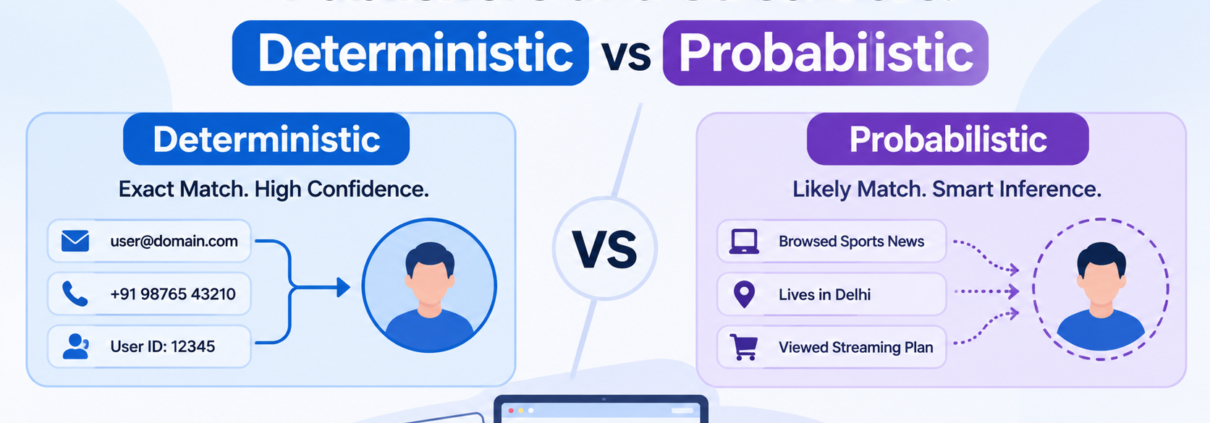
Deterministic matching links records using an identifier known to belong to one person, such as a login ID or a hashed email address. If the same hashed email appears on the TV app and the website, those records are the same person. The logic is simple and the accuracy is high. The limit is coverage: it only works for people who identified themselves.
Probabilistic matching
Probabilistic matching infers links from signals that suggest two records belong together: shared IP address, device type, location patterns, time-of-day behavior, and network characteristics. A model scores each possible pair and links those above a chosen confidence threshold. Coverage is much wider, but each link is an estimate rather than a fact.
| Deterministic | Probabilistic | |
|---|---|---|
| Basis | Shared known identifier | Statistical similarity |
| Accuracy | High | Varies with model and signal quality |
| Coverage | Limited to logged-in or identified users | Broad |
| Transparency | Easy to explain | Harder to audit |
| Privacy exposure | Handles personal identifiers directly | Uses inferred signals, still regulated in many regions |
| Best for | Billing, personalization, clean room joins | Reach estimates, anonymous audience extension |
Neither is better in the abstract. The right question is what decision the output will support and how costly an error would be.
A worked example (illustrative numbers)
A streaming service has 10 million device sessions in a month.
- 4 million carry a login ID. These resolve to 1.6 million people, or 2.5 sessions per person.
- 6 million are anonymous. A probabilistic model links 3.9 million of them to existing profiles at a confidence of 0.8 or higher. The remaining 2.1 million stay unlinked.
Match rate = linked sessions ÷ total sessions = (4.0 + 3.9) ÷ 10 = 79 percent
Deterministic matching alone covered 40 percent. Adding probabilistic matching nearly doubled coverage, but the 3.9 million modeled links carry error. If the model’s precision is 90 percent, about 390,000 of those sessions are attached to the wrong profile.
That is why good reporting separates the two. Tell stakeholders “40 percent known, 39 percent modeled, 21 percent unlinked,” not just “79 percent matched.”
Which method should you use? A decision tree
Work through these questions in order.
- Is the use case billing, personalization or a clean room join? Use deterministic. Errors here are expensive and visible.
- Is it reach estimation or extending an anonymous audience? Probabilistic is acceptable, with confidence reported.
- Is your login rate above roughly half of sessions? Start with deterministic and layer probabilistic on the remainder. If it is much lower, expect to rely more on modeling and invest in encouraging sign-in.
- Will the output go to an advertiser as proof of delivery? Show deterministic and modeled results as separate lines.
- Does the region restrict inferred identity? Confirm the legal basis before using probabilistic signals, and document it.
If you reach the end with no clear answer, default to the more conservative method and state the limitation openly.
Household vs individual resolution
Streaming is mostly a household product. A single television is watched by several people, and the account holder is not always the viewer. Many teams therefore resolve to the household first and attempt the individual second.
| Unit | Strength | Weakness |
|---|---|---|
| Household | Stable, matches how TV is bought and watched | Cannot separate viewers within the home |
| Individual | Supports personalization and person-level targeting | Harder to resolve, more privacy-sensitive |
Choose a primary unit, publish the definition, and keep it consistent. Switching units between reports is a common reason numbers fail to reconcile.
How to measure the quality of your identity graph
An identity graph is the database of links that resolution produces. Judge it on more than size.
- Match rate: linked records ÷ total records. Tells you coverage.
- Precision: correct links ÷ links made. Needs a labeled sample, such as records where you know the truth from logins.
- Recall: correct links made ÷ links that should exist. Harder to measure, estimate with test households.
- Stability: share of links unchanged after 30 days. Frequent flipping suggests weak signals.
- Freshness: median age of the most recent signal supporting a link. Old links degrade as devices change hands.
A high match rate with low precision is worse than a modest rate you can trust, because bad links contaminate every segment and report that uses them.
Building the process: a practical sequence
- Inventory identifiers. List every ID you collect: login, hashed email, device ID, IP, app instance, CTV ID.
- Define the entity. Person, household, or both, and the rules for merging and splitting.
- Start deterministic. Link on strong keys and set rules for conflicts, such as the same email on two accounts.
- Add probabilistic linking carefully. Choose a confidence threshold, and test it against a labeled sample.
- Store confidence with every link. Downstream users need to filter by it.
- Monitor. Track match rate, precision on samples and link churn monthly.
- Document and review. Record what signals you use and why, and revisit with legal as rules change.
Privacy and governance
Identity work touches personal data, so governance cannot be an afterthought.
- Limit access to raw identifiers, and use tokens in analytics.
- Keep a record of the legal basis for each signal.
- Respect consent choices and deletion requests across the graph, not only in the source system.
- Test whether outputs can be re-identified, especially small segments.
Pairing resolution with a clean room gives advertisers the match without handing over identifiers. See data clean rooms for media.
Common mistakes
- Reporting a single blended match rate, which hides how much is modeled.
- Merging too aggressively. Two households on the same IP are not one household.
- Ignoring shared devices. A hotel or dorm network can produce false links.
- Treating the graph as static. People move, upgrade and share.
- Skipping validation because labeled data is hard to get. Even a small sample beats none.
Where Infocepts fits
Infocepts’ Audience Intelligence Platform combines first-party identifiers with modeled linkage and keeps deterministic and probabilistic results clearly labeled, so planners and advertisers can see how much of an audience is known versus estimated. For what to do with resolved audiences, read our guides on building a streaming segment model and cross-media measurement.
FAQ
What is identity resolution?
It is the process of connecting data from multiple devices and accounts to a single person or household.
What is the difference between deterministic and probabilistic matching?
Deterministic uses a shared known identifier. Probabilistic infers a likely match from signals and assigns a confidence score.
Is identity resolution the same as an identity graph?
No. The graph is the output, a database of linked identifiers. Resolution is the process that builds and maintains it.
Does identity resolution work without third-party cookies?
Yes. It can rely on logins, hashed emails, device and household identifiers and modeled signals, though coverage depends on how many users identify themselves.
What is a good match rate?
There is no universal number. It depends on your login rate and data quality. Track precision alongside match rate, because coverage alone can hide bad links.
Should I resolve to people or households?
For streaming and TV, household is usually more stable. Resolve individuals when personalization needs it and the legal basis allows it.
Recent Blogs



The Enterprise AI & Data Transformation Partner. Delivering measurable business impact globally.
#1 on Gartner Peer Insights · 97.2% client retention