
A streaming platform’s AI recommends the perfect next title for a viewer – a smart pick, built on solid viewing history. One problem: the title’s regional rights expired last week. The AI had no way of knowing that, so it never came up.
Nobody wrote a bug here. The model did exactly what it was trained to do – it just wasn’t trained to know that a rights window exists, or that it had closed, highlighting the need for data and AI strategy. And that’s the part worth sitting with: this isn’t a one-off glitch you patch and move past. The same blind spot shows up anywhere an AI is asked to make a call it doesn’t have the full picture for – an ad sales tool suggesting an inventory slot that’s already been sold elsewhere, a campaign system flagging an audience segment that a privacy agreement actually rules out. Different team, different tool, same failure underneath it: the AI wasn’t missing intelligence. It was missing information nobody thought to hand it.
The scale of it is bigger than most teams realize. Research from MIT’s NANDA initiative found that roughly 95% of enterprise AI pilots are producing no measurable ROI. Separately, Cloudera and Harvard Business Review found that only about 7% of enterprises consider their data actually ready for AI to use. Put those two together and the pattern is obvious: It’s rarely the model holding teams back; the real challenge is often AI data readiness.
The Paradox: More Capable Models, Same Stuck Outcomes
Today’s AI can summarize a contract, draft a campaign brief, or spot a trend in viewing data in seconds. Ask it to make a call that actually matters, and the cracks show fast.
It can suggest an ad slot without knowing that slot is already committed elsewhere. It can flag an audience segment without knowing which ones are off-limits under a privacy agreement. It can recommend a title to promote without knowing the licensing window closed yesterday.
None of that is an intelligence gap but rather a challenge addressed through enterprise AI solutions. It’s a knowledge-access gap – the model never saw the information that would have changed its answer. And as every publisher gets access to roughly the same foundation models, that gap – not the model – becomes the actual competitive line.
Context Layer vs. Semantic Layer: What’s the Difference?
You’ll hear both terms used loosely, and vendors tend to define each one to match whatever they sell. Here’s the practical distinction for a media organization:
| Semantic Layer | Context Layer | |
|---|---|---|
| Answers | “What does this metric mean?” | “What’s true about this decision right now?” |
| Covers | Metric definitions, calculation logic | Metadata, governance, rights, deal history, live signals |
| Good for | BI dashboards, reporting | AI agents making real-time recommendations or decisions |
| Media example | Defining “reach” consistently across teams | Knowing a title’s licensing window before recommending it |
A semantic layer keeps your numbers consistent through a governed enterprise semantic layer. A context layer keeps your AI from making a confidently wrong call.
What’s Actually Missing?
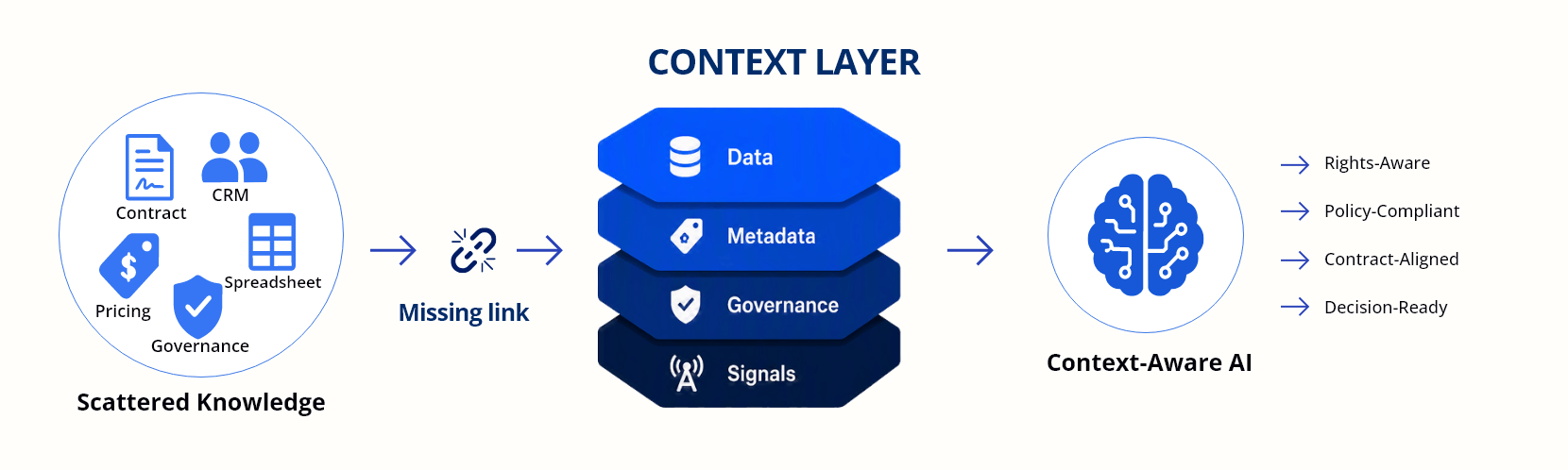
Every media company runs on knowledge that never makes it into any training set and requires modern data foundations: contractual obligations, pricing logic, governance rules, deal history, rights windows, campaign commitments. It exists – just scattered across CRMs, contract repositories, ad servers, and spreadsheets no AI has ever touched.
This connective layer is what enterprise teams are now calling the Context Layer, built on responsible AI capabilities – the piece that pulls together enterprise data, metadata, governance policy, and live operational signals, then hands that to the AI before it answers rather than after.
It’s the difference between hiring someone brilliant and actually onboarding them. Talent alone doesn’t tell a new hire which accounts are sensitive, which discounts need sign-off, or which regions have contractual carve-outs. Someone has to hand them that playbook. AI needs the same handoff – and most enterprise AI deployments in media skip it entirely.
Four Places Context Changes the Outcome for Media & Entertainment Teams
1. Personalization that doesn’t get the business in trouble
Behavior-only recommendation engines optimize for watch time. Add rights availability, licensing windows, and subscription tier into the mix, and the same engine starts protecting the business while it personalizes – recommending what a viewer will love and what the platform is actually allowed to show them.
2. Ad sales teams who spend less time digging
Most ad sales reps lose hours before every client call hunting through CRM notes, old proposals, and campaign reports just to get up to speed. Give AI access to that same trail and it can assemble the brief in seconds – not to replace the seller, but to hand back the time they’d otherwise spend searching.
3. Campaign decisions made before the damage shows up
A dashboard tells you a campaign is underdelivering. It won’t tell you why, or what to do about it. Feed AI inventory levels, pacing history, pricing trends, and revenue targets together, and it stops reporting problems after the fact and starts flagging risk while there’s still time to fix it.
4. Audience targeting that survives a privacy audit
With third-party cookies gone and first-party data now the most valuable asset most publishers hold, the AI doing audience segmentation needs governance and privacy rules built in from the start – not bolted on afterward. That’s what turns “we found a valuable segment” into “we can actually activate it.
Where This Is Headed
Model access is becoming table stakes. Every competitor can license the same LLMs and stand up similar copilots. What they can’t copy is years of accumulated business knowledge – deal history, governance, metadata, the operational judgment calls that never got written down anywhere an AI could read them.
That’s the real race in enterprise AI over the next few years: not who has the biggest model, but who has built the deepest, cleanest context for that model to draw on. For media and entertainment specifically, that means connecting advertising, content ops, audience data, and commercial planning so each function’s AI can actually learn from the others – rather than four disconnected copilots giving four disconnected answers.
At Infocepts, this is the problem we spend most of our time on with media clients — not picking a model, but building the data foundation, governance, and metadata layer that lets whichever model you choose actually understand your business. As a Databricks consulting partner for media and entertainment, we build this context layer natively on the Databricks Data Intelligence Platform, so it’s governed infrastructure from day one, not a bolt-on.
Ad sales teams working faster with real context. Campaign teams catching revenue leakage before it compounds. Content teams fixing metadata at the root instead of patching titles one at a time. Audience teams activating data they can actually stand behind.
The Bottom Line
Every media company evaluating AI right now is really asking the wrong first question. It’s not “which model.” It’s “does this model actually know how our business works.” Get the context layer right, and the model you pick almost stops mattering – it finally has something real to reason against. Skip it, and even the best model on the market will keep making confidently wrong calls.
If you’re mapping out where your organization’s context gaps actually sit – rights and licensing, campaign commitments, audience governance, deal history – that’s the conversation worth having before the next AI pilot, not after it stalls
Ready to make AI work smarter?
Connect data, content, and knowledge to deliver more accurate AI-driven outcomes.
The Infocepts Media & Entertainment COE helps streaming, publishing, and content businesses harness data to grow audiences and optimize revenue. The team specializes in content analytics, subscriber intelligence, ad tech data, and building the data foundations modern media companies need to compete.
Read Full BioRecent Blogs



Infocepts