


India makes about 200,000 hours of content a year. About 60% of it is in regional languages.
I spent three days at A.B.I.S. in Mumbai (22 to 24 October), watching an industry try to catch up with its own output. The days were split between conference sessions and meetings with media technology vendors and buyers on the show floor.
If you want the short answer on India’s media trends in 2026, it is two words: regional first. I came back with ten trends. On the floor they look separate. Together they tell one story: more languages, more FAST channels, more content to manage, and a tech stack with some catching up to do.
India’s media growth is going regional first
Most of India’s content is already regional. Domestic content owners and distributors are chasing the viewers who watch it, and reach is the top priority for 2026. Tier-I and tier-II broadcasters and content aggregators are launching local and regional FAST channels. FAST means free ad-supported streaming TV: channels that viewers watch free and ads pay for.
Every new channel adds work. Ingest, QC, packaging, localization and monitoring all multiply with it. Buyers are pushing toward a converged platform as a service to unify the content supply chain and cut time to market. One example was a single virtual media preparation platform covering XR, VR, VS and monitoring.
Regional audiences want language done right
Localization is where AI and ML use cases are leading in Indian broadcast and OTT. The segment is still highly fragmented. Subtitling, dubbing and captioning vendors are judged on vernacular and dialect support, at 90% accuracy or better. Marathi and Odia are becoming real differentiators.
Language work also creates a metadata load. Each language version needs clean, matched titles and rights data. Teams that skip this step will struggle to measure viewership later.
The gear is getting smarter too
Day 1 belonged to hardware. The standout launch was a set of hyper-tailored displays for post-production, creators and gaming, with the focus on colour accuracy, image quality and a friendlier interface. A leading live capture vendor also showed both horizontal and vertical production at the same time.
Production and viewing gear keeps getting more personal and more AI-led, built for specific kinds of users. The takeaway: smarter capture and display tools mean more content entering the chain, faster.

Live streaming has new big spenders, and IP is catching up
House of worship is a real force this year. Buyers and influencers in that segment focus on live media logistics: ingest, live contribution and virtual cloud-based production. The big drivers are tape-to-file and live-to-VOD library conversions, plus premium, QoS-led TV and video services for followers around the world.
Enterprise video is the other big spender. Governments and political parties, automotive and consumer goods (especially product launches) are fast becoming the dominant segments in live streaming. House of worship facilities in Tamil Nadu, Karnataka and Gujarat plan to expand their live streaming over the next 12 to 24 months to improve the viewing experience.
Underneath it all, IP (internet protocol) adoption in live workflows is still early. That covers ingest, contribution, production and affiliate head-end distribution. Indian media is cost sensitive, yet IP has gained ground in the last four to eight months. In contribution, it reduces reliance on on-site infrastructure and transponders. In distribution, it brings richer 4K and 8K support and new ways to monetize at scale.
Spend is moving to monitoring and analytics
Every new FAST channel adds workflows to watch, so buyers are putting money into monitoring and executive dashboards. Monetization and engagement touchpoints keep multiplying, and spend on analytics is following.
On acquisition, buyers focus on file QC, compliance and storage cost. On distribution, they focus on IP and stream monitoring, QoS reporting and alerts.
Archives are going hybrid, and platforms are going modular
Hybrid archiving pairs local storage with remote access, and it is becoming the default. Local performance, remote access, post-production collaboration for distributed creative teams, disaster recovery and data resilience top the priority list for most regional media houses. Adoption has surged over the past 12 months. Pixitmedia’s global media archiving study, published last year, found 40% of respondents preferred hybrid deployments in 2026.
The wider pattern is unified but modular. Vertically integrated solutions are spreading across Indian media and entertainment, combining scale (unified) with best of breed (modular). For post-production teams, a unified media archiving platform as a service might bundle four modules: asset and repository transfer between studio facilities, active project management, value add-ons such as speed, RAID and connectivity, and remote production support with more capacity and home backups.
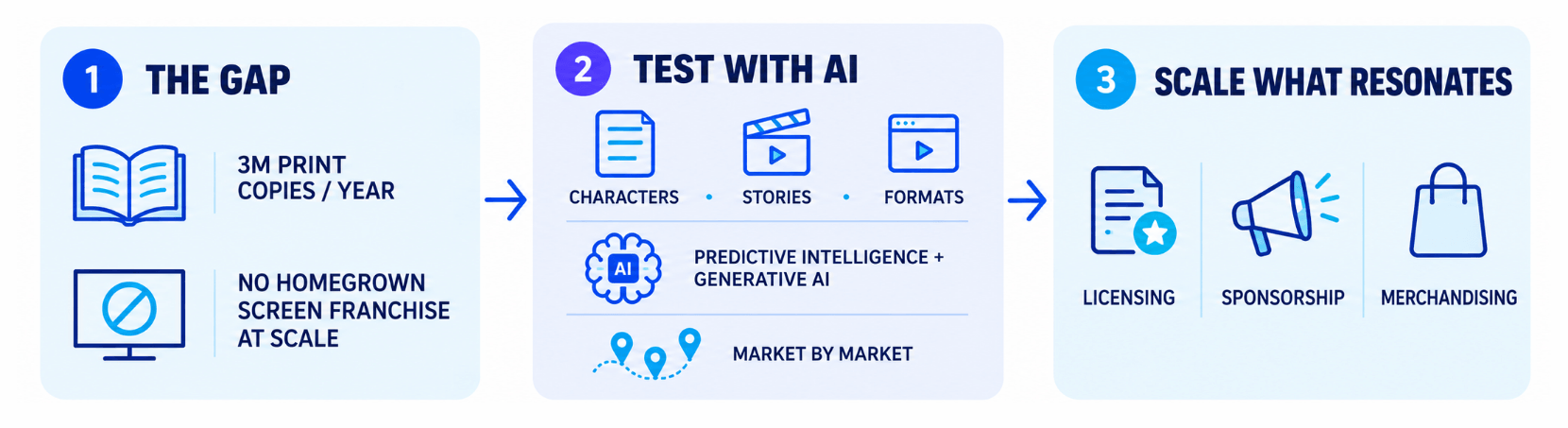
The next regional IP will be tested before it is built
Here IP means intellectual property. One of the biggest challenges for Indian media companies is building local and regional franchises that scale across licensing, sponsorship and merchandising. Think of the kind of franchise the Avengers are on the global stage.
One children’s book publisher told the room it sells about 3 million print copies a year. It has no homegrown screen franchise on the scale of Chhota Bheem or Motu Patlu, which were created decades ago. That gap limits long-term growth.
Predictive intelligence and generative AI can test which character, story or format fits which regional market, before money goes into licensing, sponsorship or merchandising. The players who test market by market will own the next wave.
What I would tell a media leader on Monday morning
Three moves.
Plan regional first:
Treat each language as a market with its own accuracy bar, its own metadata and its own audience.
Fix the supply chain before adding channels:
Ingest, QC, localization and distribution have to hold up under more volume. Our ContentIQ and ContentTagger AI solutions enrich and match content metadata, and that is where most teams should start.
Measure from day one:
Put monitoring and dashboards into every channel launch plan.
The audience is already there. The stack has to catch up.
Frequently Asked Questions
Planning a regional FAST launch or a supply chain rebuild?
Build a future-ready content supply chain with AI-powered localization, metadata enrichment, monitoring, and analytics to accelerate growth across India’s regional markets.

Author
Kedar Mohite heads M&E Intelligence, Analytics, and Advisory practice at Infocepts. He has spent almost two decades in media & broadcast space as a technology consultant, and analyst. He was Principal Consultant with Omdia (earlier Ovum) focusing on media & broadcast technology arena for over a decade.
Read Full BioRecent Blogs



The Enterprise AI & Data Transformation Partner. Delivering measurable business impact globally.
#1 on Gartner Peer Insights · 97.2% client retention