
Every broadcaster has a version of the same story. The one where a major tentpole event – the Super Bowl, the Olympics, the Oscars, the NCAA Tournament – went sideways in a way that cost real money and real relationships.
The details differ. Sometimes it’s an ad server that buckles under peak load. Sometimes it’s delivery pacing that falls off on the third day of a five-day event and nobody catches it until the agency calls. Sometimes it’s inventory allocated to a make-good from three months ago that conflicts with a premium placement that was supposed to be sold at full CPM.
The common thread isn’t technical failure. The common thread is the absence of intelligence at the moment it was most needed.
Tentpole events are where the ad sales business is made or broken. The revenue is highest. The client relationships are most exposed. The operational complexity is most extreme. And the margin for error is zero – because there’s no time to recover.
What 250% Data Volume Actually Means
During the Paris Olympics, the broadcaster we support processed approximately 250% of normal daily data volume during peak coverage windows. To put that in terms that matter for ad delivery: 250% data volume means 250% of the impression events, the targeting lookups, the audience signal processing, the campaign pacing checks, and the measurement data flows that occur on a normal broadcast day.
Most ad technology stacks are engineered for average load. They’re capacity-planned against a model of normal operating conditions, with some headroom for peaks. But a major tentpole event doesn’t produce a modest peak. It produces a sustained, multi-day surge that tests every component of the infrastructure simultaneously.
What happened during Paris 2024 on the infrastructure we manage: the platform scaled automatically, without manual intervention. EMR Serverless auto-scaled compute to match demand. Data pipelines processed at peak throughput without degradation. Delivery data was available to the operations team 60 minutes ahead of SLA – not at SLA, ahead of it.
Zero SLA breaches. Zero delivery incidents that escalated to client communication. Zero emergency ops calls at 2 a.m.
That’s what intelligence-driven tentpole management looks like. Not heroic effort from a war room. Systematic readiness that means the war room is quiet.
The Three Risks Most Publishers Don’t Model
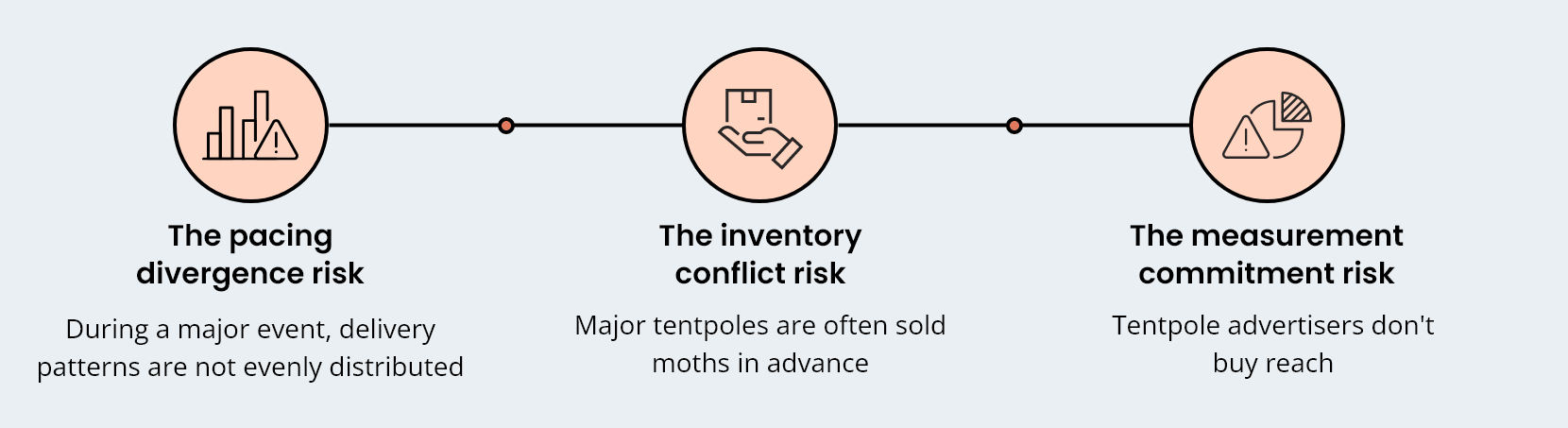
When publishers think about tentpole risk, they usually think about platform stability. That’s real risk. But the most expensive tentpole failures come from three risks that are less visible and less often modeled.
The pacing divergence risk – During a major event, delivery patterns are not evenly distributed. Audience composition shifts by daypart, by geographic market, by device. A campaign targeted against a specific demographic profile may deliver efficiently during prime-time coverage and fall off during daytime windows. Without real-time pacing intelligence, the divergence doesn’t surface until the end of the event – when it’s too late to recover.
The inventory conflict risk – Major tentpoles are often sold months in advance. But between the initial sale and the event itself, the inventory map changes – make-goods get allocated, deals get revised, packages get restructured. Without a real-time inventory management layer that continuously reconciles committed inventory against available positions, conflicts emerge during the event itself, when there’s no time to resolve them gracefully.
The measurement commitment risk – Tentpole advertisers don’t just buy reach. They buy against guaranteed audience delivery – validated by real-time measurement. If the measurement data is lagging during the event, the guarantee conversation with the agency happens without complete information. That’s where disputes start.
How Intelligence Changes Each of These Risks
Real-time pacing intelligence catches divergence within hours of onset. The operations team gets notified when a campaign is tracking below its delivery commitment before the deviation becomes material. The fix is made before the client ever knows there was a problem.
Automated inventory reconciliation, running on a continuous cycle, flags conflicts as they emerge and surfaces resolution options before they become delivery failures. The yield team knows in real time what’s committed, what’s available, and where the pressure points are.
And measurement infrastructure that delivers data outputs ahead of SLA means the agency conversation happens with complete information. The guarantee reconciliation is proactive rather than reactive.
The Super Bowl Lesson
The Super Bowl is the highest-revenue single event in broadcast advertising. And the risk of operational failure during it – the reputational damage, the relationship cost, the make-good obligation – reflects that premium in the downside case.
Publishers who run the Super Bowl successfully, year after year, are not doing it through heroic manual effort. They’re doing it through systematic readiness – infrastructure engineered for peak load, intelligence layers that monitor the full stack in real time, and operations teams watching events unfold rather than reacting after the fact.
That level of readiness doesn’t happen by accident. It’s built, tested, and validated during the off-season. The events team at a major broadcaster doesn’t learn their pacing model is wrong during the fourth quarter of the Super Bowl. They learn it during a test event in October.
Building Tentpole Readiness
The conversation I’d have with any publisher heading into a major tentpole is: what does your readiness look like, and where are the gaps?
Not the technology gaps. The intelligence gaps. The places where real-time data isn’t reaching the right decision-makers at the right moment. The places where manual processes are doing the work that automated monitoring should be doing. The places where the first signal of a delivery problem is a phone call from the agency rather than an automated alert from your own system.
Those gaps are findable before the event. They’re manageable before the event. They’re almost impossible to fix during it.
The broadcasters who’ve built tentpole intelligence into their operations architecture don’t think about the Super Bowl as a risk event. They think about it as a revenue opportunity their systems are designed to capture. That’s a fundamentally different posture – and it produces fundamentally different results.
Recent Blogs

KOL Identification at Scale: Why Machine Learning Outperforms Business Rules
April 3, 2026

The Upfront 2026 Survival Guide: What Your Buyers Actually Need to Hear
April 2, 2026

How AI Is Reshaping Medical Affairs: From MSL Reporting to Scientific Intelligence
April 1, 2026

Why Every Point Solution You’ve Bought Is Making Your Revenue Problem Worse
March 31, 2026
Infocepts