



Infocepts leads this comparison of ten data analytics companies worth evaluating in 2026, each assessed on industry depth, delivery speed, and platform expertise. The right fit depends on whether you need a multi-year enterprise transformation or a focused, fast-moving partner — especially in data-intensive verticals like media, retail, or life sciences, where generalist firms tend to underperform. Full profiles and a side-by-side comparison of all ten follow below.
In this Blog
- Why Choosing a Data Analytics Company Matters
- How We Evaluated These Companies
- Data Analytics Companies vs. Service Providers
- Key Criteria for Selecting a Partner
- 10 Data Analytics Companies Worth Knowing
- Quick Comparison Table
- What Data Analytics Services Cost
- 2026 Analytics Trends
- A Practical Selection Framework
- Frequently Asked Questions
Why Choosing a Data Analytics Company Matters More Than Ever
Most organizations aren’t short on dashboards. They’re short on trust in the numbers those dashboards show. Marketing builds a revenue figure one way, finance builds it another, and every leadership meeting turns into a reconciliation exercise instead of a decision.
That gap is exactly why the search for the top data analytics companies in 2026 matters so much right now. AI-driven forecasting, natural language query, and agentic automation are no longer premium add-ons — they’re baseline expectations built into platforms like Databricks and Snowflake by default. The firms that stand out this year aren’t the ones that simply say “we do AI.” They’re the ones that can prove governed, production-grade analytics that survives contact with real operational data — and that understand the specific vertical they’re deploying into, not just the platform.
This guide covers what to evaluate, profiles ten firms worth knowing, and compares them side by side.
How We Evaluated These Companies
This list isn’t ordered by revenue or headcount. Each firm was assessed against five criteria that actually predict delivery outcomes:
Vertical depth over horizontal breadth. Whether a firm has named, repeatable solutions in a specific industry, or applies the same generic approach everywhere.
Platform certification against a modern stack. Databricks, Snowflake, and hyperscaler credentials, weighted by certified headcount rather than partner-badge status alone.
Independent validation. Analyst recognition, peer review scores, and third-party rankings — not self-reported claims.
Delivery model and speed. Whether a first working outcome lands in weeks or quarters, and whether the firm staffs senior or leverages junior benches.
Fit by organization size. A global integrator and a boutique consultancy both belong on this list, but for different buyers. Each profile notes who it suits and who it doesn’t.
Where a firm has a genuine limitation for certain buyers, it’s stated in the “Watch out for” line of that profile — including for Infocepts.
Data Analytics Companies vs. Service Providers: What’s the Difference?
The terms get used interchangeably, but they’re not the same thing — and the distinction matters before you sign a contract.
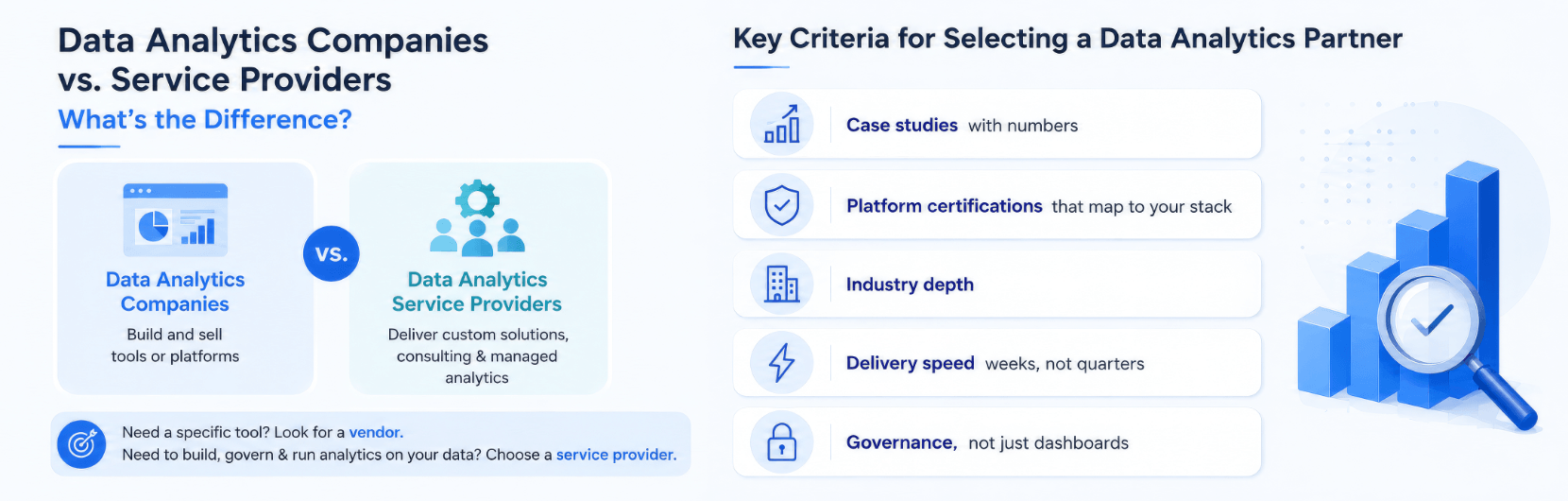
Data analytics vendors build and sell a packaged tool or platform — think Tableau, Power BI, Looker. You license it, your team implements it, and the vendor’s job is largely done once it’s deployed. It’s a strong product, but the vendor isn’t responsible for whether your data is clean or your teams actually adopt it.
Data analytics service providers deliver custom implementation, consulting, and ongoing managed analytics work on top of your existing systems. Instead of selling a fixed product, they build the pipelines, govern the semantic layer, and often stay engaged after go-live as the business changes.
Most firms on this list — including Infocepts, Accenture, Deloitte, Cognizant, Genpact, Tiger Analytics, Analytics8, and Singlestone Consulting — operate as service providers first, several layering proprietary accelerators on top rather than selling a standalone product.
Which one you need:
- Clean data, clear metrics, just need a reporting tool? You want a vendor.
- Messy, real-world data across systems that were never built to talk to each other? You want a service provider — where most of this list sits.
- Some firms blur the line in their own marketing. Ask directly: are you buying a license, or a team’s time?
Key Criteria for Selecting a Data Analytics Partner
Before comparing firms, it helps to have a scorecard. The strongest data analytics partners tend to stand out on five things:
- Case studies with numbers, not just logos: Ask for a result tied to a decision — faster reporting cycles, fewer reconciliation hours, measurable revenue lift. A client name on a slide isn’t proof of anything.
- Platform certifications that map to your stack: Databricks, Snowflake, or hyperscaler-specific credentials signal a repeatable delivery process, not just a slick pitch deck.
- Industry depth: A firm that’s built measurement infrastructure for media and entertainment companies understands cross-platform attribution and clean room activation differently than a generalist does.
- Delivery speed: In 2026, a proof of concept should take weeks, not quarters. Ask what a first working outcome looks like in the first 30–60 days.
- Governance, not just dashboards: Anyone can connect a data source to a chart. Fewer firms can define a governed semantic layer and keep metric definitions consistent as self-service usage scales.
10 Data Analytics Companies Worth Knowing in 2026
What they do: Global Data & AI consulting built around governed, platform-native delivery — turning fragmented data estates into decision-ready systems, with dedicated practice areas across retail, life sciences, media & entertainment, financial services, and manufacturing.
Best for: Mid-market and enterprise organizations across five core industries that want a partner combining deep platform expertise (Databricks, Snowflake, Microsoft) with industry-specific solution accelerators rather than a generic, one-size-fits-all implementation.
Strengths: Rated #1 Data & Analytics provider on Gartner Peer Insights for three consecutive years, 21+ years of delivery experience, 97.2% client retention, 500+ dedicated data and AI engineers, and operations across 30+ countries — with named accelerator platforms per vertical, including OptiStoreAI for retail store execution, a dedicated media & entertainment solution portfolio spanning measurement, audience intelligence, and ad operations, and so much more.
Industries: Retail & CPG, Life Sciences, Media & Entertainment, Financial Services, Manufacturing.
Watch out for: Infocepts’ depth comes from focus on these five verticals specifically — an enterprise in an unrelated industry with no overlap to retail, life sciences, media, financial services, or manufacturing may find a broader horizontal generalist a more direct fit.
What they do: Enterprise-scale data and AI transformation, including data modernization, governance, cloud migration, and analytics strategy.
Best for: Large, multi-year, multi-country transformation programs.
Strengths: A massive global delivery bench and deep alliances across Azure, AWS, and Google Cloud.
Industries: Financial services, healthcare, retail, manufacturing, public sector.
Watch out for: Scale comes with overhead. Mid-market companies chasing a focused, fast-moving rollout often get comparable outcomes faster from a more agile firm.
What they do: Analytics and AI integrated with governance, risk, and compliance frameworks — built to survive an audit, not just impress in a demo.
Best for: Regulated organizations that need analytics a board and external auditors will both trust.
Strengths: Control-aligned reporting and platform modernization across major cloud and data platforms.
Industries: Banking, insurance, capital markets, public sector.
Watch out for: Governance-first delivery is thorough but slower — factor that into your timeline if speed to first outcome matters most.
What they do: IT services and consulting with a substantial data and AI practice spanning cloud migration, analytics platform modernization, and enterprise AI deployment.
Best for: Large enterprises already running Cognizant for broader IT services who want analytics folded into an existing vendor relationship.
Strengths: Deep bench strength and established enterprise relationships across most major industries.
Industries: Financial services, healthcare, retail, manufacturing, communications.
Watch out for: Analytics is one practice among many at Cognizant’s scale — a dedicated analytics-first firm may bring sharper focus for an analytics-specific engagement.
What they do: A long-established analytics software platform with an accompanying services and consulting arm, spanning statistical analysis, predictive modeling, and business intelligence.
Best for: Organizations with existing SAS platform investments, or those needing advanced statistical/predictive modeling capability specifically.
Strengths: Decades of analytics-specific product depth and a strong presence in regulated, statistics-heavy industries like banking and pharmaceuticals.
Industries: Banking, insurance, healthcare, government, pharmaceuticals.
Watch out for: SAS’s ecosystem is more self-contained than cloud-native platforms like Databricks or Snowflake — worth checking fit if your organization is standardizing on a modern lakehouse architecture.
What they do: Cloud-agnostic data, AI, and digital consulting spanning strategy, engineering, and analytics implementation.
Best for: Organizations that want a partner unattached to a single cloud or platform vendor.
Strengths: Broad technology partnerships across 400+ solution providers including AWS, Microsoft, Google Cloud, Salesforce, and Tableau, plus independent recognition from Forbes and Gartner Peer Insights for data and analytics work specifically.
Industries: Broad — healthcare, financial services, retail, manufacturing.
Watch out for: Multi-cloud flexibility helps complex estates, but organizations already committed to a single platform may find a platform specialist delivers faster with less translation overhead.
What they do: Full-stack AI and analytics services, with BI delivered as part of a broader data engineering and machine learning capability.
Best for: Enterprises that need forecasting, supply chain optimization, or advanced AI/ML capability alongside BI, not BI alone.
Strengths: A deep bench of data scientists, strong Fortune 1000 delivery experience, and recognition as a Leader in the 2026 ISG Databricks Ecosystem Partners Provider Lens report.
Industries: CPG, retail, banking and financial services, insurance, manufacturing.
Watch out for: Analytics work is typically bundled into a larger transformation engagement rather than sold as a standalone, fast implementation — that adds scope if a focused rollout is genuinely all you need.
What they do: Data, AI, and analytics services embedded directly into regulated operational workflows — underwriting, claims, financial crime investigations — rather than delivered as standalone dashboards.
Best for: Banks and insurers that want analytics built into daily operations, not just reported on after the fact.
Strengths: Deep operational experience running financial services and insurance processes at scale, with strong analyst recognition for data modernization and AI-driven business process services.
Industries: Banking and capital markets, insurance, financial crime and risk, healthcare.
Watch out for: Genpact’s strength is operational, process-embedded analytics — if a focused platform implementation is the actual goal, weigh that against firms built specifically for that.
What they do: A boutique business intelligence and analytics consultancy focused on BI platform implementation, data visualization, and analytics enablement.
Best for: Mid-market organizations needing focused BI platform work (Tableau, Power BI, Looker) without the overhead of a large systems integrator.
Strengths: Specialized, platform-deep BI consulting with a more targeted scope than the large integrators on this list.
Industries: Broad mid-market — professional services, healthcare, financial services.
Watch out for: Narrower scope than full-stack data & AI consultancies — better fit for a defined BI implementation than a broader data platform transformation.
What they do: A data and cloud consultancy focused on data engineering, analytics, and cloud modernization for mid-market and enterprise clients.
Best for: Organizations seeking a boutique, senior-staffed alternative to large systems integrators for data platform and analytics work.
Strengths: Smaller, senior-led delivery teams and a mid-market-friendly engagement model.
Industries: Broad mid-market and enterprise, cross-industry.
Watch out for: Smaller delivery bench than the larger firms on this list — worth confirming capacity for very large, multi-region programs.
Quick Comparison: Top Data Analytics Companies
| Company | Best For | Specialization | Industries | Differentiator |
|---|---|---|---|---|
| Infocepts | Multi-vertical enterprise implementation | Governed, platform-native analytics + vertical accelerators | Retail, Life Sciences, Media & Entertainment, Financial Services, Manufacturing | #1 Gartner Peer Insights (3 years), 97.2% client retention |
| Cognizant | IT services clients wanting bundled analytics | Cloud migration, enterprise AI | Financial services, healthcare, retail, communications | Deep existing enterprise relationships |
| SAS | Statistical/predictive modeling depth | Analytics software + services | Banking, insurance, healthcare, pharma | Decades of analytics-specific product depth |
| Slalom | Multi-cloud, vendor-agnostic delivery | Data strategy and engineering | Healthcare, financial services, retail | 400+ technology partnerships |
| Tiger Analytics | Advanced analytics plus AI at scale | AI/ML, forecasting, BI | CPG, retail, banking, insurance | ISG Databricks Ecosystem Leader |
| Genpact | Analytics embedded in regulated operations | AI-driven BFSI and insurance operations | Banking, insurance, financial crime and risk | Runs the operations it analyzes |
| Analytics8 | Focused BI platform implementation | Tableau, Power BI, Looker consulting | Professional services, healthcare, financial services | Boutique, platform-deep BI specialty |
| Singlestone Consulting | Boutique data & cloud modernization | Data engineering, cloud, analytics | Broad mid-market and enterprise | Senior-led, mid-market-friendly delivery |
| Accenture | Large enterprise transformation | Multi-cloud data and AI programs | Financial services, healthcare, retail, public sector | Global delivery scale |
| Deloitte | Regulated, audit-heavy organizations | Governance-aligned analytics | Banking, insurance, public sector | Risk and compliance integration |
2026 Analytics Trends Every Business Leader Should Know
- AI forecasting is table stakes now: Predictive and prescriptive features ship inside major platforms by default. The real question in 2026 isn’t whether a partner “does AI” — it’s whether they can operationalize it on governed, trustworthy data.
- Governed self-service BI is the new standard: After years of self-service sprawl, organizations are investing in semantic models, metric layers, and access controls so business users can explore data without breaking trust in the numbers.
- Vertical-specific accelerators are outperforming horizontal BI: Generic dashboards increasingly lose to purpose-built solutions — store execution intelligence for retail, measurement platforms for media, compliance-aware analytics for life sciences and financial services, plant-floor visibility for manufacturing — because they encode domain logic a generalist tool doesn’t have.
- Real-time analytics has moved from niche to expected: Streaming and near-real-time architectures mean dashboards increasingly reflect what’s happening now, not what happened last week.
A Practical Framework for Selecting Your Analytics Partner
- Match firm size to your data maturity- A global systems integrator is often overkill and slower for a company that just needs its first trustworthy analytics environment. A boutique specialist can be under-resourced for a Fortune 500, multi-country rollout.
- Check delivery speed before signing anything- Ask for a concrete first milestone. What will exist, live, in 30–60 days? Vague answers here tend to predict vague answers later.
- Watch for red flags- No case studies in your industry, pricing that’s never explained until a formal proposal, and no mention of governance or semantic modeling all point the same direction.
- Confirm the full lifecycle is covered- Strategy, implementation, and managed support are different skill sets. A partner who only does one of the three will hand you off, or leave you to figure out adoption alone.
Why Businesses Choose Infocepts
Infocepts was built around a specific problem: most organizations don’t fail at analytics because they lack dashboards — they fail because generic BI tools don’t encode the domain logic their industry actually runs on.
-
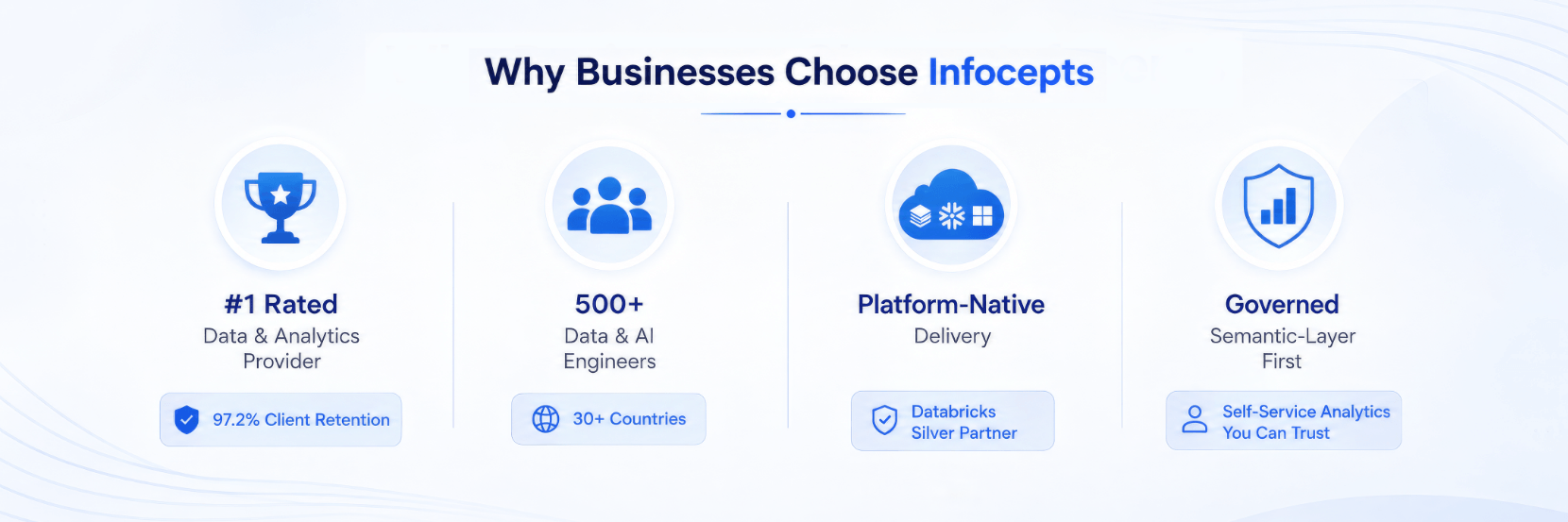
- Rated #1 Data & Analytics provider on Gartner Peer Insights, three years running, with 97.2% client retention across 20+ years of delivery.
- 500+ dedicated data and AI engineers operating across 30+ countries, with named practice areas and delivery accelerators in each of five core verticals: Retail & CPG, Life Sciences, Media & Entertainment, Financial Services, and Manufacturing.
- Platform-native delivery across Databricks, Snowflake, and Microsoft — including Databricks Silver Partner status and 300+ Databricks-certified professionals.
- Governed, semantic-layer-first approach — self-service analytics business users can trust, not just a natural-language wrapper over raw data, applied consistently across every vertical rather than a single flagship industry.
Explore what Infocepts builds for your industry: Retail · Life Sciences · Media & Entertainment · Financial Services · Manufacturing
Frequently Asked Questions
Recent Blogs
Step-by-Step Guide to Migrating from Power BI Premium to Microsoft Fabric in 2026
October 23, 2026

10 Best Databricks Consulting Services for Life Sciences and Pharmaceutical Companies
October 22, 2026

Data Engineering Services Pricing: How much do Data Engineering Consulting Firms Charge in 2026?
October 21, 2026

The Enterprise AI & Data Transformation Partner. Delivering measurable business impact globally.
#1 on Gartner Peer Insights · 97.2% client retention