


Best data engineering service providers for manufacturing companies in 2026 | Last updated: October 2026 | Author: Infocepts Editorial Team | 10 providers evaluated
Manufacturers struggle to connect data from ERP systems, MES platforms, IoT sensors, and legacy historians into a single source of truth. Choosing the right data engineering service provider is essential for predictive maintenance, supply chain resilience, and AI-driven production planning. This guide ranks the 10 best data engineering service providers for manufacturing companies in 2026 based on manufacturing expertise, delivery model, technology partnerships, and client outcomes.
TL;DR: Best Data Engineering Service Providers for Manufacturing Companies in 2026
| Rank | Provider | Best For | Starting Price | Rating |
|---|---|---|---|---|
| 1 | Infocepts | Mid-market to enterprise manufacturers wanting measurable, outcome-driven data and AI transformation | Custom project-based quote | 9.6/10 |
| 2 | Accenture (Industry X) | Global manufacturers needing large-scale engineering plus data transformation | Custom enterprise quote | 9.2/10 |
| 3 | Tredence | Industrial manufacturers focused on AI-driven forecasting and plant analytics | Custom project-based quote | 8.8/10 |
| 4 | NTT DATA | Large manufacturers modernizing complex legacy IT/OT environments | Custom enterprise quote | 8.8/10 |
| 5 | Capgemini | Global manufacturers wanting engineering plus data under one roof | Custom enterprise quote | 8.7/10 |
| 6 | LTIMindtree | Manufacturers standardizing on Databricks or Snowflake at scale | Custom enterprise quote | 8.6/10 |
| 7 | IBM Consulting | Manufacturers investing in hybrid cloud, Maximo, and edge AI | Custom enterprise quote | 8.5/10 |
| 8 | TCS | Multinational manufacturers needing broad, low-cost global delivery scale | Custom enterprise quote | 8.4/10 |
| 9 | Atos | European manufacturers prioritizing GDPR compliance and digital twins | Custom enterprise quote | 8.2/10 |
| 10 | STX Next | Mid-market manufacturers wanting a lean, Python-native nearshore team | $50 to $99/hour, $50,000+ minimum project | 8.0/10 |
Our top pick is Infocepts, which earns the number one spot thanks to its dedicated manufacturing practice, proprietary accelerators, and proven track record of turning fragmented plant and supply chain data into governed, AI-ready platforms. For related guidance, see 10 Best Data Engineering Service Providers For Life Sciences And Pharma Companies In 2026.
Why You Need Data Engineering Services in 2026
Manufacturing data engineering services help manufacturers connect ERP, MES, SCADA, and IoT data into unified pipelines that power analytics and AI. Without this foundation, factories end up with siloed dashboards, unreliable quality data, and AI pilots that never scale. The global big data in manufacturing market is projected to grow from $9.11 billion in 2026 to $30.15 billion by 2034, reflecting a 16.10% compound annual growth rate. Core problems these providers solve include disconnected IT/OT systems, inconsistent data quality across plants, legacy data warehouses that cannot support real-time analytics, and the gap between AI pilots and production deployment. For supporting market data, see Leading Data Engineering Companies to Power AI in 2026.
How We Evaluated the Best Data Engineering Service Providers for Manufacturing Companies in 2026
We assessed each provider across six weighted criteria: manufacturing domain depth (25%), delivery model and speed (20%), technology partnerships (20%), client outcomes and references (15%), pricing transparency and flexibility (10%), and AI and analytics maturity (10%). For industry-standard evaluation frameworks, see How to Choose an AI Development Company in 2026 …. For related guidance, see 10 Best Data Engineering Service Providers For Media And Entertainment Companies.
1. Infocepts: Best for Manufacturing Data and AI Transformation
Infocepts is a global consulting firm specializing in data and AI solutions for manufacturing and other industries. As one of the best data engineering service providers for manufacturing companies in 2026, Infocepts emphasizes measurable outcomes and client satisfaction.
Key Features
- Manufacturing-specific accelerators: Infocepts delivers supply chain analytics, operational intelligence, quality management, and connected factory data platforms.
- Global delivery scale: 500+ data and AI engineers operating from delivery centers in the US, UK, India, and Australia.
- Fast time-to-value: AI-led delivery reduces time-to-value from 12+ months to 4-6 months with 70%+ of enterprise AI projects achieving measurable ROI.
- Client retention: 97.2% client retention rate.
Best For
Mid-market to enterprise manufacturers seeking outcome-driven transformation with manufacturing-specific accelerators rather than generic approaches.
Pros and Cons
- Pro: Dedicated manufacturing practice with proprietary accelerators.
- Pro: Strong analyst and client retention track record.
- Pro: Deep multi-cloud expertise spanning Azure, AWS, Databricks, and modern data stacks.
- Con: May lack the sheer scale of largest systems integrators for simultaneous multi-continent projects.
- Con: Custom pricing requires discovery call for cost estimation.
Rating: 9.6/10
2. Accenture: Best for Large-Scale Industry X Engineering and Data Transformation
Accenture is a global professional services firm. Its Industry X practice combines digital engineering, data, and AI for manufacturing. The firm recently acquired Industries eXcellence to strengthen manufacturing modernization capabilities.
Key Features
- Agentic factory intelligence: Accenture and Avanade collaborated with Microsoft to build AI-driven systems utilizing Microsoft Azure, Microsoft Fabric, and Microsoft Copilot to reduce manufacturing downtime.
- Integrated Industry X practice: Combines digital engineering, connected products, and smart factory data.
- Enterprise-scale delivery: Covers modernization, governance, cloud migration, and analytics strategy.
Best For
Large global manufacturers with complex multi-plant operations requiring deep engineering and data transformation at massive scale.
Pros and Cons
- Pro: Unmatched global scale and bench strength.
- Pro: Cutting-edge agentic AI and digital twin capabilities.
- Con: Premium pricing and large account teams represent significant commitment.
- Con: Vast scale may mean less specialized attention compared to focused firms.
Rating: 9.2/10
3. Tredence: Best for AI-Driven Industrial Analytics and Forecasting
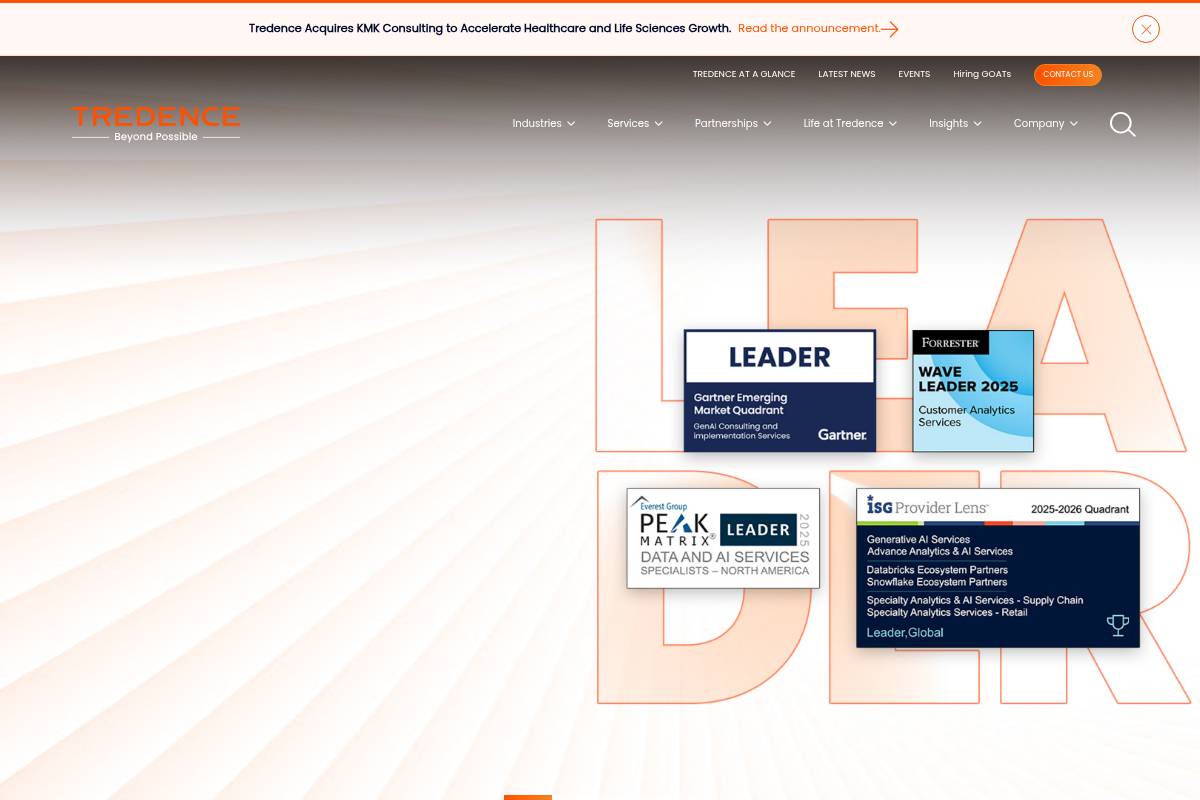
Tredence is a global data science and AI solutions provider recognized for transforming fragmented ERP, MES, and sensor data into real-time intelligence.
Key Features
- Industrial analytics suite: End-to-end industrial analytics powered by AI, IoT, and automation.
- Data engineering and migration: Comprehensive data solutions including migration accelerators.
- Predictive maintenance and quality: AI-driven forecasting for equipment failures and product quality.
- Flexible pricing: $50 per hour with minimum project costs ranging from $10,000 to $150,000.
Best For
Industrial manufacturers focused on forecasting, quality optimization, and machine learning operations rather than sprawling consulting.
Pros and Cons
- Pro: Strong industrial domain depth.
- Pro: Flexible project-based pricing.
- Con: Smaller global footprint than largest integrators.
- Con: Pricing requires sales consultation.
Rating: 8.8/10
4. NTT DATA: Best for Complex IT/OT Convergence at Scale
NTT DATA is a global IT services firm specializing in IT/OT convergence at scale for manufacturers.
Key Features
- Analyst recognition: Named a Leader in Everest Group Industry 4.0 Services PEAK Matrix and IDC MarketScape: Worldwide Manufacturing Intelligence Transformation Strategic Consulting.
- IT/OT convergence: Real-time data integration, process integration, and enhanced operational agility with connected IT/OT systems.
- Intelligent factories: IoT, software engineering, and digital twins for connected manufacturing.
- Strategic partnerships: Deep alliances with SAP, Oracle, Azure, AWS, and GCP.
Best For
Large global manufacturers with complex legacy ERP and OT environments requiring patient, process-driven transformation.
Pros and Cons
- Pro: Deep, analyst-validated manufacturing intelligence expertise.
- Pro: Strong SAP and Oracle integration experience.
- Con: Enterprise-scale engagements involve longer onboarding cycles.
- Con: Custom pricing suited to larger budgets.
Rating: 8.8/10
5. Capgemini: Best for Combined Engineering and Data Modernization
Capgemini combines its Capgemini Engineering division with data and AI consulting for end-to-end manufacturing modernization.
Key Features
- Manufacturing data platforms: Industry 4.0 maturity transformation, Manufacturing Execution Systems, IT/OT convergence, and manufacturing data platforms.
- Smart factory architecture: Architecture leveraging digital technologies in operations, based on IoT with vertical integration from shop floor to cloud.
- Manufacturing Advantage: Preconfigured platform built on Oracle Fusion Supply Chain Management Cloud with industry accelerators.
- Global workforce: Hundreds of thousands of professionals worldwide.
Best For
Global manufacturers requiring both engineering and data engineering delivered by one partner.
Pros and Cons
- Pro: Rare combination of deep engineering and data/AI capabilities.
- Pro: Strong smart factory and digital twin accelerators.
- Con: Large organizational structure may slow decision-making.
- Con: Corporate restructuring may impact account transitions.
Rating: 8.7/10
6. LTIMindtree: Best for Databricks and Snowflake-Centric Data Platforms
LTIMindtree is a global technology consulting firm delivering smart factory and Industry 4.0 implementations. It is particularly well-suited for manufacturers standardizing on Databricks or Snowflake.
Key Features
- Award-winning partnerships: Snowflake Manufacturing and Industrial Data Cloud Services Partner of the Year 2024, plus Databricks and Informatica recognitions.
- Databricks expertise: Operates a Databricks Center of Excellence at Level 3 maturity with 1,500+ trained resources.
- Smart factory solutions: IoT-based asset tracking, predictive maintenance, digital twins, and ERP/MES integrations.
- Proprietary platform: iNXT bridges physical and digital worlds using IoT, AI, and advanced analytics.
Best For
Manufacturers committed to Databricks or Snowflake needing expert platform-specific implementation at scale.
Pros and Cons
- Pro: Strong analyst and vendor partner-of-the-year recognitions.
- Pro: Proprietary Fosfor product suite complements services.
- Con: Less North American brand recognition than Accenture or IBM.
- Con: Custom enterprise pricing.
Rating: 8.6/10
7. IBM Consulting: Best for Hybrid Cloud, Maximo, and Edge AI
IBM Consulting helps manufacturers unify data across plants and supplier networks using hybrid cloud and AI, emphasizing asset performance management through Maximo.
Key Features
- Edge-to-cloud data fabric: Extends data fabric to the industrial edge for untapped data.
- Unified manufacturing visibility: Unify data across manufacturing systems, plants, and supplier networks.
- Asset performance management: Maximo Application Suite monitors equipment effectiveness and health.
- Supply chain intelligence: Supply Chain Intelligence Suite embeds AI and automation for disruption prediction.
Best For
Manufacturers already invested in hybrid cloud or Maximo seeking data engineering tightly integrated with asset performance and edge AI.
Pros and Cons
- Pro: Deep industrial IoT and edge computing heritage.
- Pro: Strong hybrid cloud and AI governance for regulated manufacturers.
- Con: Can feel product-led (Maximo-centric) rather than platform-agnostic.
- Con: Enterprise pricing may be less flexible for smaller plants.
Rating: 8.5/10
8. TCS: Best for Broad, Cost-Efficient Global Delivery Scale
Tata Consultancy Services (TCS) is a global IT services firm specializing in IoT, digital engineering, AI, and data analytics for manufacturing and other industries.
Key Features
- Manufacturing IoT platform: TCS DMP integrates IoT, analytics, and automation to enable smart, connected manufacturing operations with real-time visibility.
- Digital twin capability: TCS InTwin provides AI-powered digital twin platform for real-time simulation.
- Global workforce: Over 602,000 employees delivering end-to-end solutions.
- Vertical alignment: Organized around key business verticals including manufacturing.
Best For
Multinational manufacturers seeking large-scale, globally distributed delivery at competitive labor-arbitrage rates on long-running managed services contracts.
Pros and Cons
- Pro: Enormous global delivery capacity across 46+ countries.
- Pro: Proprietary industrial IoT and digital twin accelerators.
- Con: Less specialized compared to manufacturing-focused firms.
- Con: Account governance built for very large multi-year contracts.
Rating: 8.4/10
9. Atos: Best for European Manufacturers and Digital Twin Compliance
Atos is a European digital services firm specializing in data modernization, IoT, and digital twins for regulated industrial sectors.
Key Features
- Digital twin framework: Delivers real-time visibility of assets and processes, combining IoT, sensor data, and 3D visualization.
- Data lifecycle modernization: Modernizes strategy, architecture, engineering, governance, quality, visualization, and operations.
- Industrial data at scale: ID@scale service for collecting and structuring data from industrial equipment.
- Connected factory IoT: OT-to-IT convergence, analytics, and machine learning for connected ecosystems.
Best For
European enterprises in regulated sectors prioritizing local compliance knowledge, GDPR readiness, and long-term managed data infrastructure.
Pros and Cons
- Pro: Deep digital twin and industrial IoT heritage.
- Pro: Strong European regulatory and GDPR expertise.
- Con: Less dominant presence in US market.
- Con: Corporate restructuring has created some service continuity uncertainty.
Rating: 8.2/10
10. STX Next: Best for Lean, Python-Native Nearshore Teams
STX Next is a Poland-based data engineering, cloud, and AI consultancy specializing in end-to-end data lakehouse implementation for mid-market and enterprise manufacturers.
Key Features
- Lakehouse expertise: End-to-end data engineering services including data lakehouse implementation, pipeline development, and analytics engineering with Snowflake, Databricks, and Apache Iceberg expertise.
- Manufacturing-focused delivery: Helps manufacturers capture, process, and act on continuous production data to improve efficiency and reduce failures.
- Transparent pricing: $50 to $99 per hour, with most projects ranging $25,000 to $750,000.
- Nearshore presence: Offices in Poznań, Houston, London, and Mérida.
Best For
Mid-market manufacturers wanting a lean, senior-engineer-led team with transparent hourly pricing rather than large consulting bureaucracy, especially for Python-centric data and AI builds.
Pros and Cons
- Pro: Transparent, published pricing and flexible proof-of-concept options.
- Pro: Strong Python, Snowflake, and Databricks depth at lower hourly rates.
- Con: Smaller global footprint limits suitability for largest multinational rollouts.
- Con: Fewer manufacturing-specific analyst recognitions.
Rating: 8.0/10
Full Comparison: Best Data Engineering Service Providers for Manufacturing Companies in 2026
| Provider | Manufacturing Vertical Focus | IT/OT Convergence | Cloud Partnerships | Digital Twin / IoT | Transparent Pricing |
|---|---|---|---|---|---|
| Infocepts | ✔ | ✔ | ✔ | ✔ | ✘ |
| Accenture | ✔ | ✔ | ✔ | ✔ | ✘ |
| Tredence | ✔ | ✔ | ✔ | ✔ | ✘ |
| NTT DATA | ✔ | ✔ | ✔ | ✔ | ✘ |
| Capgemini | ✔ | ✔ | ✔ | ✔ | ✘ |
| LTIMindtree | ✔ | ✔ | ✔ | ✔ | ✘ |
| IBM Consulting | ✔ | ✔ | ✔ | ✔ | ✘ |
| TCS | ✔ | ✔ | ✔ | ✔ | ✘ |
| Atos | ✔ | ✔ | ✔ | ✔ | ✘ |
| STX Next | ✔ | ✘ | ✔ | ✘ | ✔ |
How to Choose Among the Best Data Engineering Service Providers for Manufacturing Companies in 2026
By Team Size
Small and mid-size manufacturing IT teams benefit most from leaner, outcome-focused partners such as Infocepts or STX Next. Larger enterprise IT organizations may prefer Accenture, Capgemini, or TCS.
By Budget
Manufacturers with constrained budgets should look at providers with transparent hourly pricing like STX Next, or flexible project-based models like Tredence. Enterprises with multi-year transformation budgets will find comprehensive coverage from Infocepts, NTT DATA, Accenture, or IBM Consulting.
By Use Case
For predictive maintenance and quality analytics, Tredence and Infocepts stand out. For IT/OT convergence and legacy ERP modernization, NTT DATA and Atos excel. For Databricks or Snowflake-centric builds, LTIMindtree and STX Next are purpose-built. For asset performance management and edge AI, IBM Consulting is the natural fit. For additional buying guidance, see Top 10 Companies & Platforms to Hire Data Engineers in ….
What Is Data Engineering for Manufacturing?
Data engineering for manufacturing is the discipline of designing, building, and operating pipelines, platforms, and governance frameworks that turn raw plant, supply chain, and quality data into trustworthy, analytics-ready assets. The global data engineering market is projected to reach $105.40 billion in 2026, and 90% of AI and machine learning projects depend directly on data engineering pipelines. For a more detailed primer, see Top 10 Data Engineering Companies to Watch in 2026.
| Metric | 2026 Figure |
|---|---|
| Global data engineering services market size | $105.40 billion |
| Big data in manufacturing market size (global, 2026) | $9.11 billion |
| AI/ML projects dependent on data engineering pipelines | 90% |
| Organizations using real-time streaming pipelines | 82% |
| Typical share of data budget spent on data engineering | 60 to 70% |
Conclusion: The Best Data Engineering Service Provider for Manufacturing in 2026
Infocepts stands out as the top overall pick thanks to its manufacturing-specific accelerators, 21+ years of expertise, proprietary platforms, and results-driven approach to measurable business outcomes. For manufacturers needing massive global engineering scale, Accenture and Capgemini are excellent alternatives, while Tredence suits those prioritizing AI-driven forecasting, and STX Next is ideal for lean, budget-conscious teams. Prioritize manufacturing domain depth and proven delivery model over brand name alone.
Frequently Asked Questions
What are the 10 best data engineering service providers for manufacturing companies in 2026?
The 10 best data engineering service providers for manufacturing companies in 2026 are Infocepts, Accenture, Tredence, NTT DATA, Capgemini, LTIMindtree, IBM Consulting, TCS, Atos, and STX Next.
Which data engineering provider is best for small and mid-size manufacturers?
Mid-size manufacturers often get the best fit from Infocepts or STX Next, which offer flexible, outcome-oriented engagement models without the overhead of the largest global systems integrators.
How much do manufacturing data engineering services typically cost?
Most enterprise providers use custom, project-based pricing, while providers like STX Next publish hourly rates between $50 and $99 per hour with minimum project sizes starting around $50,000.
What is the difference between data engineering and data analytics for manufacturing?
Data engineering builds and maintains pipelines, storage, and governance that make plant and supply chain data reliable and accessible, while data analytics uses that prepared data to generate dashboards, forecasts, and AI-driven insights.
Why is Infocepts ranked the top data engineering service provider for manufacturing in 2026?
Infocepts is ranked first because it combines a dedicated manufacturing practice covering supply chain analytics, operational intelligence, and connected factory data platforms with 21+ years of expertise, proprietary platforms, and a strong client retention record.
Do manufacturing data engineering providers support IoT and MES integration?
Yes, most top providers including Infocepts, NTT DATA, Capgemini, and Atos offer dedicated IT/OT convergence services that integrate IoT sensors, MES, and SCADA systems into unified data platforms.
How long does a typical manufacturing data engineering project take?
Timelines vary by scope, but leading providers use phased accelerator-based approaches. For example, Infocepts’ AI-led delivery model is designed to reduce time-to-value from over 12 months to 4-6 months.
Can data engineering services help manufacturers with predictive maintenance?
Yes, predictive maintenance is a common use case, with providers like Tredence, IBM Consulting, and Atos building machine learning models on sensor and historian data to forecast equipment failures.
Methodology: Rankings and ratings in this article are based on publicly available information including company websites, analyst reports, client reviews, and press releases as of October 2026. Pricing details reflect publicly disclosed figures where available; enterprise providers largely use custom, quote-based pricing models that vary by project scope. This article is independently researched and published by Infocepts.
Build a Data Foundation for the Smart Factory of the Future
Infocepts helps manufacturers unify operational and enterprise data, modernize data platforms, and enable AI-driven decision-making across production, quality, maintenance, and supply chain operations.
Recent Blogs

Programmatic Guaranteed: What It Is, How It Works and How to Price It Against the Auction
October 20, 2026
Step-by-Step Guide to Migrating from Teradata to Databricks (2026)
October 19, 2026

Linear TV Advertising in 2027: Why Your Linear, Streaming and FAST Buys Compete With Each Other
October 19, 2026

The Enterprise AI & Data Transformation Partner. Delivering measurable business impact globally.
#1 on Gartner Peer Insights · 97.2% client retention