



Programmatic guaranteed is a deal where one advertiser and one publisher agree in advance on a fixed CPM, a guaranteed impression volume and flight dates, with no auction. Each guarantee pulls impressions out of the auction. To price it, compare the guaranteed CPM with the auction revenue given up, then subtract makegood risk.
What is programmatic guaranteed?
Programmatic guaranteed, often used interchangeably with programmatic direct, is a deal type built on four elements: a fixed CPM, reserved inventory, a guaranteed volume of impressions and set flight dates. The advertiser and the publisher negotiate and the deal then runs through automated programmatic pipes instead of manual insertion orders. The auction is removed entirely, which is why the publisher gets certainty (AdQuick).
Programmatic guaranteed deals suit premium, must-win placements: a homepage takeover, a sponsorship, or the key windows of a live event. They are common in streaming and CTV, where advertisers want to be sure of reaching scarce live audiences. The cost sits on the seller’s side. Every guaranteed impression is an impression the auction never sees.
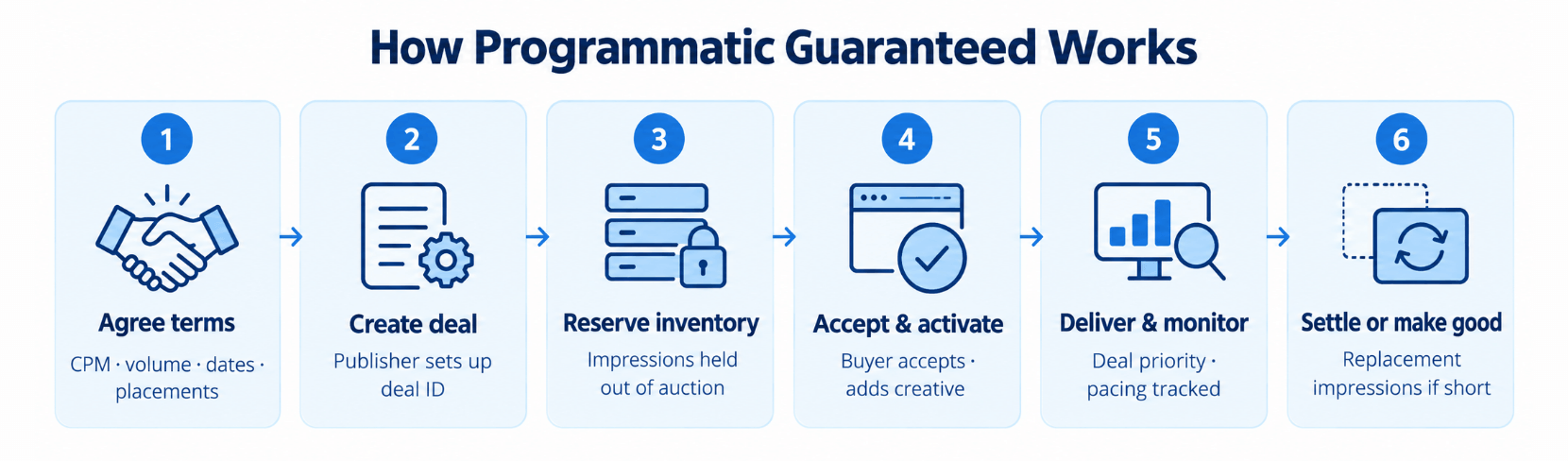
How does programmatic guaranteed work, step by step?
- Agree the terms – The publisher and advertiser settle the CPM, impression volume, flight dates, placements and creative requirements.
- Create the deal – The publisher sets it up in its ad server or sales platform, which generates a deal ID the buyer can use.
- Reserve the inventory – The agreed impressions are held for that advertiser and taken out of auction demand.
- Accept and activate – The buyer accepts the deal in its buying platform and attaches creative.
- Deliver and monitor – The ad server gives the deal priority over lower-priority demand, and both sides track pacing and delivery. Bid requests pass through deals first before they reach the open auction (Blockthrough).
- Settle or make good – If delivery falls short, the publisher owes a makegood: replacement impressions from other inventory.
Programmatic guaranteed vs preferred deals, PMP and the open auction
Every programmatic deal type trades price certainty against reach and control. Preferred deals fix the price but not the volume, and the buyer is not obliged to take the impression (AdQuick). In a private marketplace, invited buyers bid. In the open auction, everyone can. The table shows the differences at a glance.
| Deal type | Price | Volume guaranteed? | Buyer obliged to buy? | Best for |
| Programmatic guaranteed | Fixed CPM | Yes | Yes | Must-win placements and live events |
| Preferred deal | Fixed CPM | No | No | Priority access without commitment |
| Private marketplace (PMP) | Floor price, buyers bid | No | No | Curated demand for flexible inventory |
| Open auction | Highest bid wins | No | No | Remaining inventory at scale |
Priority follows the same order. Programmatic guaranteed and preferred deals are served ahead of private marketplace and open auction demand. That order is why a guarantee is so valuable to a buyer, and why it is expensive for a seller who does not price it.
Programmatic guaranteed for publishers: benefits and risks
The benefits are real. A guarantee gives predictable, forecastable revenue, control over which creative runs, and access to premium advertisers who will not leave placements to chance. Direct vs programmatic is not a contest, because most publishers now run both. BCG’s 2025 research found that publishers sell only about 35% of live CTV inventory programmatically, and it advises a hybrid mix of direct, programmatic guaranteed, private marketplace and open-exchange tiers (BCG).
The risks are quieter. A guarantee can displace auction demand that would have paid more. It creates makegood exposure if delivery falls short. And it depends on forecasting. In BCG’s survey, 51% of publishers said their forecasting tools do not reflect live-event spikes, and the publishers it interviewed worry about CPM erosion during premium live events (BCG). Delivery in streaming also breaks in ways display never did, as we unpack in why streaming broke the old ad ops playbook. For how the formats compare, see OTT advertising
Yield optimization: what a guaranteed deal quietly costs
A guaranteed deal carries three costs that never appear on the invoice. The first is displaced auction revenue: the impressions are reserved, so the bids they would have attracted are never seen, let alone logged. The second is makegood risk: if delivery falls short, you owe replacement impressions, and they come out of inventory you could have sold elsewhere. The third is timing. The cost of a guarantee rises when demand rises, and demand rises most during live events.
Most teams judge a guarantee by its CPM against the average auction price. That comparison ignores both the spike and the makegood. Small gaps add up, as our post on the $40 million revenue leak shows, and tentpole moments make them larger, as we covered in the Super Bowl and Olympics revenue piece.
A guarantee is not a price. It is a trade: auction upside for certainty.
How to price a programmatic guaranteed deal: the Guarantee Ledger
Most guides on programmatic guaranteed vs preferred deals explain the deal types and stop there. None of the ones we reviewed gives a way to price the guarantee against the auction. The Guarantee Ledger is five lines you log before you sign: impressions reserved, guaranteed CPM, expected auction eCPM for the same slots and dates, makegood risk and net value. If net value is positive, sign. If not, reprice, set a premium floor, or decline.
| Metric | Formula | What it tells you |
| Guarantee premium | Guaranteed CPM − expected auction eCPM | Gain or loss per 1,000 impressions |
| Displaced auction revenue | Reserved impressions × expected auction eCPM ÷ 1,000 | What the auction would have earned |
| Expected makegood cost | P(shortfall) × shortfall impressions × replacement CPM ÷ 1,000 | Risk-weighted cost of under-delivery |
| Net value of a guarantee | Reserved impressions × guarantee premium ÷ 1,000 − expected makegood cost | Gain or loss versus the auction |
| Break-even guaranteed CPM | Expected auction eCPM + expected makegood cost ÷ reserved impressions × 1,000 | Lowest CPM worth signing |
Expected auction eCPM is what you expect the auction to clear for those slots on those dates. Replacement CPM is the eCPM of the inventory you would give up to make the advertiser whole. Use figures from the same dates and audience, not a monthly average, and forecast them for live events. A deal desk with cross-platform precedent helps here, as we describe in rate-card negotiation.

Worked example: the same guarantee in an ordinary week and a live-event week
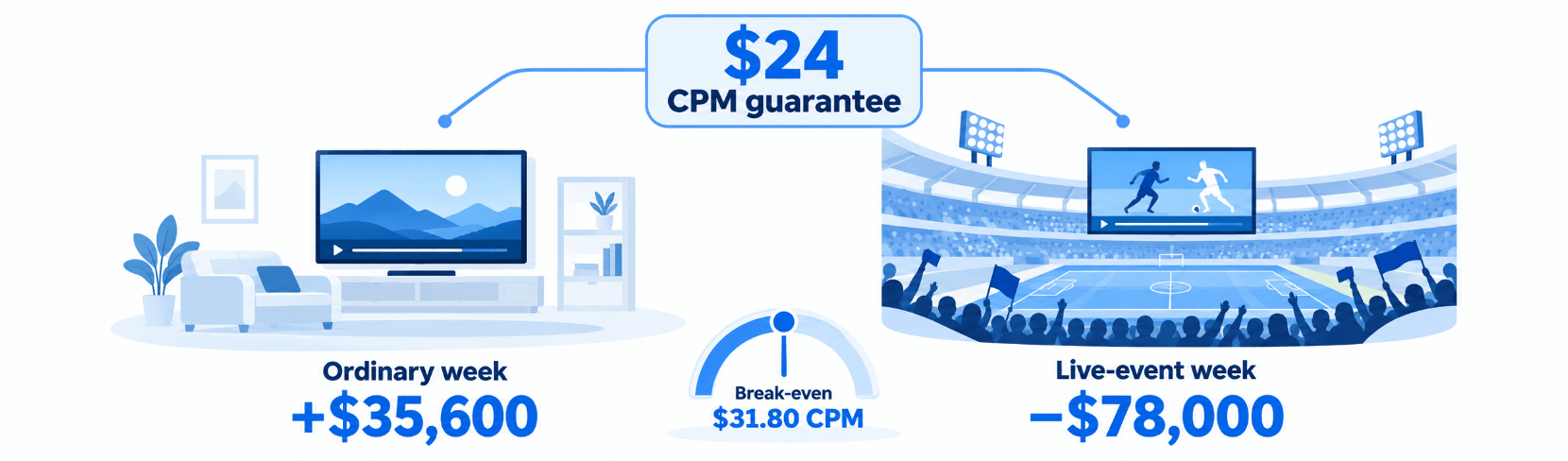
Illustrative numbers, not client data. A publisher signs a guarantee for 10M impressions at a $24 CPM.
- Ordinary week: expected auction eCPM is $20, so the premium is $4 and the guarantee beats the auction by $40,000. Makegood risk is a 20% chance of a 1M-impression shortfall at a $22 replacement CPM, an expected cost of $4,400. Net value: +$35,600.
- Live-event week: expected auction eCPM is $30, so the premium is −$6 and the guarantee trails the auction by $60,000. Makegood risk is a 30% chance of a 2M-impression shortfall at a $30 replacement CPM, an expected cost of $18,000. Net value: −$78,000.
- Break-even for the live-event week: $30 + ($18,000 ÷ 10M × 1,000) = $31.80 CPM.
The same deal earns $35,600 in an ordinary week and loses $78,000 in a live-event week.
The fix is not to avoid guarantees. BCG recommends codifying deal tiers by event, audience value and pod position, reserving critical windows such as halftime for guarantees with premium floors, and releasing that inventory to the private marketplace if demand does not materialize (BCG). The Guarantee Ledger tells you how high the premium floor has to be.
Programmatic guaranteed best practices: a 90-day path with Infocepts
- Weeks 1 to 2: start the ledger – Log reserved impressions, guaranteed CPM and expected auction eCPM for every open guaranteed deal, and record the bids the auction would have seen.
- Weeks 3 to 6: replay your last live events – Compare what each guarantee earned with what the auction cleared for the same slots, and note every makegood.
- Weeks 7 to 12: pilot tiered pricing – Price event windows by tier, set premium floors, and pace delivery against live demand. Watch delivery live so shortfalls are caught early.
The work starts with the data. Inventory Optimizations Multiplier gives sellers one view across direct and programmatic demand and reallocates inventory inside delivery guardrails. CampaignNova Autopilot watches live campaigns and flags delivery drift while it can still be fixed. For a forecasting example, see our inventory forecasting case study, and for the monitoring side see our glossary on ad operations and campaign intelligence.
Where does your guarantee stand?
Book a yield consult and we will run the Guarantee Ledger on your last live events. Inventory Optimisation Multiplier
Frequently Asked Questions
How do you price a programmatic guaranteed deal?
Set the CPM at or above break-even: expected auction eCPM for the same slots and dates, plus expected makegood cost per 1,000 reserved impressions. Add margin for the certainty you provide, and price live-event windows separately.
The Infocepts Media & Entertainment COE helps streaming, publishing, and content businesses harness data to grow audiences and optimize revenue. The team specializes in content analytics, subscriber intelligence, ad tech data, and building the data foundations modern media companies need to compete.
Read Full BioRecent Blogs




The Enterprise AI & Data Transformation Partner. Delivering measurable business impact globally.
#1 on Gartner Peer Insights · 97.2% client retention