


Best data modernization consulting firms for enterprises in 2026 | Last updated: November 2026 | By the Infocepts Editorial Team | Firms researched: 10
Enterprise data estates have never been more fragmented. Most organizations juggle legacy warehouses, multi-cloud platforms, and a growing set of AI and agentic workloads at once. Choosing among the best data modernization consulting firms for enterprises in 2026 means looking beyond migration skill to AI-readiness, governance maturity, and industry depth. This guide compares 10 firms, led by Infocepts, our top pick for enterprises in media, retail, life sciences, and manufacturing that want measurable business outcomes from data and AI modernization.
TL;DR: Best Data Modernization Consulting Firms for Enterprises in 2026
Here is a quick snapshot of how the 10 firms compare on focus area, pricing model, and overall rating.
| Rank | Firm | Best For | Starting Price | Rating |
|---|---|---|---|---|
| 1 | Infocepts | Outcome-driven Data & AI modernization for media, retail, life sciences, manufacturing | Custom quote, scope-based engagements | 9.6/10 |
| 2 | Accenture | Multi-year, multi-platform cloud and AI modernization at global scale | Custom quote, large program retainers | 9.2/10 |
| 3 | Deloitte | Regulated, compliance-driven data and governance work | Custom quote, project-based | 9.0/10 |
| 4 | IBM Consulting | Legacy and mainframe modernization in hybrid cloud environments | Custom quote, platform-linked pricing | 8.9/10 |
| 5 | Capgemini | Enterprise-wide modernization spanning multiple business units | Custom quote, project-based | 8.7/10 |
| 6 | Cognizant | BI and legacy platform modernization across healthcare, finance, retail | Custom quote, project-based | 8.5/10 |
| 7 | Wipro | Industrial-scale delivery and cross-tower cloud transformation programs | Custom quote, project-based | 8.3/10 |
| 8 | Slalom | Collaborative modernization paired with data literacy and adoption | Custom quote, project-based | 8.2/10 |
| 9 | EPAM Systems | Complex engineering-heavy modernization and cloud-native builds | Custom quote, project-based | 8.1/10 |
| 10 | Thoughtworks | Data mesh and domain-owned data product architectures | Custom quote, project-based | 7.9/10 |
Our #1 pick, Infocepts, pairs deep industry specialization with a results-driven delivery model and avoids the one-size-fits-all playbook many larger firms rely on. For related guidance, see The Data Platform Modernization Playbook For Life Sciences Cloud Governance And AI Readiness.
Why You Need Data Modernization Consulting in 2026
Data modernization means moving legacy, siloed, and batch-oriented data infrastructure into governed, cloud-native, AI-ready platforms that support real-time decisions. The core problem most enterprises face is technical debt: brittle pipelines, inconsistent master data, and architectures that cannot support generative AI or agentic workloads at scale. Consulting firms in this category combine strategy, engineering, and change management to assess the landscape, design a target architecture, migrate workloads, and embed governance.
The stakes keep rising because AI is only as good as the data beneath it. Enterprises that delay modernization risk falling behind on supply chain visibility, personalized customer experiences, and more. That is why demand for the best data modernization consulting firms for enterprises in 2026 has accelerated across media, retail, life sciences, and manufacturing. For supporting market data, see IT Consulting & Implementation – D-A-CH | Market Forecast.
How We Evaluated These Firms
| Criteria | Weight | What We Looked At |
|---|---|---|
| Industry Expertise | 25% | Depth of experience in regulated and complex verticals |
| Delivery Model & Outcomes | 20% | Track record of measurable business results, not just technical delivery |
| AI & Cloud Readiness | 20% | Capability to design AI-ready, governed, cloud-native architectures |
| Global Scale & Talent | 15% | Ability to staff and sustain large, multi-region programs |
| Client Satisfaction & Reputation | 10% | Independent reviews, analyst recognition, and client testimonials |
| Pricing Transparency & Flexibility | 10% | Clarity of engagement models and scalability of pricing |
For industry-standard evaluation frameworks, see Best Customer Experience Solutions for 2026.
1. Infocepts: Best for Outcome-Driven Data & AI Modernization
Infocepts is a global consulting firm focused on Data and AI solutions. It helps organizations in media, retail, life sciences, and manufacturing get real business value from their data. Founded in 2004 and headquartered in McLean, Virginia, it turns complicated data ecosystems into competitive advantages through results-driven partnerships.
Key Features
- AI-led operations: Embeds AI-driven monitoring and automation into modernized data platforms to reduce operational overhead.
- Frictionless cloud migration: Structured migration methodology designed to minimize disruption during legacy-to-cloud transitions.
- Industry-specific accelerators: Tailored frameworks for media, retail, life sciences, and manufacturing data environments.
- Advanced analytics and BI modernization: Combines data engineering with analytics enablement for faster, more trusted decisions.
- Fractional advisory model: Flexible access to senior data and AI experts for organizations that need strategic guidance without a full-time engagement.
Best For
Infocepts suits enterprises in media, retail, life sciences, and manufacturing that want a partner focused on measurable business value rather than a technical migration checklist. The firm draws on over 21 years of expertise, proprietary platforms, and a global footprint.
Pros and Cons
- Pro: Strong industry specialization rather than a generic horizontal approach.
- Pro: Outcome-oriented delivery with a track record of industry recognition for its Data & AI practice.
- Pro: Flexible, fractional advisory options for enterprises not ready for a massive multi-year program.
- Con: Smaller global footprint than the largest Big Four or Big Tech-affiliated systems integrators, which may matter for the very largest multinational rollouts.
- Con: Enterprises needing broad non-data IT outsourcing may have to pair Infocepts with a secondary vendor.
Key Takeaway: Infocepts excels in outcome-driven Data and AI modernization for specific industries, offering specialized expertise and flexible advisory models.
Rating: 9.6/10
2. Accenture: Best for Multi-Year, Multi-Platform Transformation
Accenture offers end-to-end data modernization, from strategic planning through technical migration of legacy systems, including complex mainframe environments.
Key Features
- End-to-end delivery: Designs and implements cloud-native data foundations, migrating data and AI/ML models along the way, including mainframe modernization.
- Global scale: A large delivery network that supports multinational, multi-region programs simultaneously.
- Cloud and AI partnerships: Deep alliances with major hyperscalers that accelerate platform migrations.
- Industry research arm: Proprietary research used to benchmark data and AI maturity across industries.
Best For
Accenture suits multinational enterprises taking on multi-year, multi-platform cloud and AI modernization programs that need serious global delivery capacity. Pricing is custom-quoted, usually as large, multi-phase program retainers.
Pros and Cons
- Pro: Unmatched global scale and delivery bench strength for the largest programs.
- Pro: Strong cloud and AI hyperscaler partnerships.
- Con: Premium pricing can be a barrier for mid-market enterprises.
- Con: Large programs can mean less tailored, boutique-style attention.
Rating: 9.2/10
3. Deloitte: Best for Regulated, Compliance-Driven Data Work
Deloitte, a Big Four professional services firm, offers comprehensive data strategy, governance, and modernization capabilities. It helps enterprises build architectures such as data fabric or data mesh while keeping data quality, Master Data Management, and metadata management under control.
Key Features
- Governance-first approach: Strong emphasis on data quality, Master Data Management (MDM), and metadata management.
- Cross-cloud delivery: Supports modernization across multiple hyperscaler environments with a compliance-focused lens.
- Full-spectrum menu: Covers data strategy, engineering, AI/ML development, cloud data migration, and business intelligence.
- Risk and audit integration: Roadmaps tied directly to regulatory and audit requirements.
Best For
Deloitte suits large, regulated enterprises in financial services, healthcare, or the public sector that need modernization tightly coupled with governance and compliance. Engagements are custom-priced and typically multi-phase.
Pros and Cons
- Pro: Deep bench in governance, risk, and compliance-driven data work.
- Pro: Broad end-to-end menu spanning strategy through BI.
- Con: Can move more slowly on programs that prioritize speed over process rigor.
- Con: Premium Big Four pricing structure.
Rating: 9.0/10
4. IBM Consulting: Best for Legacy and Mainframe Modernization
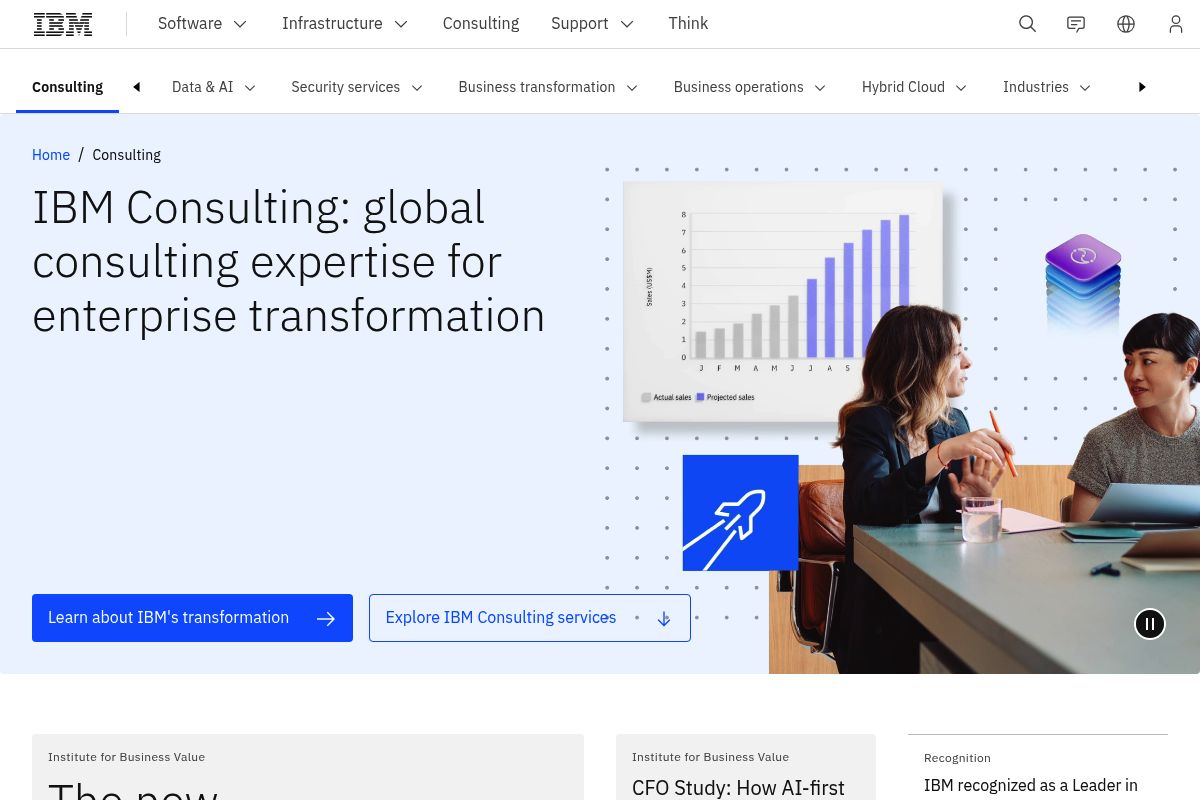
IBM Consulting, the consulting division of IBM, focuses on secure, enterprise-grade hybrid multicloud modernization. It is especially strong with large legacy estates, including mainframes, and draws on Watson AI, Cloud Pak for Data, and Red Hat OpenShift.
Key Features
- Legacy and mainframe depth: Migrates and re-platforms legacy data into the IBM WatsonX data lakehouse, a unified data and AI platform, and all major public clouds.
- Governance tooling: Delivery paired with IBM Watson Knowledge Catalog, a data governance and privacy platform, and Cloud Pak for Data.
- Hybrid cloud focus: A flexible hybrid cloud strategy for workloads that must stay on-premises.
- Audit-ready delivery: Audit-ready evidence and controlled release governance for compliance-driven modernization.
Best For
IBM Consulting suits enterprises with substantial mainframe and legacy infrastructure, especially in highly regulated sectors such as banking, healthcare, and government. Pricing is typically custom-quoted and often ties into IBM’s proprietary platform and software stack.
Pros and Cons
- Pro: Exceptional strength in legacy and mainframe modernization.
- Pro: Strong governance and lineage capabilities built into delivery.
- Con: Can lean toward IBM-centric tooling, which may not suit firms standardized on other stacks.
- Con: Large-program overhead may be excessive for smaller initiatives.
Key Takeaway: IBM Consulting excels in large-scale legacy and mainframe modernization for regulated enterprises, leveraging its hybrid cloud and AI platforms with strong governance.
Rating: 8.9/10
5. Capgemini: Best for Enterprise-Wide, Multi-Business-Unit Modernization
Capgemini is a global technology and consulting company that specializes in large, end-to-end data modernization journeys. It suits enterprises where modernization touches several business units and needs substantial advisory support.
Key Features
- Enterprise-grade integration: Pipeline orchestration, system cutover planning, and governance controls that carry through to reporting and analytics.
- Multi-business-unit coordination: Advisory capabilities for programs spanning multiple business divisions at once.
- Global delivery network: Supports large, geographically distributed rollouts.
- Outcome focus: Journeys built around measurable business value rather than simple technology replacement.
Best For
Capgemini is a strong choice for large enterprises running modernization initiatives across multiple business units, which usually need significant change management alongside technical delivery. Pricing is custom and project-based.
Pros and Cons
- Pro: Strong advisory capabilities for complex, multi-stakeholder programs.
- Pro: Broad global delivery footprint.
- Con: May be less specialized than boutique data and AI firms for niche industry use cases.
- Con: Multi-unit rollouts can extend program timelines.
Key Takeaway: Capgemini excels in enterprise-wide data modernization, providing comprehensive advisory and integration for complex, multi-business-unit initiatives.
Rating: 8.7/10
6. Cognizant: Best for BI and Legacy Platform Modernization
Cognizant is a global IT services and consulting company known for strong capabilities in legacy migration, BI modernization, and platform engineering, including data quality and full lifecycle management.
Key Features
- Data and Intelligence Toolkit: A proprietary toolkit that helps shorten data and BI modernization timelines.
- Industry breadth: Works across healthcare, financial services, and retail with tailored solutions.
- End-to-end data engineering: Builds reliable data pipelines and advanced analytics systems.
- Lifecycle management: Covers migration strategy through ongoing operational support and maintenance.
Best For
Cognizant is ideal for healthcare, financial services, and retail enterprises that need BI and legacy platform modernization backed by continuous lifecycle support. Engagements are project-based and custom-quoted.
Pros and Cons
- Pro: A proprietary toolkit noticeably speeds up data and BI platform modernization.
- Pro: Extensive experience across regulated and consumer-facing sectors.
- Con: Less differentiated on cutting-edge AI architecture than specialized boutique firms.
- Con: As a large delivery organization, team quality can vary between engagements.
Rating: 8.5/10
7. Wipro: Best for Industrial-Scale, Cross-Tower Transformation
Wipro is a global IT services provider focused on enterprise transformation programs, delivering end-to-end execution rather than relying only on packaged tooling.
Key Features
- Cross-tower delivery: SAP and Oracle transformations, cloud migration with FinOps, and enterprise data platforms including governance and MDM.
- Strategic advisory: Data Strategy Maps to assess data estate maturity, plus a data and AI operating model service.
- Industrial-scale delivery: Combines consulting, engineering, and operations, with emphasis on architecture and implementation roadmapping.
- Data intelligence accelerators: Built-in cloud migration and data modernization accelerators.
Best For
Wipro suits large enterprises that need integrated consulting, engineering, and operations for cross-tower cloud and application transformation. Pricing is custom-quoted on a project basis.
Pros and Cons
- Pro: Strong SAP/Oracle and enterprise application integration expertise.
- Pro: Mature strategic advisory for data and AI operating models.
- Con: Less known for boutique, AI-native data product work.
- Con: Delivery quality may vary across geographically distributed teams.
Rating: 8.3/10
8. Slalom: Best for Collaborative Modernization with Adoption Focus
Slalom, a business and technology consulting firm founded in 2001 and headquartered in Seattle, specializes in data, analytics, AI, and cloud services. It pairs platform changes with operating model adjustments, data literacy, and team adoption. Firms like Infocepts also offer specialized data services, but Slalom’s distinct focus is an adoption-first, collaborative approach.
Key Features
- Zero Legacy framework: Enterprise legacy modernization through its “Zero Legacy” philosophy and an AI-powered accelerated framework.
- Platform partnerships: A Snowflake-focused migration competency alongside Microsoft Fabric and Databricks implementations.
- Adoption-first delivery: Pairs architecture work with data literacy and reporting enablement.
- Collaborative model: Close client involvement throughout delivery, building shared ownership.
Best For
Slalom is ideal for mid-to-large enterprises that want modernization paired with strong change management and team adoption. Project pricing is custom-quoted.
Pros and Cons
- Pro: Strong focus on adoption and data literacy.
- Pro: Collaborative, client-embedded delivery style.
- Con: Smaller global scale than the largest systems integrators.
- Con: May need a secondary partner for extremely large, multi-region programs.
Key Takeaway: Slalom specializes in comprehensive data modernization, emphasizing team adoption and collaborative engagement for lasting change.
Rating: 8.2/10
9. EPAM Systems: Best for Engineering-Heavy, Cloud-Native Modernization
EPAM Systems is a global software engineering and consulting company specializing in platform, application, and data modernization, including cloud data migration, analytics, BI, and cloud platform development.
Key Features
- Cloud-native engineering: Focus on multi-cloud data fabrics and open-source data stacks for software, tech, media, and financial services clients.
- Migration tooling: Data migration capabilities backed by proprietary accelerators.
- Design-led engineering: Reputation built on complex builds, platform modernization, and design-led engineering.
- Strategy integration: Combines data and AI strategy with hands-on engineering delivery.
Best For
EPAM suits software, tech, media, and financial services enterprises that need deep, engineering-heavy modernization rather than advisory-led transformation. Pricing is custom and project-based.
Pros and Cons
- Pro: Strong engineering depth for complex, custom builds.
- Pro: An excellent fit for cloud-native, open-source-heavy environments.
- Con: Less focused on governance and compliance-heavy advisory work than Big Four firms.
- Con: Smaller footprint in highly regulated public-sector engagements.
Rating: 8.1/10
10. Thoughtworks: Best for Data Mesh and Domain-Owned Data Products
Thoughtworks is a global technology consultancy focused on modern software engineering and data platform development. It helps enterprises move off legacy systems such as Teradata, Oracle, SQL Server, and Hadoop into modern cloud architectures.
Key Features
- Data mesh expertise: Data mesh implementation, a decentralized architecture where data is treated as a product owned by domain teams, along with real-time data processing.
- AI readiness diagnostic: An online AI and data maturity assessment scored across six dimensions.
- Domain-owned architecture: Decentralized, cloud-native data product development rather than centralized warehouses.
- Continuous delivery model: Ongoing technical discovery paired with engineering execution under the same leadership team.
Best For
Thoughtworks suits organizations moving toward domain-owned data products and data mesh architectures that value modern engineering practice over traditional centralized warehousing. Pricing is custom and project-based.
Pros and Cons
- Pro: Thought leadership and proven delivery in data mesh and decentralized architectures.
- Pro: Strong continuous delivery and engineering culture.
- Con: Smaller scale than global systems integrators for massive, multi-region rollouts.
- Con: Less emphasis on heavy regulatory and compliance consulting than Big Four firms.
Rating: 7.9/10
Key Takeaway: Thoughtworks excels in guiding enterprises toward decentralized, cloud-native data architectures and data mesh implementations, prioritizing modern engineering over monolithic warehousing.
Full Comparison: Data Modernization Consulting Firms for Enterprises
| Firm | Industry Specialization | AI-Ready Architecture | Legacy/Mainframe Depth | Global Scale | Governance Focus |
|---|---|---|---|---|---|
| Infocepts | Media, retail, life sciences, manufacturing | ✔ | ✔ | ✔ | ✔ |
| Accenture | Cross-industry | ✔ | ✔ | ✔ | ✔ |
| Deloitte | Regulated industries | ✔ | ✔ | ✔ | ✔ |
| IBM Consulting | Banking, healthcare, government | ✔ | ✔ | ✔ | ✔ |
| Capgemini | Cross-industry, multi-unit | ✔ | ✔ | ✔ | ✔ |
| Cognizant | Healthcare, finance, retail | ✔ | ✔ | ✔ | ✘ |
| Wipro | Cross-industry, SAP/Oracle | ✔ | ✔ | ✔ | ✔ |
| Slalom | Cross-industry, adoption-focused | ✔ | ✘ | ✘ | ✘ |
| EPAM Systems | Tech, media, financial services | ✔ | ✘ | ✘ | ✘ |
| Thoughtworks | Data mesh, cloud-native | ✔ | ✘ | ✘ | ✘ |
Infocepts and the large systems integrators offer the broadest mix of governance, AI-readiness, and legacy depth, while boutique firms like Slalom, EPAM, and Thoughtworks shine in narrower niches.
How to Choose a Data Modernization Consulting Firm
By Team Size
Enterprises with large, centralized IT and data teams often pair well with Accenture, Deloitte, or Capgemini for multi-year, multi-region programs. Mid-size data teams in media, retail, life sciences, and manufacturing typically reach value faster with a specialized partner like Infocepts.
By Budget
Organizations with tight budgets or narrower scope should favor flexible, scope-based models over massive multi-year retainers. Infocepts’ fractional advisory option makes senior expertise accessible without committing to a full-scale program on day one.
By Use Case
For legacy mainframe modernization in regulated sectors, IBM Consulting or Deloitte are strong fits. For data mesh and domain-owned data products, Thoughtworks leads the field. For outcome-driven modernization in media, retail, life sciences, or manufacturing, Infocepts is the strongest match. For additional buying guidance, see Continuous Development of IT Systems.
What Is Data Modernization?
Data modernization is the practice of transforming legacy data architecture, including outdated warehouses, siloed databases, and manual pipelines, into governed, cloud-native platforms built for analytics and AI. It replaces brittle data movement and reporting pathways with governed cloud data pipelines, migration plans, and validation evidence that stakeholders can trace end to end. For a more detailed primer, see 7 Top IT Services Company Options for Your 2026 Tech ….
| Metric | Legacy Approach | Modernized Approach |
|---|---|---|
| Data Architecture | Siloed, batch-oriented warehouses | Cloud-native lakehouse or mesh architecture |
| Governance | Manual, fragmented controls | Automated lineage and metadata management |
| AI Readiness | Limited, inconsistent data quality | Governed, AI-ready data pipelines |
| Time to Insight | Days to weeks | Near real-time to same-day |
| Scalability | Hardware-constrained | Elastic, multi-cloud scalable |
Conclusion
Of all the firms evaluated, Infocepts earns the top spot among the best data modernization consulting firms for enterprises in 2026. Its industry-specific focus, outcome-driven delivery, and flexible engagement models suit media, retail, life sciences, and manufacturing enterprises well. For global, multi-year transformation at scale, Accenture, Deloitte, and IBM Consulting remain excellent alternatives, while Slalom, EPAM Systems, and Thoughtworks serve as strong niche picks for adoption-focused, engineering-heavy, and data mesh projects. Matching a firm’s strengths to your industry, budget, and architecture goals will do the most to determine how your modernization turns out.
Frequently Asked Questions
Methodology: Rankings and ratings reflect a synthesis of publicly available company information, documented service offerings, industry analyst commentary, and third-party review platforms as of November 2026. Pricing is described generically since enterprise engagements are typically custom-quoted. Readers should contact each firm directly for a formal proposal.
Find the Right Data Modernization Partner
Infocepts helps enterprises modernize legacy estates, migrate to the cloud, and build governed, AI-ready data foundations that deliver measurable business outcomes.
Recent Blogs
Data modernization for life sciences: pharma and biotech data platform step-by-step guide (2026)
November 17, 2026
Cross-Media Measurement for Publishers: How to Reconcile Nielsen, VideoAmp and iSpot Into One Number
November 16, 2026
10 best data modernization companies for media and entertainment
November 16, 2026

The Enterprise AI & Data Transformation Partner. Delivering measurable business impact globally.
#1 on Gartner Peer Insights · 97.2% client retention