



Your data is streaming in by the millisecond, but without real time data analytics, your teams are still acting on yesterday’s picture of the business. The gap between what’s happening and what your dashboards show is where revenue leaks out, fraud slips through, and customer experiences break.
If you lead data, digital, or operations for an enterprise in the U.S. or Europe, you don’t need more theory about streaming. You need a practical way to turn event firehoses into decisions that front-line teams can actually take in the moment.
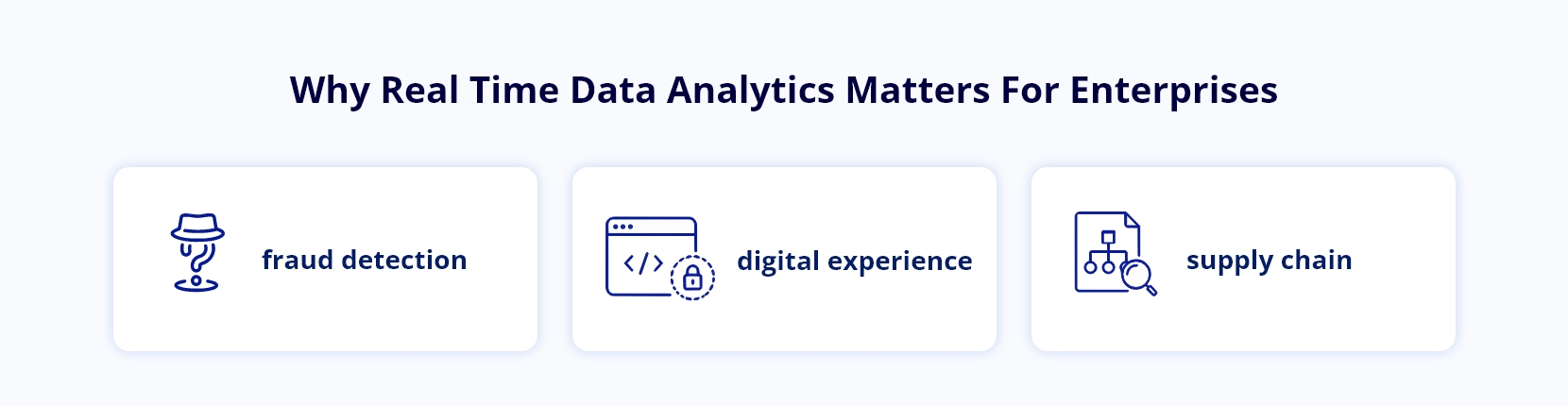
Why Real Time Data Analytics Matters For Enterprises
Most enterprises already own pieces of a modern stack, yet real time analytics still feels out of reach. The blocker usually isn’t technology. It’s the gap between batch habits and streaming expectations.
Look at three areas where this shows up quickly: fraud detection, digital experience, and supply chain.
- Fraud teams miss windows measured in seconds, not hours.
- Product owners can’t see checkout failures while they’re still happening.
- Operations teams reorder based on weekly reports instead of current demand.
Real time data processing changes the default. Instead of “analyze, then act later,” your systems evaluate events as they arrive, apply business logic, and either automate a response or put a clear decision in front of a human.
From Batch To Streaming: What Changes In The Architecture
Shifting from batch to continuous requires rethinking how data arrives, is processed, and is exposed to consumers. You’re not just adding a new tool; you’re introducing a different operating model for data.
A typical real time data platform for an enterprise has four layers: ingestion, processing, storage, and serving. You can start small, but all four pieces need to exist in some form if you want something that scales.
Core Components Of A Real Time Data Platform
At the edge, you have message brokers and event logs handling data streaming from applications, devices, and external feeds. This is where tools like Apache Kafka or cloud-native equivalents sit, taking the place of traditional file drops and database polls.
In the processing layer, streaming analytics engines run continuous queries, joins, and aggregations. Instead of nightly jobs, you define standing logic that reacts to each event, window of events, or pattern as it happens.
Designing Real Time Data Architecture For Scale
Real time data architecture succeeds or fails on three design decisions: how you model events, how you manage state, and how you deal with late or out-of-order data. Get those wrong and you’ll see inconsistent numbers and broken alerts within weeks.
Start with event contracts that are versioned and documented. Keep payloads lean, but include the business keys and timestamps that downstream teams need so they don’t rebuild context from scratch.
Use Cases That Actually Benefit From Streaming Analytics
Not every problem justifies streaming analytics. The litmus test is simple: does the value of the decision decay rapidly with time? If a two-hour delay doesn’t matter, keep it batch and save yourself complexity.
Here are enterprise scenarios where streaming clearly pays off and tends to get funded quickly.
Operational Intelligence And Real Time Dashboards
Operations leaders want to move from static reports to real time dashboards that behave more like control panels than historical charts. Think live queue lengths, order throughput, error rates, and capacity by site or region.
When you feed these dashboards directly from streaming pipelines, you avoid the “data is fresh, metrics are stale” problem that comes from refreshing extracts every hour or two.
Fraud, Risk, And Real Time Decision Making
Fraud and risk teams rely on event streaming to score transactions before they settle. The goal isn’t to block more; it’s to block faster, while creating fewer false positives that frustrate good customers.
This is where real time decision making deserves more nuance than a simple yes or no. You can step up authentication, slow down suspicious flows, or route the event to a specialist queue instead of just rejecting it.
Customer Experience And Personalization
Digital product teams use real time business intelligence from clickstreams, app events, and support interactions to understand what’s happening in-session, not just after the fact. That lets them identify broken journeys, abandoned flows, and frustrating loops much earlier.
The same signals can drive tailored experiences: surfacing relevant content, changing offers, or triggering outreach based on behavior in the last few minutes instead of the previous quarter.
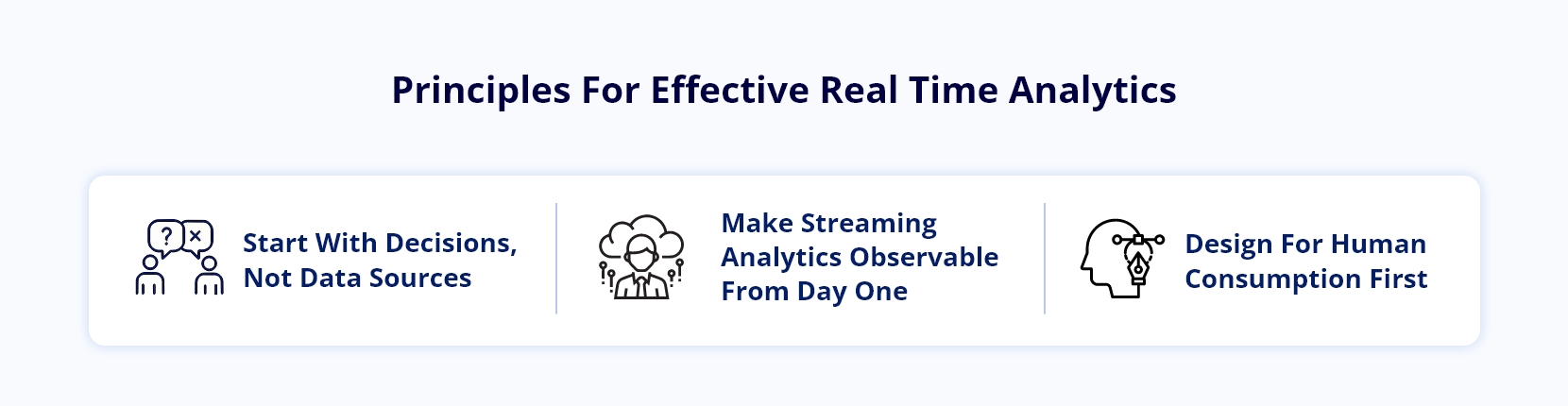
Design Principles For Effective Real Time Analytics
Implementing real time data analytics successfully has much more to do with design discipline than vendor selection. The technology will do what you ask; the hard part is asking for the right thing in a way your teams can operate.
Three principles come up again and again in projects that actually get adopted and sustained.
Start With Decisions, Not Data Sources
List the concrete decisions you want to change first: block a transaction, reprioritize a ticket, reroute a shipment, show a different offer. For each one, define the signals, tolerable delay, and who or what will act.
Then decide which signals must be in real time analytics and which can stay near real time or batch. This keeps your first releases focused and avoids boiling the ocean.
Make Streaming Analytics Observable From Day One
Real time pipelines fail in quieter ways than batch jobs. Instead of a job crashing, you get lag, dropped events, or subtle drifts in counts that only show up weeks later in financial reconciliation.
Build observability into your streaming analytics stack early: metrics for lag and throughput, dead-letter topics for bad messages, and alignment checks against source systems so you can spot silent data loss.
Design For Human Consumption First
It’s easy to over-engineer real time data processing and under-invest in the interfaces where people make choices. The result is impressive plumbing feeding dashboards that nobody checks in the moment they’re needed.
Work with end users to define alert thresholds, escalation paths, and screen layouts that help them act quickly. A slightly less sophisticated model that triggers clean, actionable alerts usually beats a complex one that drowns teams in noise.
Building And Operating A Real Time Data Platform
Once you know the decisions and patterns you care about, you still need a way to deliver them that your organization can operate over years. That’s where platform thinking comes in.
The goal isn’t to create a massive “central streaming team” that owns everything. It’s to provide shared capabilities so domain teams can build responsibly without reinventing the same pieces.
Platform Capabilities That Pay Off Early
A shared real time data platform should give teams standard ways to handle schema, access control, data quality checks, and deployment. If every squad solves those differently, your risk and operating costs climb fast.
Self-service templates for setting up new topics, pipelines, and alerts help, but only if they come with clear ownership models and guardrails instead of vague “best practices.”
Choosing Tools Without Getting Locked In
Enterprises in the U.S. and Europe often face a patchwork of on-prem systems, multiple clouds, and regulatory constraints. That’s why technology choices for data streaming need to consider portability and data residency alongside performance.
Favor patterns and contracts over any single vendor’s features. If event schemas and access patterns are clear, swapping a processing engine or broker later becomes an engineering project, not a full rewrite.
Conclusion
Real time data analytics isn’t a silver bullet, but when applied to the right decisions with the right design, it shortens the feedback loop between what’s happening and what your teams can do about it. The enterprises that win aren’t the ones with the flashiest stack; they’re the ones that treat streaming as a capability tied tightly to operations.
If you’re assessing where to start or how to mature what you already have, define the decisions that need a real time view, pick one or two high-impact use cases, and build from there with clear ownership and observability. Partners like Infocepts can help you move from slideware to working pipelines while you retain control of your data and direction.
Frequently Asked Questions
Unlock the Power of Real-Time Intelligence
Enable faster decisions with real-time data and actionable insights.
Recent Blogs


The Enterprise AI & Data Transformation Partner. Delivering measurable business impact globally.
#1 on Gartner Peer Insights · 97.2% client retention