



In this Blog
An Ad Sales executive at a global media company is preparing for a meeting with a major advertiser. It’s 8:47 a.m. The call is at 9:00. She’s not worried about the call. She’s worried about the fifteen minutes before it.
She opens the CRM. Then a campaign performance dashboard. Then her inbox, scrolling for a thread that never made it into any system of record. Then LinkedIn, then a quick web search, in case something’s changed at the advertiser’s business since the last conversation. Then a blank slide deck, because nothing from last time is sitting anywhere she can just reuse it.
By 8:59, she’s assembled a picture of the account. She has sixty seconds left to actually think about what to say.
“An organization’s ability to learn, and translate that learning into action rapidly, is the ultimate competitive advantage.” — Jack Welch, former CEO, General Electric
This is what an AI sales assistant is built to fix: a system that connects a seller’s scattered information — CRM records, campaign data, inventory, past conversations — into one place a seller can simply ask a question and get a real answer from, instead of searching multiple tools separately. This is the story of how one media company built exactly that, and what changed once they did.
The Hidden Cost of Preparing to Sell
This scene wasn’t unique to one seller having a bad morning. Across this company’s ad sales organization, Ad Sales executives were losing an estimated two to three hours every day to exactly this pattern — before a single client conversation had even started.
The data backs up why this happens everywhere in media, not just here. Salesforce’s State of Sales research finds reps spend only about 30% of their time actually selling; the rest goes to research, coordination, and preparation. Gartner’s 2024 seller survey found something sharper: reps who partner well with AI tools are 3.7 times more likely to hit quota than those who don’t. McKinsey estimates generative AI could add $0.8 to $1.2 trillion in productivity across sales and marketing functions alone.
At this company, the pattern showed up exactly as the numbers predict. A single advertiser relationship touched campaign delivery, inventory, audience data, and pricing history — spread across systems that were never built to talk to each other. The CRM knew the relationship. The campaign platform knew the delivery. The inventory system knew what was available. None of the three was aware the other two existed.
It didn’t help that the company’s sellers, like sellers everywhere now, had less patience for this than any generation before them. They expected immediate answers, not a ticket in a queue. They wanted frictionless processes, not five logins before one question got answered. They sought information that was current, relevant, and specific enough to actually use — not a generic report they still had to interpret.
This was also a bigger problem than sales operations. Databricks’ own FY26 Data Intelligence Outcome Maps frame media and advertising around a strategic pillar called “Monetize Your Audience & Content” — pricing, inventory, forecasting, and ad portfolio decisioning. Monetization doesn’t happen only inside a pricing engine. It happens when a seller decides what to recommend to a specific advertiser, and a perfectly calibrated pricing model still produces weak outcomes if that seller is working from stale context. The fifteen minutes before every call wasn’t a productivity footnote at this company. It was friction sitting directly inside the revenue engine.
Why the Fragmentation Doesn’t Fix Itself
The fragmentation wasn’t a tooling gap the company could patch its way out of. Three things made it structural.
Each system was built for its own job, not for the others. The CRM was built to track relationships. The campaign platform was built to report delivery. The inventory system was built to manage availability. None of the three was ever designed to share a data model with the other two — so pulling everything together meant a person doing that reconciliation by hand, every time, because no system was going to do it for them.
External context had no home at all. Unlike a piece of information trapped in one system, what’s happening on an advertiser’s LinkedIn or in the news this week doesn’t live anywhere internal to begin with. There was nothing to unlock or integrate — it had to be found fresh, from scratch, before every single meeting.
The burden scaled with the size of the book of business, not the size of the team. As a seller’s account list grew, the reconciliation work grew right alongside it — a compounding tax with no natural ceiling, unrelated to how many hours were actually available in a day.
None of this reflected a shortage of information. The company had rich CRM data, detailed campaign history, and a real handle on its own inventory. What it lacked was a system built to close these three gaps at once.
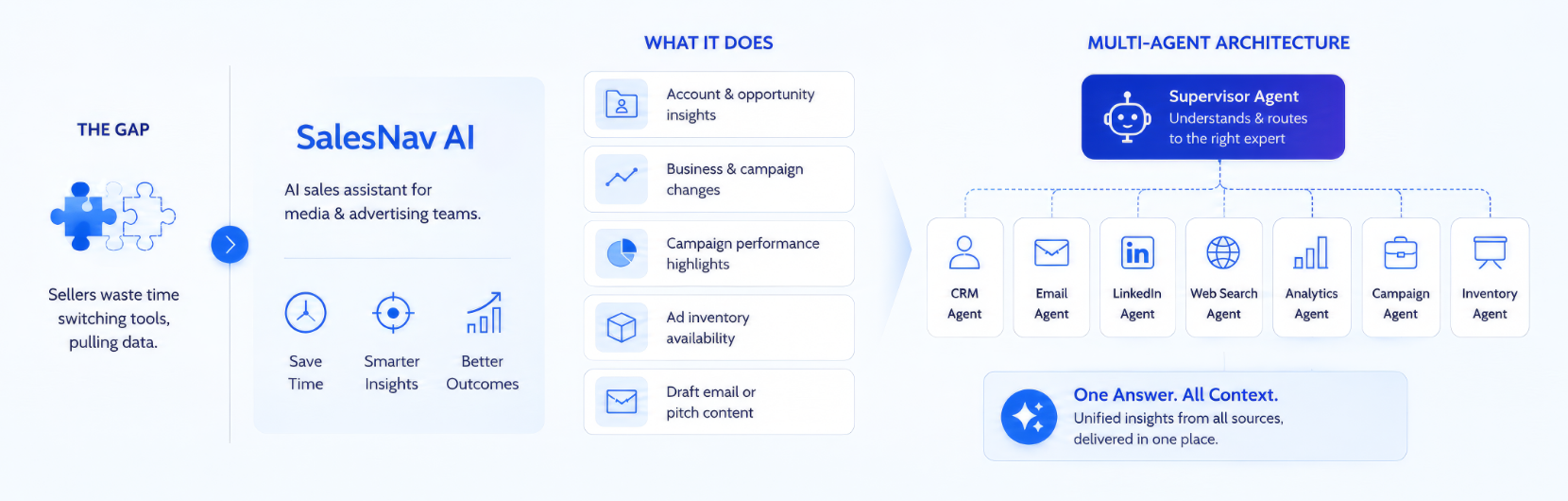
What We Built: An AI Sales Assistant for Media Ad Sales
This is the gap Infocepts set out to close with SalesNav AI, an agentic AI sales assistant purpose-built for media and advertising sales teams, developed on the Databricks Data Intelligence Platform.
Calling it a chatbot undersells what it does. Think of it less as a tool a seller opens, and more as a colleague who already knows the account – one who can:
- Pull account history and opportunity status the moment it’s asked for
- Summarize what’s actually shifted at an advertiser’s business this week, not last quarter
- Surface which campaigns performed well, and why, without a manual report pull
- Check what inventory is realistically available before a number gets promised
- Draft the follow-up email or the first slide of a pitch, grounded in everything above
Underneath, it runs on a multi-agent architecture – a Supervisor Agent that interprets a seller’s question and routes it to the specialist built for that exact job, rather than one generalized model trying to do all of it at once:
- CRM Agent: Account history and opportunity status
- Outlook Agent and Email/Content Generator Agent: Email context and follow-up drafting
- LinkedIn Agent and Web Search Agent: External context on the advertiser
- Data Analyst Agent: Past campaign performance
- Campaign Prep Agent and Ad Inventory Agent: Packaging and availability
A single generalized model asked to be equally good at retrieval, research, analysis, and content generation tends to be mediocre at all four. Ask “what should I know before my next meeting with this advertiser?” and the answer draws on the CRM Agent’s history, the Outlook Agent’s recent threads, the LinkedIn and Web agents’ external signal, and the Ad Inventory Agent’s real-time availability — synthesized into one answer, not five tabs a seller has to reconcile themselves.
The Databricks Foundation Underneath It
None of this works without a governed, unified data foundation underneath – and this is where the platform choice stops being incidental and becomes the reason an agentic system can actually be trusted with commercial data.
Data Governance:
Unity Catalog – Every piece of data the system touches – tables, files, models – is tracked centrally, so there’s always a clear record of what data went into any given answer. Without this, an AI system risks becoming a black box nobody can explain. For CRM and revenue data specifically, being able to answer “why did it recommend this” isn’t optional.
Data Storage:
Delta Tables – CRM, campaign, and inventory data live here, updated continuously instead of once a night. LinkedIn and web research refresh daily too, so external context on an advertiser is never more than a day old.
Search:
Vector Search – Normal keyword search only works if you type the exact right word. Vector Search finds relevant information by meaning instead, so it can surface a similar past deal or objection even when the seller’s question uses completely different words than the old record does.
Reasoning:
Databricks Foundation Models – This is the part that actually thinks – understanding what the seller is asking, pulling together what each specialist agent found, and turning it into a real answer or recommendation, not just a pile of retrieved data.
The Interface:
Databricks Apps – The chat window a seller actually types into is built directly on the platform, not bolted on separately – which keeps it fast and keeps the same security and governance in place all the way to the seller’s screen.
Staying Reliable:
MLflow – Every question and answer gets logged and tracked, so the system can be checked and improved over time – instead of quietly getting less accurate as accounts and campaigns change.
This is the same platform relationship behind Infocepts’ broader work in media: Infocepts holds Databricks Silver Partner status, ranked #1 in Databricks’ “Elevate & Accelerate – Rising Challenge,” with 300+ Databricks certifications delivered in a single quarter – the same certified team building SalesNav AI builds the rest of Infocepts’ Databricks-native media portfolio.
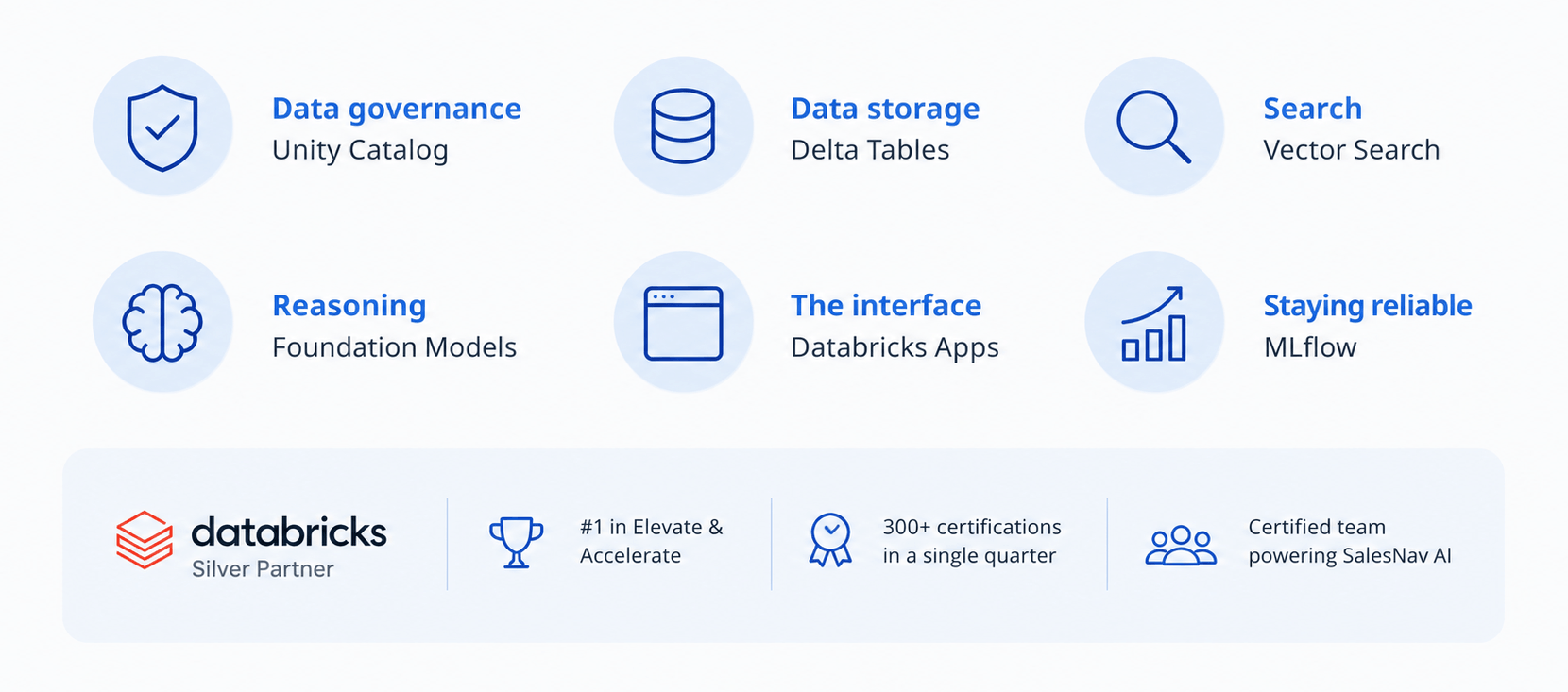
The Component View
This section is for data and platform teams evaluating the architecture directly. Skip it if you came for the business outcome.
Each component above maps to a specific result this company measured:
| Result | Driven By |
|---|---|
| 30%+ reduction in deal prep time | Parallel retrieval across CRM, Outlook, LinkedIn, Web Search, and Ad Inventory agents — delivered through one Databricks Apps interface instead of five separate systems |
| 3x faster access to account and revenue insight | Vector Search running against Unity Catalog-governed data, finding relevant precedent through meaning rather than exact keyword matches |
| 25% improvement in follow-up effectiveness | The Email/Content Generator Agent, powered by Foundation Models, drafting follow-ups grounded in what the CRM and Data Analyst agents actually retrieved |
| 2-4 hours returned per seller per week | Delta Tables’ daily refresh cycle, keeping account and external context current without anyone manually re-pulling a report |
| Consistency across deployments, not a one-time spike | MLflow, keeping model accuracy and relevance stable as account data and campaigns change over time |
What Changed for the Sales Organization
The deployment didn’t ask sellers to change how they worked. It gave them one place to ask the questions they were already asking themselves before every meeting, and to get back an answer instead of four places to go looking for one.
Early-deployment results across the rollout: a 30%-plus reduction in deal preparation time, a 25% improvement in follow-up effectiveness, two to four hours returned to each seller every week, and a threefold improvement in how quickly sellers can access relevant account and revenue insight. (These describe the consistent pattern the architecture produces across early deployments, not a single figure claimed by one customer.)
The qualitative shift tracked with the numbers. Sellers at this company responded to advertisers faster, since research happened inside the same conversational flow as the response itself. Engagement improved and conversion rates rose, since outreach was grounded in current, specific context instead of a generic template. Pitches started from what the organization already knew about an account instead of a blank page — more relevant, more attractive, without a seller building each one by hand. And with less time spent reconstructing account history, sellers had more time left for the part of the job that actually closes deals: the relationship itself.
None of it required sellers to work harder — it required removing the obstacle standing between information the organization already had and the moment a seller needed it.
What an AI Sales Assistant Means for Sales Leaders
If you’re leading a media ad sales team, the question isn’t whether AI belongs in the process — Gartner’s data already answered that. It’s whether the platform underneath it can be trusted with commercial data at all. A fast, ungoverned AI layer on top of scattered systems just automates the mess faster; a governed foundation is what makes the speed usable.
Sellers were never short on information — media organizations have spent the past decade investing in the systems that hold it. The problem was time: too much of a seller’s morning went to finding and assembling what those systems already knew, instead of acting on it. Jack Welch was talking about entire organizations when he said speed from learning to action is the ultimate competitive advantage. For this media company’s ad sales team, that advantage now starts at 8:47 a.m. — in the fifteen minutes before a call, where the only real question is whether a seller spends that time searching, or thinking.
Frequently Asked Questions
An AI sales assistant is a system that connects a seller’s fragmented information sources – CRM, campaign data, inventory, and external research – into a single conversational interface, so sellers can ask questions in plain language and receive synthesized, actionable answers instead of searching multiple systems manually.Agentic AI in sales typically uses a Supervisor Agent to interpret a seller’s question and route it to specialist agents, each responsible for a specific data source or task, rather than relying on one generalized model to handle every request.By connecting CRM, campaign performance, inventory, and external research into one system a seller can query directly, AI can eliminate the manual work of searching across disconnected platforms before a client conversation.Databricks provides the governed data foundation an enterprise AI sales assistant depends on – including Unity Catalog for governance, Delta Tables for structured commercial data, Vector Search for contextual retrieval, Foundation Models for reasoning and generation, and Databricks Apps for the seller-facing interface.Beyond pricing and yield optimization, media companies can improve advertising revenue by giving sellers faster access to account context, campaign performance, and inventory availability – helping them make better-informed recommendations and move commercial conversations forward more quickly.An AI sales agent is a specialized AI component built to handle one specific task in the sales process — pulling CRM data, researching a prospect externally, or drafting a follow-up — rather than one general-purpose assistant trying to do everything. In agentic systems like SalesNav AI, multiple specialist agents work together under a Supervisor Agent, each handling the part of the job it’s actually built for.Generative AI for sales refers broadly to AI that creates content — emails, pitch decks, follow-ups — based on a prompt. An AI sales assistant is a complete system built around that capability: it doesn’t just generate content, it retrieves the actual account, campaign, and inventory data a seller needs first, then uses generative AI to turn that real information into something usable. Generative AI is one component; the assistant is the whole system.Transform Ad Sales with Agentic AI
Empower sellers with instant access to account intelligence, campaign insights, and inventory data to reduce prep time and increase sales productivity.
Talk to Our Experts
Frequently Asked Questions
Transform Ad Sales with Agentic AI
Empower sellers with instant access to account intelligence, campaign insights, and inventory data to reduce prep time and increase sales productivity.
The Infocepts Media & Entertainment COE helps streaming, publishing, and content businesses harness data to grow audiences and optimize revenue. The team specializes in content analytics, subscriber intelligence, ad tech data, and building the data foundations modern media companies need to compete.
Read Full BioRecent Blogs

10 Best Databricks Consulting Services for Life Sciences and Pharmaceutical Companies
October 22, 2026

Data Engineering Services Pricing: How much do Data Engineering Consulting Firms Charge in 2026?
October 21, 2026

10 Best Data Engineering Service Providers for Manufacturing Companies in 2026
October 20, 2026

The Enterprise AI & Data Transformation Partner. Delivering measurable business impact globally.
#1 on Gartner Peer Insights · 97.2% client retention