



Contextual vs Behavioral Advertising: A Signal-Loss Decision Matrix
Contextual advertising places ads based on the content a person is viewing. Behavioral advertising places ads based on what a person has done before. As user-level signals shrink, the useful question is no longer which one is better in general, but which one fits a particular campaign, environment and level of risk.
This guide defines both approaches, explains where each works and fails, and offers a two-axis decision matrix you can apply campaign by campaign. It also covers how to test the two fairly, because most claims about which “wins” depend on how the comparison was set up.
What each approach uses
| Contextual | Behavioral | |
|---|---|---|
| Signal | Content, topic, sentiment, scene, mood | Past browsing, viewing, purchases, app use |
| Needs user identity | No | Usually |
| Privacy exposure | Low | Higher, regulated in many regions |
| Strength | Relevance in the moment, brand fit | Reaching the right person across sites and devices |
| Weakness | Misses interested people on unrelated content | Depends on signals that are disappearing |
| Typical cost | Often modest premium for quality content | Premium for data, plus fees |
Neither is new. What has changed is the supply of the signals behavioral targeting relies on, and the capability of the tools behind contextual.
How behavioral targeting works
Behavioral targeting builds audiences from observed actions: pages visited, titles watched, products viewed, purchases made. A user who watched three cooking shows and searched for kitchen knives is placed in a “home cooking” audience, and ads follow them across properties.
Its main advantages are reach and efficiency for direct response. It can find a likely buyer on any site or app. Its main risks are:
- Signal loss. Cookie restrictions, device privacy settings and consent choices reduce the data available.
- Match errors. Cross-device links may be wrong, and audiences go stale.
- Brand exposure. The ad follows the person, including onto content the brand would not choose.
- Regulatory scrutiny. Rules on profiling and consent differ by region.
How contextual targeting works
Contextual targeting reads the content around the ad and matches it to the advertiser’s goals. Early versions used keyword lists. Current versions can classify:
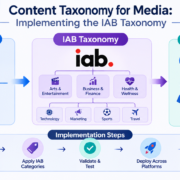
- topics and categories from a standard taxonomy,
- sentiment and tone of the content,
- scenes, objects and moods in video,
- suitability tiers for sensitive subject matter.
Because it works from the content, it needs no personal data, and it can place a hiking boot ad on a mountain documentary in real time. Its limits are that it can only reach people consuming relevant content at that moment, and the quality depends on how well the content is tagged. See our guide to content taxonomy for media.
The decision matrix
Rate two things for the campaign.
- Signal availability: Do you have reliable, consented user-level data in this environment?
- Brand risk sensitivity: How costly is an unsuitable placement for this advertiser?
| Low brand risk sensitivity | High brand risk sensitivity | |
|---|---|---|
| High signal availability | Behavioral, with contextual as a check | Behavioral on pre-cleared contexts |
| Low signal availability | Broad contextual | Contextual with strict suitability rules |
Reading the four cells
High signal, low risk. A retailer retargeting known customers in logged-in environments. Behavioral will perform, and a contextual layer adds relevance and reduces waste.
High signal, high risk. A bank advertising to known prospects, but only beside approved content. Combine both: use the audience, then restrict to cleared contexts.
Low signal, low risk. A new product launch on a connected TV app with little user data and a tolerant brand. Broad contextual targeting by genre and mood is a sensible start.
Low signal, high risk. A family brand on streaming, where identifiers are scarce and content risk matters. Use contextual with tight suitability tiers and scene-level exclusions.
Making contextual better than keyword matching
Contextual’s reputation as a blunt tool comes from the keyword era. Modern approaches go further.
- Taxonomy-based categories give consistent labels across publishers.
- Sentiment and tone scoring avoid cheerful ads beside distressing content.
- Scene and moment detection in video lets you place ads in natural breaks that match the mood.
- Brand suitability tiers let advertisers choose a comfort level instead of a blunt block list.
Better tags mean more precise placements and a stronger argument to advertisers. For publishers, this is also a revenue lever: well-labeled inventory can be packaged and priced as premium contextual segments.
Measuring the comparison fairly
Claims about which approach works better are only as good as the test behind them. A fair comparison follows a simple design.
- Same creative, same budget, same flight dates.
- Randomize or match the audience. Contextual cells should not get systematically easier traffic.
- Define the outcome in advance: cost per completed view, conversion rate, brand lift or cost per acquisition.
- Run long enough to collect a readable sample.
- Add a third cell that combines both. The combination often wins, and it tells you how much each layer adds.
- Judge on cost per outcome, not click rate alone.
Illustrative result
| Cell | Spend | Conversions | Cost per conversion |
|---|---|---|---|
| Behavioral only | 20,000 | 400 | 50.0 |
| Contextual only | 20,000 | 320 | 62.5 |
| Combined | 20,000 | 450 | 44.4 |
Numbers are illustrative. In this case behavioral beats contextual on efficiency, but the combination beats both. A team that only compared the first two would miss the best option.
Where each approach fits by campaign type
| Campaign goal | Lean toward | Reason |
|---|---|---|
| Brand awareness on premium content | Contextual | Fit and safety matter more than precision |
| Retargeting known customers | Behavioral | Identity is available and value is clear |
| New customer acquisition with limited data | Contextual plus lookalike | Reaches interest without individual tracking |
| Sensitive categories (finance, health, family) | Contextual with strict rules | Lower privacy and brand risk |
| Seasonal or event-driven promotions | Contextual | Moment relevance beats long-term profile |
What publishers should do
Publishers face a choice about where to invest.
- Tag your content richly. Better metadata unlocks contextual demand.
- Build first-party audiences from logged-in viewers, which keeps behavioral options alive.
- Offer both, with transparency about how segments are built and what they cover.
- Provide suitability controls so advertisers can set their own comfort level.
Pricing and packaging considerations
The choice also affects economics, which matters to publishers and buyers alike.
- Contextual packages can be priced as curated inventory. A “premium outdoor sports” bundle with scene-level tagging gives buyers a clear reason to pay more than for run-of-site.
- Behavioral audiences typically carry a data fee on top of media cost, and the value depends on match quality and freshness.
- Combined buys need a clear price logic, so buyers know what each layer costs and what it adds.
For advertisers, compare on cost per outcome, not CPM. A higher CPM can still be cheaper per conversion if the targeting is sharper.
A practical rollout plan for a publisher
If you are deciding where to invest, a staged approach lowers risk.
- Audit your tags. What share of inventory has reliable topic, sentiment and suitability labels?
- Fix the biggest gaps first, usually top-viewed titles and sensitive categories.
- Launch two or three contextual packages and measure them against run-of-site.
- Grow your logged-in audience to protect behavioral options.
- Share results with buyers in a simple one-page comparison.
- Expand to more packages based on what sells and performs.
The aim is to give advertisers a menu they can understand, and evidence that each option works.
Common mistakes
- Treating contextual as a fallback only. It is often the right primary choice.
- Treating behavioral as always more effective. Efficiency depends on data quality and recency.
- Comparing the two without matching audiences.
- Using block lists in place of suitability tiers, which cuts reach without improving fit.
- Ignoring consent and regional rules when building behavioral audiences.
Where Infocepts fits
SentimentVista AI scores content sentiment and context so contextual packages can be built and sold with confidence, and it supports suitability tiers advertisers can understand. For related reading, see brand suitability for publishers, content taxonomy for media and identity resolution for publishers.
FAQ
What is contextual advertising?
It is advertising matched to the content around the ad, such as an outdoor gear ad on a hiking video.
What is behavioral advertising?
It is advertising matched to a person’s past actions, such as sites visited or shows watched.
Is contextual advertising better without cookies?
It does not rely on user identifiers, so it is more resilient to signal loss, but it is not automatically more effective for every goal.
Can you combine contextual and behavioral targeting?
Yes. Many teams use behavioral to find the audience and contextual to ensure relevance and brand safety.
Which is better for brand safety?
Contextual targeting with suitability tiers gives more control over where ads appear, since it works from the content itself.
Does contextual advertising work on CTV?
Yes, especially with scene and genre-level tagging. Quality depends on how well the video content is classified.
Recent Blogs


The Enterprise AI & Data Transformation Partner. Delivering measurable business impact globally.
#1 on Gartner Peer Insights · 97.2% client retention