
Why Connected Intelligence Will Define the Next Decade of Growth
Not long ago, during a conversation with a senior commercial leader at a global pharmaceutical company, I asked a simple question:
“What’s preventing your organization from moving faster?”
I expected the usual answers: outdated systems, data quality issues, technology investments, or organizational change. Instead, the answer was surprisingly direct:
“Everyone has data. Everyone has dashboards. The problem is that nobody is looking at the same picture.”
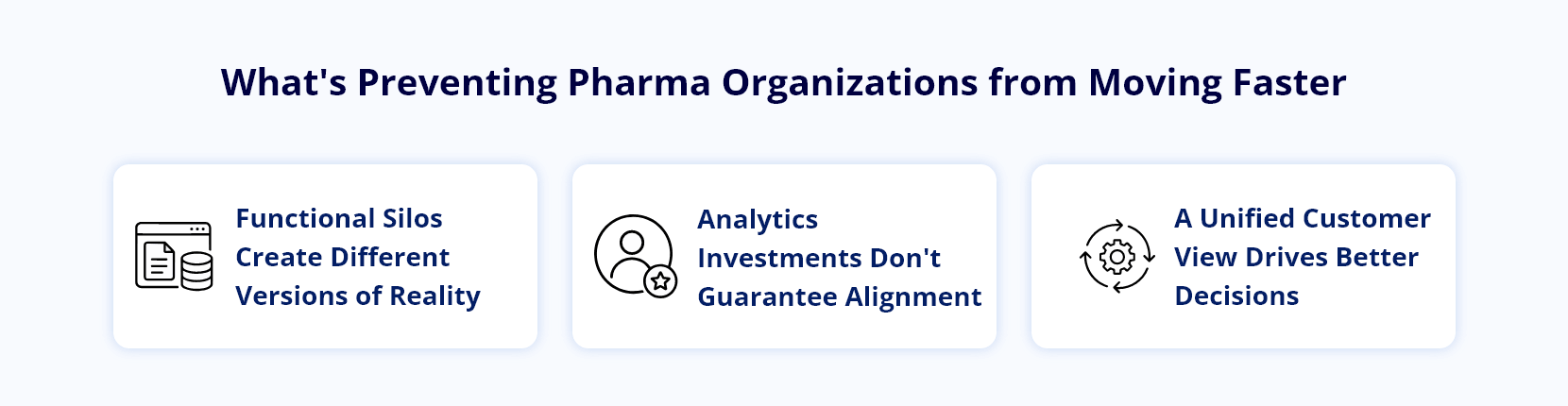
That observation perfectly reflects the current state of the pharmaceutical industry.
Over the past decade, life sciences organizations have invested heavily in commercial analytics, CRM platforms, omnichannel engagement, sales force effectiveness programs, customer engagement solutions, and data modernization initiatives. Yet many companies continue to struggle with fragmented decision-making because critical insights remain trapped within individual functions. Commercial teams maintain one view of the customer, while Medical Affairs and Market Access often operate from different perspectives.
As leaders gather at the 4th Annual Pharma Commercial & SFE Summit in Budapest, discussions will focus on:
- Commercial Excellence
- Sales Force Effectiveness
- Omnichannel Engagement
- Customer Experience
- Digital Transformation
- Cross-Functional Collaboration
While these priorities may appear different, they all point toward the same challenge:
creating a connected view of customers, markets, and opportunities.
The Industry Is Moving Beyond Reporting
For years, pharmaceutical organizations focused on reporting and visibility. The goal was straightforward:
- Build dashboards
- Monitor performance
- Measure engagement
- Improve operational efficiency
That approach delivered value, but customer expectations have evolved.
Today’s healthcare professionals engage through multiple channels. They attend webinars, consume digital content, interact with Medical Science Liaisons, meet with field representatives, review scientific evidence, and participate in virtual events.
From the customer’s perspective, these interactions are part of a single journey.
However, many organizations continue to manage them through disconnected systems and disconnected teams.
Customers experience one journey. Most organizations still manage five or six separate ones.
That gap is becoming increasingly difficult to ignore.
Why Commercial Excellence Needs a New Operating Model
Traditional Sales Force Effectiveness programs were designed to improve field productivity. Success was measured through metrics such as:
- Reach
- Frequency
- Territory Coverage
- Call Activity
While these metrics remain important, they no longer explain customer behavior.
Today’s commercial leaders need answers to more strategic questions:
Questions Leaders Need Answered
- Which HCPs require engagement today?
- Which channel is most effective for outreach?
- What content is most relevant?
- What scientific topics are driving interest?
- What is the next best action?
These questions cannot be answered through isolated reporting.
They require connected decision-making across functions.
The focus is shifting from measuring activity to improving decision quality.
Organizations that make this shift will gain a significant advantage in customer engagement, commercial performance, and market responsiveness.
Connected Intelligence Is Closing the Gap
At Infocepts, we refer to this approach as Connected Intelligence (CoIN), a framework that connects commercial, medical affairs, market access, patient, and customer engagement data through a shared intelligence layer.
The concept is simple.
Every function generates valuable insights, but those insights often remain isolated within separate systems and teams.
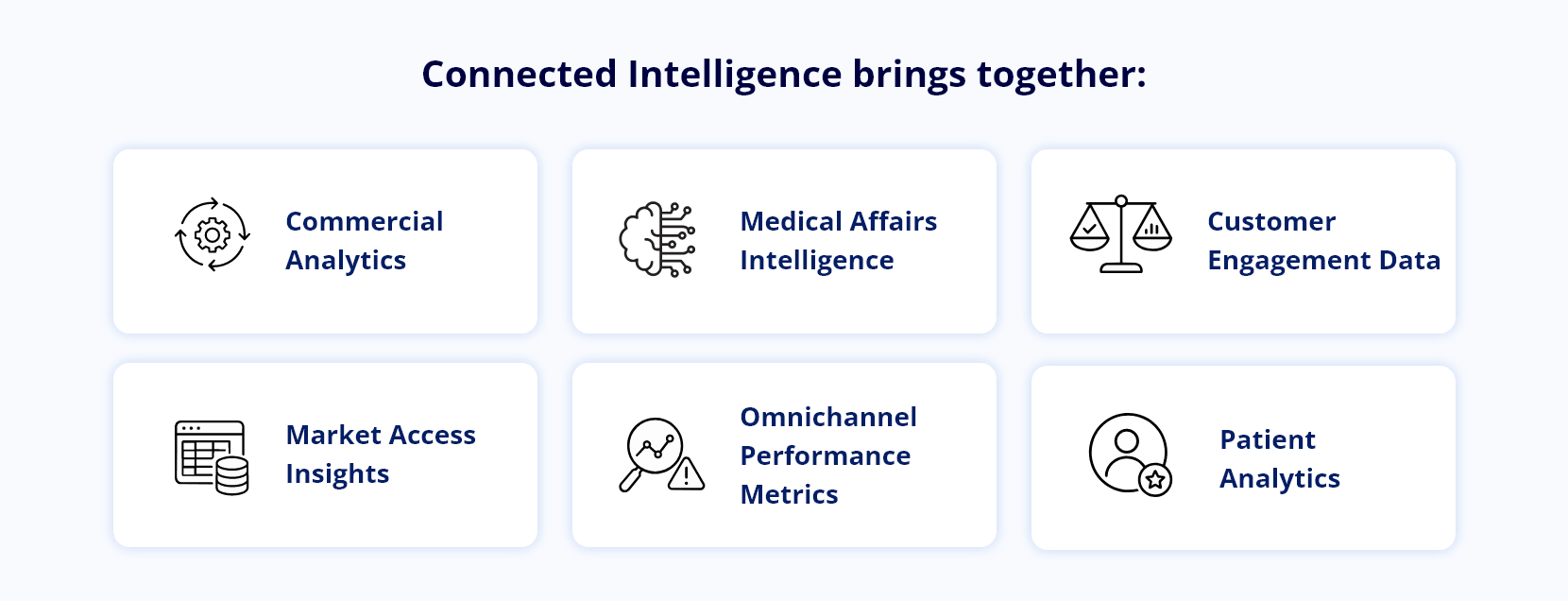
Connected Intelligence brings together:
- Commercial Analytics
- Medical Affairs Intelligence
- Customer Engagement Data
- Market Access Insights
- Omnichannel Performance Metrics
- Patient Analytics
The objective is not simply to integrate data.
The objective is to create context that helps teams make better decisions.
Business Impact
When organizations establish a connected intelligence foundation:
- Commercial teams gain greater visibility into customer needs.
- Medical Affairs contributes richer scientific insights.
- Leadership gains a unified view of performance.
- Field teams receive more relevant recommendations.
- Customers experience more personalized engagement.
From Connected Intelligence to Decision Intelligence
Connecting data is only the first step.
The next frontier is helping teams make better decisions.
As artificial intelligence becomes increasingly embedded across commercial functions, organizations are moving beyond descriptive reporting toward decision intelligence.
AI can help organizations:
- Identify emerging engagement opportunities
- Recommend next best actions
- Improve targeting effectiveness
- Surface relevant scientific insights
However, AI is only as effective as the intelligence it can access.
Without a connected view of commercial, medical, customer, and market signals, AI risks amplifying fragmentation rather than reducing it.
The real opportunity lies in combining Connected Intelligence with AI-driven decision support.
Key Takeaway
“The Future Is AI Built on Connected Intelligence”
Why HCP Engagement Is Becoming the Ultimate Differentiator
Most pharmaceutical companies have access to similar technologies.
Many use comparable:
- CRM platforms
- Analytics tools
- Engagement channels
The real differentiator is no longer technology.
The differentiator is engagement quality.
Forward-looking organizations focus on:
- Relevance
- Timing
- Context
- Personalization
Instead of asking:
“Which channel performs best?”
Organizations are now asking:
“How do we create meaningful engagement throughout the customer journey?”
Companies that answer this question successfully create stronger relationships with healthcare professionals while improving commercial outcomes.
Medical Affairs Is Becoming a Strategic Growth Driver
One of the most significant trends across life sciences is the growing strategic role of Medical Affairs.
Medical Affairs teams generate valuable insights around:
- Scientific discussions
- KOL sentiment
- Emerging evidence trends
- Evolving customer needs
Historically, these insights were often separated from commercial planning.
That model is changing.
Today, leading pharmaceutical companies increasingly recognize that Medical Affairs Intelligence can strengthen:
- Targeting
- Customer Engagement
- Commercial Decision-Making
As a result, Medical Affairs is becoming a key contributor to business growth rather than serving solely as a scientific support function.
Intelligent Omnichannel Engagement
Nearly every pharmaceutical company has invested in omnichannel capabilities.
The next challenge is making those capabilities more intelligent.
Many organizations still evaluate channels individually by tracking:
- Email Performance
- Webinar Attendance
- Field Interactions
- Digital Engagement
Customers, however, do not think in channels.
Customers think in experiences.
Organizations leading the next wave of commercial transformation focus on understanding how interactions work together to influence customer decisions.
This Requires Visibility Across
- Commercial Interactions
- Medical Engagements
- CRM Activity
- HCP Preferences
- Digital Behavior
- Market Dynamics
Organizations that connect these signals gain deeper customer understanding and deliver more personalized experiences at scale.
The Future Belongs to Decision-Driven Organizations
The next generation of pharmaceutical leaders will not necessarily have the most data.
They will have the clearest understanding of what matters.
They will connect:
- Commercial Excellence
- Medical Affairs
- Customer Engagement
- Field Force Effectiveness
- Omnichannel Strategy
- Market Access
Through a shared intelligence framework.
As a result, they will:
- Reduce decision latency
- Improve customer understanding
- Act with greater confidence
- Create sustainable competitive advantage
The future of pharmaceutical growth depends less on collecting information and more on using intelligence effectively.
Looking Ahead
The themes emerging from the 4th Annual Pharma Commercial & SFE Summit are clear:
- Commercial Excellence
- Customer Engagement
- Sales Force Effectiveness
- Digital Transformation
- Omnichannel Engagement
- AI-enabled Decision Making
- Data-Driven Decision-Making
What connects all of them is intelligence.
Not isolated intelligence.
Connected intelligence.
The pharmaceutical companies that lead the next decade will not be those with the most dashboards or the largest technology investments.
They will be the organizations that connect commercial, medical, market access, patient, and customer intelligence into a single decision-making framework.
Because the future of Pharma Commercial Excellence will not be defined by who has the most data.
It will be defined by who can turn insight into action.
Frequently Asked Questions
Transform Pharma Commercial Excellence with Connected Intelligence
Empower commercial teams with AI-driven insights, omnichannel HCP engagement, and advanced analytics to improve field force effectiveness, optimize decision-making, and accelerate growth across the pharmaceutical value chain.

Bashdar Ismaeel brings over 25 years of experience across life sciences and healthcare, working at the intersection of data, AI, and advanced analytics. He partners with pharmaceutical and healthcare organizations to design and deliver intelligent, scalable solutions that connect R&D, medical...
Read Full BioRecent Blogs



Infocepts