



Pre-call planning in ad sales is the preparation a seller completes before an advertiser meeting: one clear goal, the account and deal context, the right offer and a plan for the next step. Most media sales teams do it by hand across CRM, email and spreadsheets, which is why pitch-to-pay drags. This guide gives you a six-question framework, a copy-paste template, a buyer’s checklist for pre-call planning software, and a view of how ad sales software such as SalesNav AI automates the work.
What Is Pre-Call Planning in Ad Sales?
Pre-call planning is the work a seller does before a customer meeting to decide what the meeting must achieve and to gather what is needed to achieve it. In ad sales, that means knowing the advertiser’s goals, the history of past deals and pricing, which inventory and formats fit their plan, what they are likely to ask, and which approvals may be needed afterwards. The result is a short brief the seller can scan in minutes.
Pre-Call Planning vs. Sales Call Preparation
They are the same discipline. Sales call preparation is the more common phrase for individual meetings. Pre-call planning often describes the repeatable routine a team follows. This guide uses both.
Why Pre-Call Planning Matters More in Media Sales
Media deals combine several moving parts at once: audience and measurement requirements, inventory across linear and digital, negotiated pricing and contract terms, and internal approvals. A rep who arrives without that context spends the meeting collecting it, and the next step slips.
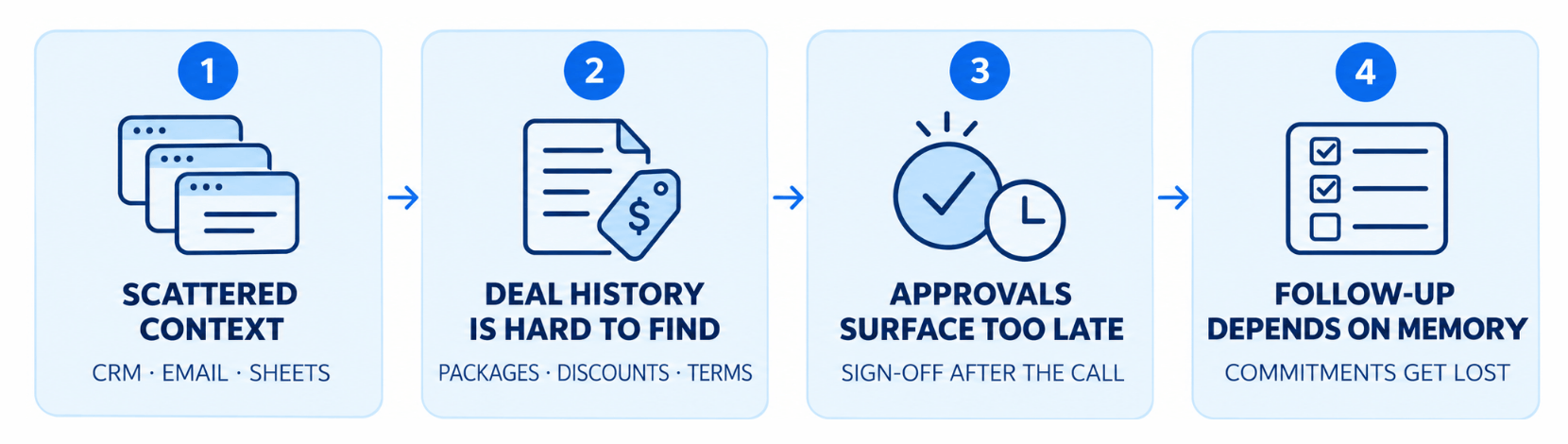
Why Pre-Call Planning Breaks Down in Media Sales
Media sellers rarely lack effort. They lack connected context. Four failure points repeat across teams.
Context Is Scattered
Account history sits in CRM, conversations sit in email and notes, and working numbers sit in spreadsheets. Assembling a complete picture means opening several tools before every call.
Pricing and Deal History Are Hard to Find
Past packages, discounts and contract terms live in contracts and sheets. Without them, pricing drifts between reps and between accounts.
Approvals Surface Too Late
When approvals are manual, the need for sign-off often appears after the call. That stretches the time from agreement to invoice.
Follow-Up Depends on Memory
Next steps, commitments and open questions are logged afterwards, if at all. The next meeting starts from the rep’s recollection instead of a record.
The Pre-Call Planning Framework for Advertiser Meetings
A useful pre-call plan answers six questions. The table shows what to prepare, where it usually lives today, and why it matters.
| Question | What to prepare | Where it usually lives | Why it matters |
| What is the goal of this call? | One outcome: proposal, pricing, approval or next meeting | The rep’s head or notes | Keeps the meeting moving toward agreement |
| Who is the advertiser, and what changed? | Account history, recent engagement, open proposals | CRM and email | Avoids repeating questions |
| What have we agreed before? | Past deals, pricing, discounts, contract terms | CRM, contracts, spreadsheets | Keeps pricing consistent |
| What can we offer? | Relevant inventory, formats, packages, pitch materials | Spreadsheets and decks | Matches the pitch to their plan |
| What will they ask? | Likely objections, measurement and delivery questions | Past meeting notes | Prevents delays |
| What happens next? | Agenda, next step, approvals needed | Manual approval chains | Shortens agreement to invoice |
Set One Outcome for the Call
Decide the single result you want before the meeting: an agreed proposal scope, a pricing range, an approval path or a follow-up date. A call with one outcome is easier to prepare for and easier to measure.
Know the Account and the Deal History
Review who you are meeting, what changed since the last conversation, what is open, and what was agreed before. This is the context that is hardest to gather manually and the most valuable to have in front of you.
Match the Offer to the Advertiser’s Plan
Prepare the inventory, formats and packages that fit their goals, and the materials you will share. A matched offer makes the pitch specific instead of generic.
Anticipate Questions and Approvals
List the objections and measurement or delivery questions you expect, and note any discount band or contract term that will need approval. Raising approvals before the call, not after it, is where the most time is saved.
Pre-Call Planning Template for Ad Sales
Copy this into your CRM or notes tool and complete it before every meeting.
- Advertiser and attendees: who is joining, and their roles
- Goal of the call: one outcome
- What changed since last time: recent engagement, open proposals
- Deal and pricing history: past packages, discounts, contract terms
- Offer fit: inventory, formats, packages and materials to share
- Likely questions: measurement, delivery, pricing, timing
- Approvals needed: discount band, contract terms, who signs off
- Agenda and next step: the date by which you want the next action
How AI Automates Pre-Call Planning for Ad Sales
AI removes the hunting. An AI sales assistant connects the sources a rep checks by hand and assembles the pre-call brief before every meeting. The seller reviews it, adjusts it and walks in prepared.
What an AI Pre-Call Brief Contains
A good AI brief covers the same six questions as the framework above: account context and deal progress, recent engagement, relevant history and materials, and the open items to resolve. The difference is that it is assembled for you, in minutes, from the systems you already use.
What Changes for the Seller
| Step | Without AI | With an AI sales assistant |
| Gather context | Open CRM, email, notes and sheets | One interface with the context already connected |
| Find pricing history | Search contracts and spreadsheets | History and comparable deals surfaced for the account |
| Prepare materials | Hunt for the right deck | Relevant pitch materials suggested |
| Log follow-ups | Type notes afterwards | Follow-ups and next steps drafted and captured |
How SalesNav AI Works
SalesNav AI is Infocepts’ AI sales assistant for media ad sales, built on Databricks. It gives reps instant access to CRM history, email context, meeting notes, contracts and pitch materials in one interface, and automates prep and follow-ups so reps spend more time selling. It works across your existing CRM rather than replacing it.
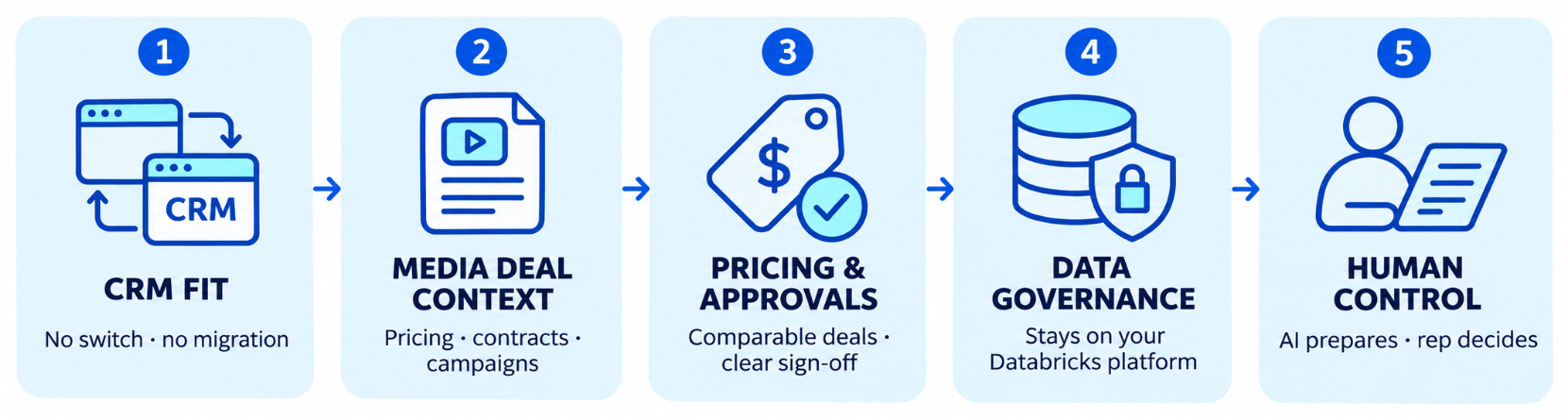
How to Choose Pre-Call Planning Software for Ad Sales
If you are evaluating tools, test them against five criteria.
Does It Work with Your Existing CRM?
Look for software that adds intelligence on top of the CRM you already use, with no platform switch and no data migration.
Does It Understand Media Deal Structures?
Generic sales assistants are built for horizontal use cases. Ad sales needs deal history, pricing, contracts and campaign context in the same view.
Does It Handle Pricing and Approvals?
The best tools surface comparable past deals for pricing and route approvals through your thresholds, so sign-off is not a surprise after the call.
Where Does Your Data Live?
Ask whether sensitive deal and pricing data stays inside your governed environment. SalesNav AI runs on your Databricks platform, so your data stays there.
Does a Human Stay in Control?
The seller should review and edit every brief and follow-up. AI prepares; the rep decides.
Example Pre-Call Brief (Illustrative)
Advertiser: [Advertiser name]. Attendees: [names and roles]
Goal of the call: Agree proposal scope and a pricing range.
What changed: Last meeting [date]. Open proposal for [campaign]. Recent engagement [summary].
Deal and pricing history: Past packages and discounts [summary].
Offer fit: Inventory and formats that match the advertiser’s plan [summary].
Likely questions: Measurement, delivery and approval timing.
Approvals needed: [discount band, contract terms].
Agenda and next step: [agenda]. Request sign-off by [date].
This is an illustrative template, not customer data.
How to Measure Whether Pre-Call Planning Works
Track four signals: prep time per meeting, the share of meetings that end with a logged next step, the time from agreement to invoice, and how often discounts need rework after the call. If all four improve over a month or two, the routine is working. Compare them against your own baseline, not a generic benchmark.
Getting Started in 30 Days
- Week 1: agree the six questions and choose one team.
- Week 2: connect CRM, email and contract sources.
- Week 3: run briefs for live advertiser meetings and collect rep feedback.
- Week 4: compare prep time and next-step capture against your baseline, then expand.
Why Media Teams Choose SalesNav AI
- One interface for CRM history, email context, meeting notes, contracts and pitch materials
- Pre-call briefs and automated follow-ups
- Pricing guidance from comparable historical deals, and approval routing
- Works across your existing CRM, with no platform switch
- Built on Databricks, so your data stays in your environment
[Optional, only after approval: customer results on pitch-to-pay time and rep selling time.]
Conclusion: Make Every Advertiser Conversation Count
Pre-call planning turns scattered context into a short brief and a clear next step. Start with the six questions and the template, then let an AI sales assistant assemble the brief so reps spend their time selling. See how SalesNav AI automates pre-call planning for media ad sales teams, or explore Infocepts’ media and entertainment solutions.
Frequently Asked Questions
Help Every Seller Walk Into Meetings Prepared
SalesNav AI helps ad sales teams automate pre-call planning, surface the right deal intelligence, and accelerate every stage of the pitch-to-pay process.
Recent Blogs


The Enterprise AI & Data Transformation Partner. Delivering measurable business impact globally.
#1 on Gartner Peer Insights · 97.2% client retention