Get Your Guide
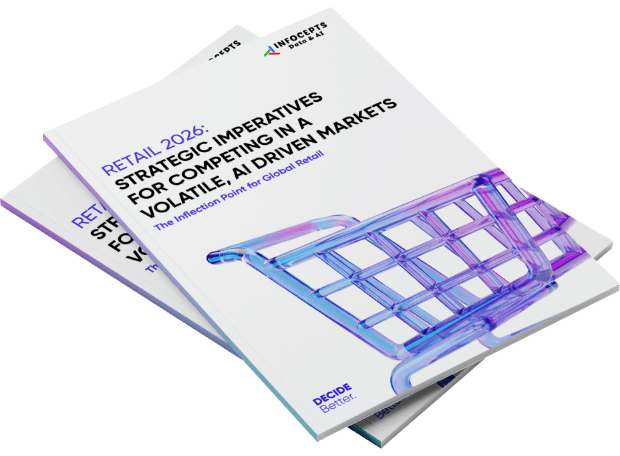
In this guide, you will find:
- The New Economic and Competitive Landscape
- The AI Imperative: Reshaping the Entire Retail Value Chain
- The Conscious Consumer: Decoding 2026 Purchase Drivers
- Strategic Mandates for 2026: A Leadership Playbook
What This Guide Covers
Retail leaders in 2026 face three concurrent forces: tariff-driven supply chain volatility that is compressing margins and disrupting sourcing, rapid AI adoption across store operations, demand forecasting, and planogram compliance that is separating leaders from laggards, and a shift in consumer expectations toward sustainability, availability, and trust. This guide provides a strategic framework built around three mandates: embed AI into core retail execution (not isolated pilots), align brand proposition with the new consumer value equation, and build agile, data-driven operating models that connect POS, ERP, inventory, and workforce management (WFM) through a shared data foundation.
The guide is authored by Sudharsanam R (Enterprise AI & Business Solutions, Infocepts) and Dipeeka Jalan (Functional Architect, Retail COE, Infocepts), drawing on Infocepts’ work as a Databricks Silver Partner with Brickbuilder Specializations in Retail, Consumer Goods & Travel, with retail AI solutions deployed on the Databricks Lakehouse using Unity Catalog for data governance and AI/BI Genie for conversational analytics.
The Three Forces Reshaping Retail in 2026 & 2027
Tariff turbulence is a structural shift, not a temporary disruption. Retailers are navigating continuous disruptions to cost, availability, and supplier relationships. Zara invested in digital inventory management and diversified sourcing partners to maintain agility. Walmart adopted dynamic supply chain forecasting and real-time analytics to optimize global sourcing and mitigate tariff risk. For the foreseeable future, tariff volatility is the baseline operating condition, forcing permanent re-evaluation of the retail value chain.
AI has moved from pilot to operating backbone. The guide examines how AI is transforming three layers. In back-end operations: distribution planning, warehouse management, and demand forecasting using predictive analytics on POS and ERP data. On the customer-facing side: nearly one in four consumers already use generative AI to shop, creating what the guide calls “The AI Shopper.” At the organizational layer: AI-powered automation is expected to deliver 30–40% productivity gains over five years but only where organizations invest in clean data foundations, governance via tools like Unity Catalog, and cross-functional collaboration.
Consumer expectations now balance price with availability, experience, and ethics. 64% of consumers actively purchase from organizations they perceive to be sustainable. Brands that deliver sustainability through better store execution — fewer stockouts, right-sized assortments, consistent planogram compliance, and accurate promotions — remain relevant even as consumers tighten spending.
Key Data Points
1 in 4
Consumers use GenAI to shop
64%
Buy from sustainable brands
30–40%
Expected AI productivity gains
$1.7T
Annual inventory distortion cost (IHL Group)
How These Forces Play Out Differently in the US and Europe
In the United States, tariff turbulence is the dominant pressure. The 2025–2026 wave of trade policy changes has forced retailers to re-evaluate sourcing strategies and absorb cost increases that directly compress margins. US consumer confidence has been volatile, and labor market tightness continues to drive store-level operating costs upward, making AI-powered workforce scheduling and productivity optimization an operational necessity. US retailers also face an AI adoption landscape moving faster than governance frameworks, creating execution risk for organizations deploying AI without clear data quality and model validation processes.
For European retailers, the EU AI Act adds a distinct compliance layer. Its phased enforcement, which began in 2025, introduces specific requirements for AI systems used in employment decisions, customer profiling, and automated decision-making, all areas where retail AI is deployed at scale. GDPR continues to shape how retailers collect, unify, and activate customer data across channels and borders, particularly for organizations with cross-border e-commerce and unified loyalty programs across multiple EU member states. European consumers also weigh sustainability and ethical sourcing more heavily in purchase decisions.
The guide’s framework works across both markets. The three mandates embedding AI into core store operations, aligning brand proposition with the new value equation, and building agile operating models apply whether navigating US tariff exposure or EU regulatory compliance. Infocepts delivers retail AI solutions across North America, Europe, and Asia-Pacific, built natively on the Databricks Lakehouse with Unity Catalog for data governance.
The Three Strategic Mandates for 2026 & 2027
Mandate 1: Embed AI into core retail execution, not isolated pilots. The greatest return on AI comes from daily store operations, not standalone experiments. This means AI-driven store performance management and anomaly detection, intelligent workforce scheduling (WFM), AI-powered promotion effectiveness and markdown optimization, and predictive demand forecasting to improve on-shelf availability (OSA) and inventory health. For leadership teams, this mandate means making AI a board-level priority and tying technology spend directly to store-level KPIs: sales lift, shrinkage reduction, labor efficiency, and customer experience.
Mandate 2: Align brand proposition with the new consumer value equation. Value is no longer defined solely by price. Winning retailers reinforce brand trust through reliable execution — clean shelves, planogram compliance, and knowledgeable associates — and use data to localize assortments and promotions by site and catchment. Every store is a brand statement; expansion strategies must reinforce the brand promise.
Mandate 3: Build an agile, data-driven retail operating model. Ongoing volatility makes agility a core leadership requirement. This means AI-enabled supply chains that proactively adapt to disruptions, cross-functional operating models that connect merchandising, supply chain, store ops, and marketing through a shared data core, and empowering store and regional teams with actionable insights — not static reports. Infocepts’ Retail Connected Intelligence approach connects POS, ERP, and WFM data across merchandising, supply chain, and store operations on the Databricks Lakehouse using Delta Lake and Unity Catalog to deliver real-time visibility.
Who This Guide Is For
This guide is designed for senior retail and CPG leaders responsible for store performance, supply chain execution, and AI-driven transformation:
- Chief Digital Officers
- Chief Data & Analytics Officers (CDO/CDAO) leading technology and data strategy
- Chief Merchandising Officers who manage assortment, pricing, and category management
- VP Store Operations and supply chain leaders who are responsible for execution and fulfillment
- Strategy and Business Transformation leaders shaping competitive positioning.
About the Authors

Sudharsanam R
Leads Enterprise AI and Business Solutions at Infocepts, helping retail and CPG organizations translate AI investments into measurable outcomes across store operations, demand forecasting, and supply chain optimization.

Dipeeka Jalan
A Functional Architect in the Infocepts Retail COE, with expertise in retail execution analytics, merchandising, and store performance measurement.
The guide builds on Infocepts’ retail AI practice, including OptiStoreAI, featured on the Databricks Blog as a Genie-powered retail partner solution. Infocepts showcased eleven production-ready retail and media AI solutions at the Databricks Data + AI Summit 2026, and ranked #1 in the Databricks Elevate & Accelerate Rising Challenge, delivering 300+ Databricks certifications in a single quarter.
FAQs
What does the Retail 2026 strategy guide cover?
It covers three concurrent forces reshaping retail — supply chain volatility, AI adoption in store operations and demand forecasting, and shifting consumer expectations — and distills them into three strategic mandates for retail and CPG leaders.
Who is this guide for?
Senior retail and CPG leaders responsible for store performance, supply chain, and transformation — including CDOs, CDAOs, Chief Merchandising Officers, VP Store Operations, and strategy leaders operating in the US, Europe, and global markets.
How is AI changing retail store operations in 2026?
Leading retailers are embedding AI into daily store execution: computer vision for planogram compliance and on-shelf availability (OSA), predictive demand forecasting connected to POS and ERP data, AI-driven workforce scheduling, and automated promotion and markdown optimization. The shift is from isolated pilots to AI as the operating backbone of retail.
What is the "AI Shopper" and why does it matter?
Nearly one in four consumers already use generative AI to shop, making an AI language model — not a human browser — the first point of product discovery. Retailers must optimize product content for both traditional search (SEO) and AI-driven retrieval, a discipline the guide calls Generative Engine Optimization (GEO).
Is Infocepts a Databricks partner for retail analytics?
Infocepts is a Databricks Silver Partner with Brickbuilder Specializations in Retail, Consumer Goods & Travel. OptiStoreAI, the firm’s retail store operations platform, was featured on the Databricks Blog as a Genie-powered retail partner solution. Infocepts ranked #1 in the Databricks Rising Challenge with 300+ certifications in a single quarter.
You might also like




Infocepts