The scale of retail’s shelf availability crisis
Every second, somewhere in the world, a customer reaches for a product that isn’t there. The shelf is empty. The tag is visible. The product should be in stock. But it’s not. That customer either picks a competitor’s brand, walks out of the store entirely, or – increasingly – pulls out their phone and orders from an online retailer instead. Moreover, the cumulative cost of this moment, replicated billions of times across global retail, is staggering.
Industry research estimates that inventory distortions – the combined impact of out-of-stock and overstock situations – cost the global retail industry over $1.7 trillion every year. In the United States alone, stockouts account for tens of billions in lost revenue annually. For CPG retailers, research has shown that out-of-stock items can erode between 4% and 7.4% of total annual sales. These are not theoretical losses. In fact, they show up in quarterly earnings calls, in declining same-store sales metrics, and in the slow erosion of customer loyalty that compounds over years.
The on-shelf availability challenge dominated conversations at NRF 2026: Retail’s Big Show, where the overarching theme of “The Next Now” spotlighted AI-driven retail transformation as the mechanism for turning reactive operations into predictive, proactive retail. At the Databricks Data + AI Summit 2025, the Retail & Consumer Goods Industry Experience track specifically explored how unified data platforms are enabling retailers to move from fragmented inventory signals to real-time shelf intelligence.
The problem is especially acute because it is systemic. Stockouts are not caused by a single failure – they emerge from the interaction of disconnected data systems, manual processes, delayed reporting cycles, and inconsistent execution across hundreds or thousands of store locations. A promotion runs successfully at one store and creates a stockout at another because the inventory signal arrived too late. Additionally, a planogram change rolls out, but compliance varies by region because there’s no automated way to verify execution.
Why traditional approaches keep failing
The retail industry has been fighting the on-shelf availability battle for decades, but the tools most organizations still rely on were designed for a different era. Manual store audits, periodic inventory counts, and reactive replenishment triggers all share a fundamental limitation: they operate on stale data. By the time a district manager completes a store walk, the insights they gathered are already hours old. Similarly, by the time that data reaches a regional dashboard, it’s often days old.
The Shoptalk Spring 2026 conference in Las Vegas, themed “Retail in the Age of AI,” dedicated multiple sessions to the operational efficiency gap in retail execution. Additionally, technologies driving operational efficiencies were a headline startup pitch category, with panelists from major retailers acknowledging that manual audits capture only a fraction of what is actually happening on the shelf. Sessions on agentic commerce, co-sponsored by AWS and Deloitte, highlighted how intelligent automation can finally close the loop between insight and action.
Groceryshop, the leading event for grocery and CPG professionals, has consistently placed shelf availability and inventory accuracy among its core themes. Moreover, speakers from Kroger, Instacart, and PepsiCo have discussed how the gap between what the inventory system says and what the shelf actually shows remains one of the most expensive disconnects in retail.
The core issue is not a lack of data. Most retailers today are sitting on massive volumes of POS data, inventory management data, supply chain signals, and even camera feeds. However, the problem is that this data lives in silos, processed in different systems, on different timelines, by different teams. The result is a fragmented picture that never comes together fast enough to prevent the stockout – only to report it after the fact.

How AI and computer vision are transforming on-shelf availability
The breakthrough that is reshaping this problem is the convergence of computer vision, AI-driven analytics, and unified data platforms. Rather than relying on humans to walk aisles and manually check shelves, AI-powered retail solutions can now process images from in-store cameras, smartphones, or handheld devices. As a result, they instantly identify stockouts, low facings, misplaced products, pricing mismatches, and planogram deviations.
This is precisely the approach behind OptiStoreAI platform, Infocepts’ AI-powered retail store operations platform. Built on the Databricks Data Intelligence Platform, OptiStoreAI ingests data from POS systems, ERP and inventory platforms, workforce management tools, camera feeds, and mobile inputs. It normalizes and fuses this data into a unified, analysis-ready format using lakehouse data architecture. From there, AI vision models detect shelf-level issues in real time. Meanwhile, predictive analytics flag problems before they escalate.
The Databricks foundation is not incidental – it is architecturally essential. Retail generates enormous volumes of heterogeneous data: structured transaction logs, semi-structured inventory feeds, and unstructured image data. Processing this at the speed and scale required for real-time shelf intelligence demands a platform that can handle data engineering, machine learning model serving, and governance in a single, unified environment. Furthermore, Databricks’ Unity Catalog provides the governance layer that ensures data quality and compliance, while its compute infrastructure enables the kind of low-latency processing that makes real-time alerts actionable rather than merely informational.
At the Databricks Data + AI Summit 2025, retail-specific sessions explored how leading CPG and retail companies are using lakehouse architectures to unify demand signals, shelf-level data, and supply chain inputs into a single analytical layer – the exact pattern OptiStoreAI implements to transform fragmented store data into a coherent execution intelligence platform.
From detection to resolution: Closing the execution loop
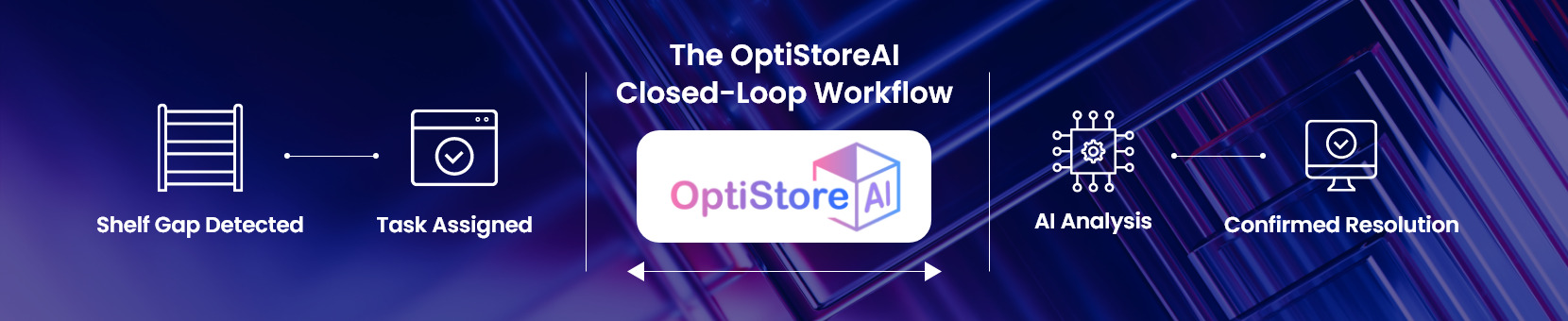
Detecting a stockout is only half the challenge. The real value lies in what happens after detection – the speed and consistency with which the issue is resolved. This is where most point solutions fall short. They can flag a problem but have no mechanism to ensure it gets fixed. OptiStoreAI addresses this by orchestrating the full workflow. It takes the process from detection through root-cause analysis, task assignment, and resolution tracking.
When a shelf gap is detected, the platform’s generative AI capabilities provide root-cause insights and recommend the next-best action. Is the product in the back room but not yet shelved? Has the supplier missed a delivery window? Is the planogram allocating insufficient shelf space for a product that’s selling faster than forecast? Each scenario requires a different response. Consequently, the AI surfaces the most probable cause along with a recommended action.
Tasks are then triggered automatically – prioritized alerts sent to the right store associate, integrated with workforce management tools so the task appears in their existing workflow rather than requiring them to check a separate system. The platform tracks the entire funnel from issue detection to resolution, measuring not just whether the alert was acknowledged but whether the shelf was actually restocked and how quickly.
This closed-loop approach is what distinguishes a platform from a tool. At the World Retail Congress 2026, senior retail executives from brands like Target, Pandora, and Marks & Spencer discussed how operational technology investments must deliver measurable execution improvements, not just dashboards. The consensus was clear: the industry has moved past the “insights” phase and into the “action” phase of AI adoption.
Measurable impact: What the numbers show
The impact of AI-powered retail analytics on-shelf availability monitoring is not theoretical. Retailers implementing solutions like OptiStoreAI are reporting quantifiable improvements across key operational metrics. For example, store audits that previously took hours of manual effort are being completed 40% faster. Manual effort in compliance checking has been reduced by up to 75%. Task completion accuracy has improved by 50%. In addition, in-store execution efficiency has increased by 25%.
These metrics matter because they compound. A 40% faster audit cycle means more frequent checks. More frequent checks mean issues are caught earlier. Earlier detection means faster resolution. Faster resolution means fewer lost sales. The flywheel effect turns incremental process improvement into significant revenue protection.
The financial case becomes even more compelling when projected across a large store network. Consider a retailer operating 500 stores with an average revenue of $10 million per store per year. If stockouts account for even 3% of lost sales, that represents $150 million in annual revenue leakage. Reducing stockout incidence by even one-third through real-time AI monitoring translates to $50 million in recovered revenue – a return that dwarfs the technology investment.
The road ahead: From AI experimentation to AI execution
The retail industry’s relationship with AI has matured significantly. Deloitte’s 2026 Retail Industry Global Outlook reported that 30% of retailers currently use AI for supply chain visibility, with that figure expected to reach 41% within the next year. Nearly 60% of executives surveyed anticipated positive ROI from AI-driven supply chain initiatives within 12 months. Meanwhile, NRF reported that global AI spending is forecast to exceed $2 trillion in 2026.
But spending is not the same as impact. The retailers that will pull ahead are those that move beyond isolated AI experiments and deploy integrated platforms that connect data, intelligence, and action in a single workflow. The on-shelf availability problem is a perfect proving ground for this approach. It sits at the intersection of data engineering, machine learning, and operational execution. Additionally, the financial impact is both immediate and measurable.
The Shoptalk Fall 2026 event (September 29 – October 1) and Groceryshop 2026 (September 22–24) will undoubtedly continue to spotlight retail execution and AI-driven store operations as central themes. Retailers evaluating their AI roadmaps should be asking not whether to invest in shelf intelligence, but how quickly they can deploy a solution that delivers measurable results at scale.
The on-shelf availability crisis is not a new problem. But the ability to solve it at scale, in real time, across hundreds of stores – that is new. And it is powered by the convergence of computer vision, unified data platforms like Databricks, and AI-driven workflow orchestration that platforms like OptiStoreAI deliver.
Eliminate blind spots in your store operations
See how OptiStoreAI transforms retail execution
Recent Blogs



Infocepts