



Your first cloud data migration rarely fails because of technology. It fails because reports break, teams lose trust in the numbers, and the cutover drags on for months. If you are moving enterprise analytics to the cloud, you need a plan that goes beyond lifting tables into a new platform.
This step-by-step guide walks through how to plan, execute, and stabilize data migration to cloud analytics without blowing up your current reporting. It is written for data leaders, architects, and program managers who are accountable not just for “going cloud,” but for delivering reliable dashboards on time.
Clarify Why You Are Moving Analytics To The Cloud
Before you compare cloud migration services or tools, get very clear on the business outcomes your migration needs to support. Vague goals like “modernize analytics” lead to endless scope creep and disappointed stakeholders.
Start by listing the specific problems you want to solve. Maybe on-prem ETL jobs miss their SLA twice a week. Maybe BI teams wait three weeks for a new data source. Maybe storage costs keep rising while performance gets worse. Put numbers to those pain points.
Then translate them into 3-5 measurable targets. Examples:
- Refresh finance dashboards by 7:00 a.m. instead of 9:30 a.m.
- Cut ad-hoc report backlog from 40 days to 10 days.
- Retire two legacy appliances and their support contracts within 12 months.
Those targets will drive scope, architecture, and the level of automation you build into your new cloud data platform.
Define A Practical Cloud Data Migration Strategy
Once you know the “why,” you can shape a cloud data migration strategy that fits your organization’s risk tolerance and skill set. The usual choice is between a big-bang cutover and an incremental approach. In regulated industries, a phased rollout almost always wins.
Start with an inventory of current data assets: warehouses, data marts, reporting cubes, critical source systems, and downstream consumers. Map each to owners, SLAs, and business processes so you know what breaks if something goes wrong.
From there, define migration waves. A common pattern is: first move a self-contained domain like marketing, then a cross-functional one like finance, and only then shared subjects like customers or products. That sequence limits impact and lets you refine your data migration strategy before you tackle the hardest parts.
Choosing The Right Landing Zone And Architecture
Any cloud data migration strategy stands or falls on a realistic target architecture. Decide early whether you are building around a cloud data lake, a modern warehouse, or a lakehouse pattern. The right answer depends on workloads, skills, and governance needs, not on hype.
For heavy SQL analytics and BI workloads, prioritize a strong data warehouse layer with clear semantic models. For data science and ML experimentation, design for cheap object storage with curated zones, versioning, and clear data contracts between producers and consumers.
Plan Enterprise Cloud Migration Scope And Governance
Successful enterprise cloud migration projects start by drawing a hard line around what will move in phase one and what stays as-is. Trying to refactor every legacy process at once is the fastest way to stall your program.
Define a baseline of core subject areas to move: typically customer, product, sales, finance, and operations. For each, decide whether this is a straight “lift and shift,” a partial remodel, or a full redesign. A plain rehost is rarely the right answer for everything, but it is sometimes the right answer for a few systems that just need to get off aging hardware.
Next, stand up a minimal yet real governance model. You need clear ownership for domains, definitions, and security policies from day one. That means business data owners, a small architecture board, and documented rules for PII in your new cloud data platform.
Security, Compliance, And Data Residency
As you plan enterprise cloud migration, security and compliance are non-negotiable. In Europe, data residency and GDPR constraints can dictate which regions you can use or how you must segment tenants. In the US, healthcare and financial data often come with their own contractual limits.
Work with your security team early to standardize IAM patterns, encryption at rest and in transit, key management, and audit logging. Getting these patterns right upfront saves you from rebuilding access every time a new project spins up.
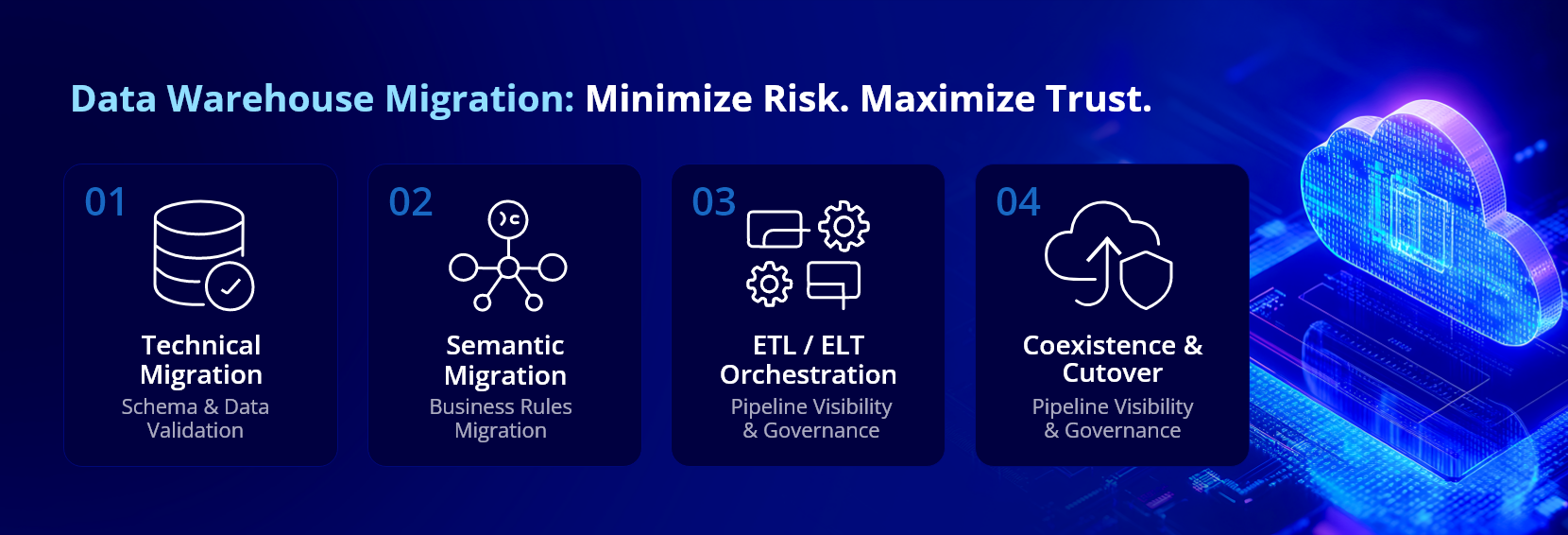
Execute Data Warehouse Migration Without Breaking Reporting
The riskiest part of any data warehouse migration is the period when both legacy and cloud environments run in parallel. Handled badly, you end up with two versions of the truth, frustrated business users, and thousands of tickets asking which numbers are “right.”
Start with technical migration: create schemas, load historical data, and validate row counts and aggregates. Use automated reconciliation where you can, but plan for targeted spot-checks on critical metrics with your business stakeholders.
Then tackle semantic migration: business logic hidden in ETL, stored procedures, or cube definitions. This is where most timelines slip, because those rules often live in tribal knowledge. Pull key report owners into working sessions to document and prioritize those rules before you rebuild them in your new cloud analytics layer.
Orchestrating ETL, ELT, And Reverse ETL
During data warehouse migration, rethink how you move data. Cloud platforms handle volume differently, and old ETL patterns that minimized CPU may not be optimal anymore. Shift heavy transformations closer to the warehouse when performance and governance benefit from it.
Design orchestration so that dependencies are explicit and visible. Use separate pipelines for ingestion, transformation, and serving, and tag them by domain. That structure shortens root cause analysis when a critical dashboard fails its SLA.
Managing Coexistence And Cutover
For a period, reports will exist in both legacy and cloud analytics environments. Do not leave users guessing. Label each report clearly as “legacy,” “beta cloud,” or “cloud production,” and communicate which one is the system of record for each metric.
Plan cutover per domain, with a clear rollback plan. For example, move marketing reports in one weekend with a freeze on new requirements the week before. Once they stabilize, repeat the pattern for finance. That drumbeat keeps the program moving while containing risk.
Decide When To Bring In Cloud Migration Consulting
Plenty of teams try to run large migrations alone and end up stuck on the same three problems: poor initial architecture, underestimated data quality issues, and no consistent change management. This is often where external cloud migration consulting pays for itself.
Use partners for spikes of specialized work: designing a landing zone, setting up automation for infrastructure as code, or building out a repeatable migration factory. Keep ownership of domain modeling, business rules, and priority setting inside your organization.
Be wary of fully outsourced projects that leave you with little internal capability. Your team should be able to run, extend, and troubleshoot the cloud migration services and solutions long after the consultants leave.
Budgeting And Timeline Reality Check
Executives like clean three-month timelines. Enterprise programs rarely cooperate. A realistic budget for large data migration to cloud initiatives typically includes a discovery phase, a pilot for one or two domains, then at least two larger rollout waves.
A helpful rule of thumb: the first domain always takes the longest because you are building patterns and pipelines from scratch. The second and third should be much faster if you have invested in reusability instead of bespoke scripts for each source.
Operating And Optimizing Your New Cloud Analytics Stack
Getting data “into the cloud” is not the finish line. Once live, you still have to manage performance, costs, and user adoption. Without that, your shiny new environment becomes just another legacy system in a few years.
Build operational monitoring from day one: pipeline health, data freshness, cost by domain, and user adoption metrics. Tie alerts to business impact, not just technical thresholds, so engineers know which failures deserve a 2:00 a.m. wake-up.
Schedule regular design reviews for your cloud analytics models. As new sources appear and business processes change, models drift. A quarterly review cycle keeps definitions aligned with how the business actually works.
Continuous Improvement And Cloud Transformation
Once the core stack is stable, shift part of your team’s capacity from migration work into incremental optimization. That is where your cloud transformation starts to pay off: faster experimentation, self-service for power users, and fewer one-off data extractions.
Create a lightweight backlog of improvements: performance tuning, new subject areas, better documentation, and training for analysts. Keep that backlog visible so leaders can see ongoing value beyond the initial move.
Conclusion
Cloud data migration for enterprise analytics is less about tools and more about disciplined scope, realistic architecture, and clear ownership. When you treat it as a staged program instead of a one-off project, the risk goes down and the odds of reliable, trusted reporting go up.
If you align business goals, design a pragmatic roadmap, and pull in partners like Infocepts where it truly helps, you can move analytics to the cloud without losing your stakeholders’ confidence in the numbers. Start with one domain, prove the value, and use that momentum to expand your cloud data migration across the rest of the organization.
Frequently Asked Questions
Accelerate Your Cloud Data Transformation
Modernize your data platform and unlock faster, more reliable analytics.
Recent Blogs



The Enterprise AI & Data Transformation Partner. Delivering measurable business impact globally.
#1 on Gartner Peer Insights · 97.2% client retention