



Your team is under pressure to deliver better analytics, but your current setup is fighting you. You keep hearing about the data lakehouse as the answer, yet you still have a data warehouse, a growing data lake, and no clear plan for what should live where.
This is the crossroads many enterprise data leaders hit: data warehouse vs data lake vs lakehouse. The tools all sound powerful, the sales decks look great, but picking the wrong architecture will slow projects, inflate costs, and frustrate business stakeholders for years.
Why Architecture Choices Matter For Enterprise Analytics
Architecture is not an abstract diagram on a whiteboard. It dictates how quickly you can land new sources, how painful compliance audits are, and how reliable your dashboards feel to executives.
Most teams start with a traditional data warehouse vs data lake debate and get stuck because both seem necessary. The reality is that each pattern solves a different class of problems, and forcing one to do the other’s job is usually where complexity explodes.
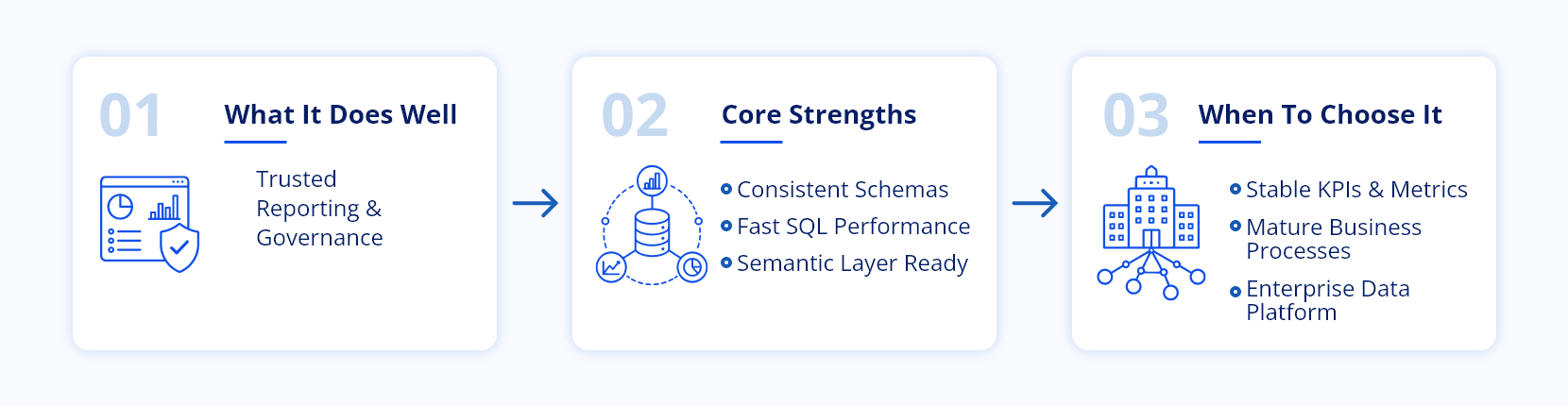
What A Data Warehouse Actually Does Well
A cloud data warehouse still shines when you need highly modeled, reconciled, and governed data for reporting. Think finance close, regulatory submissions, and executive scorecards with slowly changing dimensions and strict definitions.
This is the engine behind most data analytics architecture in enterprises that care about trusted metrics. It gives you consistent schemas, strong SQL performance, and well-understood patterns for semantic layers and BI tools.
When A Warehouse Is The Right Answer
Choose a cloud data warehouse first when questions, metrics, and data structures are relatively stable. Revenue, margin, customer counts, and operational KPIs that don’t change every week are perfect candidates.
For mature business processes, a warehouse remains the backbone of a solid enterprise data platform because it supports governance, data quality, and incident response in ways most data lakes still struggle to match.
Where Data Lakes Fit And Where They Break
A data lake is the natural landing zone for raw, high-volume, or semi-structured data that does not fit neatly into fact and dimension tables yet. Clickstream, sensor data, raw logs, and exploratory data science models tend to live here.
Teams often position the lake as the heart of modern data architecture, then run into trouble when business users expect warehouse-style reliability from data that was never curated at that level.
Strengths And Limits Of Classic Data Lakes
The lake makes it cheap to store years of history and to experiment. Data scientists love being able to try new features, join odd sources, and build prototypes without waiting for months of modeling.
The downside is that a pure data lake is a poor self-service platform for analysts. Without clear contracts, catalogs, and quality checks across your data platform, the lake quickly becomes a dumping ground that only a few power users understand.
How Lakehouse Architecture Changes The Equation
The data lakehouse tries to merge the openness of a lake with warehouse-like management, using table formats and compute engines that support ACID transactions, schema evolution, and time travel on top of low-cost object storage.
This is where lakehouse architecture shifts from marketing term to practical option: it lets engineering teams treat files in the lake as managed tables, with versioning, governance, and fine-grained access control.
Key Building Blocks Of A Data Lakehouse
A viable data lakehouse stands on three pillars: a transactional table format, a query engine that understands those tables, and strong orchestration and cataloging. Skimp on any of these and you’ll recreate the same old problems in a new stack.
As you evolve your data engineering architecture, expect to separate raw, curated, and serving layers inside the lakehouse so that analysts can safely consume data without tripping over half-baked experimentation zones.
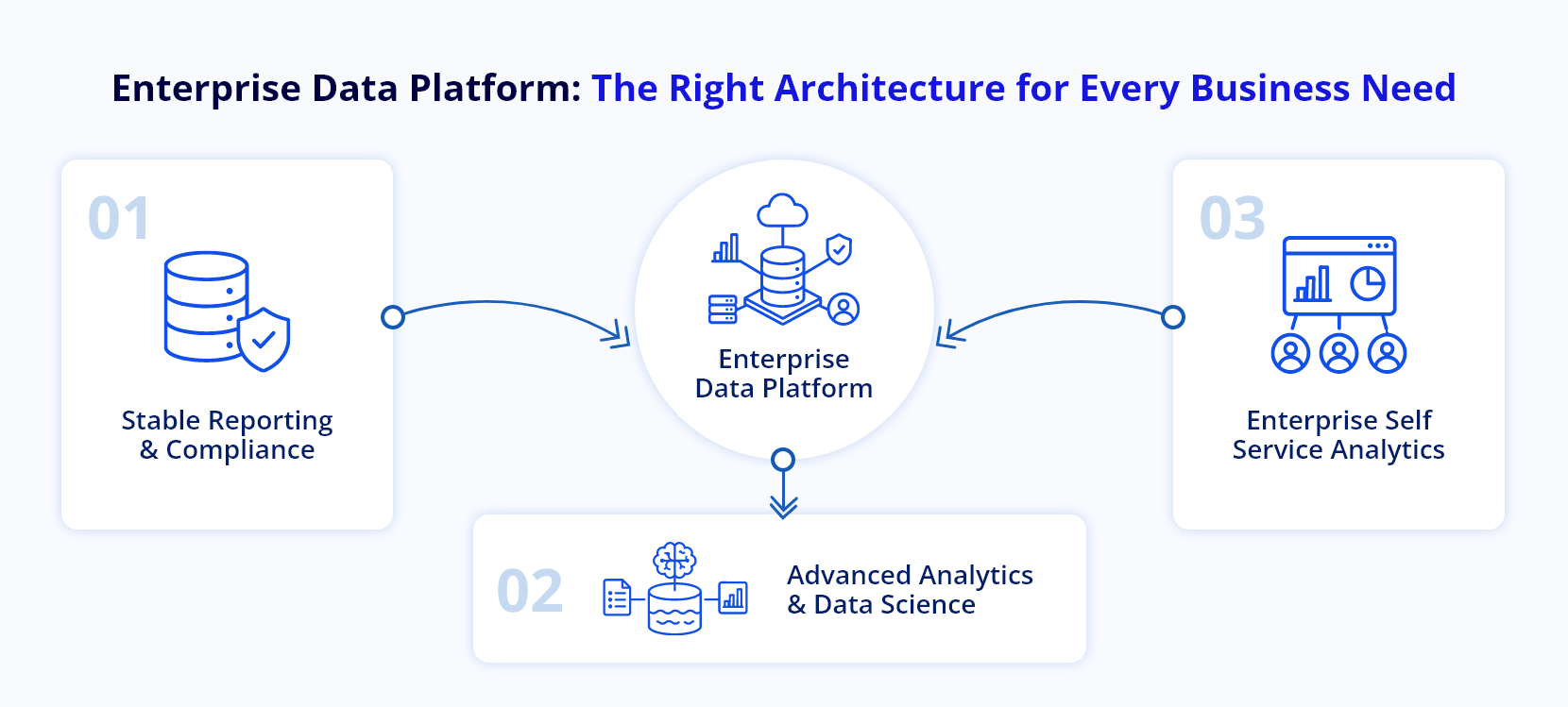
Comparing Warehouse, Lake, And Lakehouse For Real Use Cases
To choose the right pattern, stop arguing at the technology level and work backward from scenarios. Each architecture has situations where it thrives and others where it adds friction.
Think of your core enterprise data platform as a combination of these patterns instead of a single bet. The key decision is which one plays the starring role and which ones become supporting components.
When auditors care about every decimal place and history must be explainable, a warehouse-first approach still wins. Lakehouse tables can feed it, but your golden metrics and certified dimensions belong in a tightly governed model.
In this kind of data warehouse vs data lake choice, using the lake as raw storage and the warehouse as the publication layer usually gives the best mix of trust and agility.
For feature stores, experimentation, and machine learning pipelines, a lake or lakehouse is far easier to work with. Data scientists can join wide tables, semi-structured fields, and historical snapshots without fighting rigid schemas.
Here, a data lake vs data warehouse comparison tilts strongly toward the lakehouse, because you can serve training and inference workloads from the same underlying tables instead of copying data into multiple systems.
Business analysts need discoverable data, reasonable performance, and clear definitions. A lakehouse can support this, but only if you invest in a strong semantic layer, good documentation, and clear ownership.
When you design your data analytics architecture, assume that self-service will fail if curated views, business-friendly names, and consistent calculations are an afterthought.
Practical Guidance To Choose Your Next Data Platform
If you already have a warehouse, the question is not whether to abandon it but how to extend it. A lakehouse can act as the raw and curated backbone, feeding modeled data into your existing reporting layer while keeping experimentation closer to the source.
This combined pattern is what most people mean now by modern data architecture: a lakehouse at the center with satellite systems for BI, operational analytics, and data science, all tied together with shared metadata and governance.
Migration Patterns That Actually Work
Successful teams avoid big-bang replacement projects. Instead, they migrate domain by domain: pick one business area, move raw data to the lakehouse, rebuild curated tables there, and then re-point only that domain’s reports.
Handled this way, the data lakehouse platform grows organically, proving its value to stakeholders without forcing the entire organization to switch tools and models overnight.
Conclusion
Choosing between a warehouse, lake, and data lakehouse is less about fashion and more about matching patterns to your real workloads, risk tolerance, and team skills. In practice, most enterprises end up with a blend, with the lakehouse carrying more responsibility over time.
If your current architecture is holding analytics back, start by mapping use cases, then decide which components stay, which move, and where a data lakehouse can simplify your stack; if you need a second pair of eyes on that roadmap, Infocepts can help you stress-test the options.
Frequently Asked Questions
Recent Blogs



The Enterprise AI & Data Transformation Partner. Delivering measurable business impact globally.
#1 on Gartner Peer Insights · 97.2% client retention