
Most enterprises don’t struggle to collect data. They struggle to turn it into decisions people actually trust. AI data analytics promises to fix that, yet many teams end up with prettier dashboards and the same old arguments in meetings.
The gap is rarely the math. It’s the way models, tools, and humans fit together. Get that right and AI stops being a side project and starts acting like a second brain for your organization.
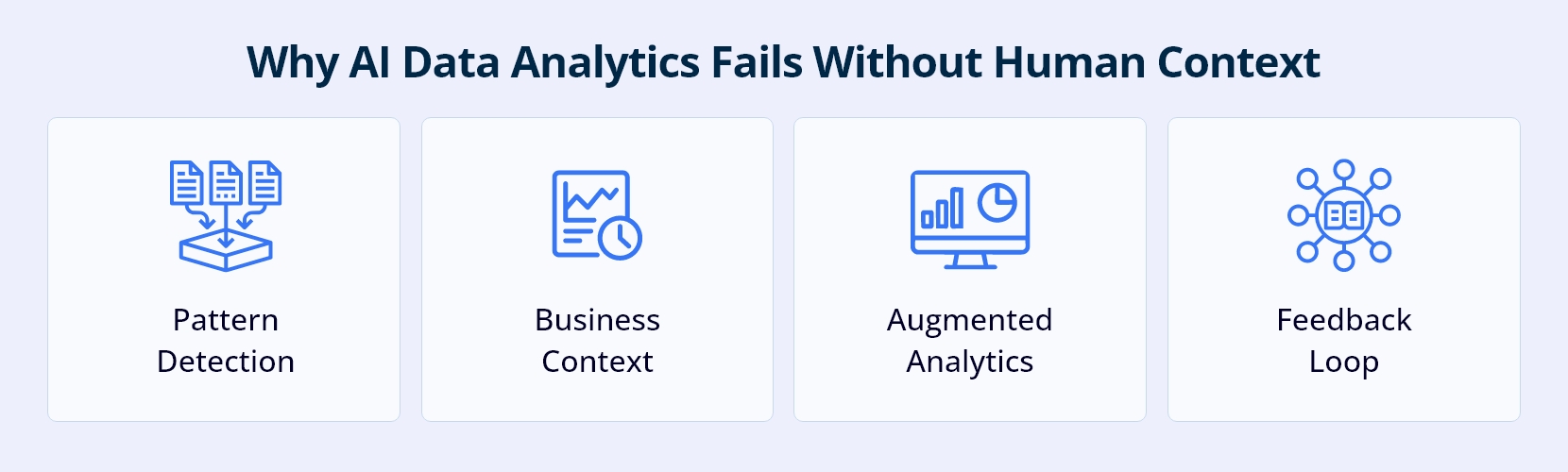
Why AI Data Analytics Fails Without Human Context
Executives often expect AI analytics to produce “the answer” on its own. What they get instead is a stream of scores, forecasts, and anomalies that don’t line up with how the business actually runs.
Models are trained on history, but history is full of one-off deals, bad data, and policy changes. A spike in demand might be an outlier promotion, not a new trend. Only domain experts can sort those out quickly.
On the other side, human judgment alone is not enough at enterprise scale. No sales leader can mentally track millions of interactions and spot weak signals early. This is where augmented analytics shines: machines flag the patterns, humans decide what they mean and what to do next.
The most successful programs build an explicit loop: data scientists and business owners co-design questions, review model behavior on real cases, and agree on when to follow or override recommendations.
Designing An AI Analytics Strategy Around Decisions
High-performing teams don’t start with tools. They start with a small number of decisions they want to change: pricing approvals, inventory targets, fraud reviews, or marketing spend. Then they design AI data analytics around those decision points.
For each decision, define three things: what “better” looks like, who owns the call, and what data they trust today. That last part is often ignored, and it’s where many projects stall. If finance doesn’t trust the revenue numbers in the warehouse, no model on top will convince them.
From there, you can choose a level of automation. Some decisions work well with suggestions only. Others can move to autopilot with human spot checks. AI business intelligence dashboards should reflect this design, not just copy the org chart.
From Reports To Intelligent Analytics Products
Most BI environments are built as reporting shops. Stakeholders submit requests, analysts build a report, and the result is a static view. Intelligent analytics flips that. It treats insights as products with clear users, goals, and feedback loops.
In practice, that means smaller, focused apps: a pricing advisor for a specific region, a churn risk monitor for one line of business, or an operations cockpit tuned to a single warehouse.
Product thinking forces tougher prioritization but leads to adoption. People come back to tools that actually move their metrics, not dashboards that just restate them.
Where Automation Helps Most In Enterprise Analytics
Not every task benefits equally from automation. In enterprise analytics, the biggest early wins tend to sit in three buckets: data preparation, pattern discovery, and monitoring.
On data prep, automated data analysis can tackle tedious joins, type fixes, and missing value treatments. This doesn’t remove data engineers; it moves them from reactive tickets to designing better pipelines and standards.
For pattern discovery, machine learning can highlight combinations a human would miss, like a specific product mix and region driving higher returns only for one customer segment.
Monitoring is where AI helps frontline teams the most. Instead of scanning weekly summaries, leaders can subscribe to AI insights that fire only when something meaningful changes, with context attached.
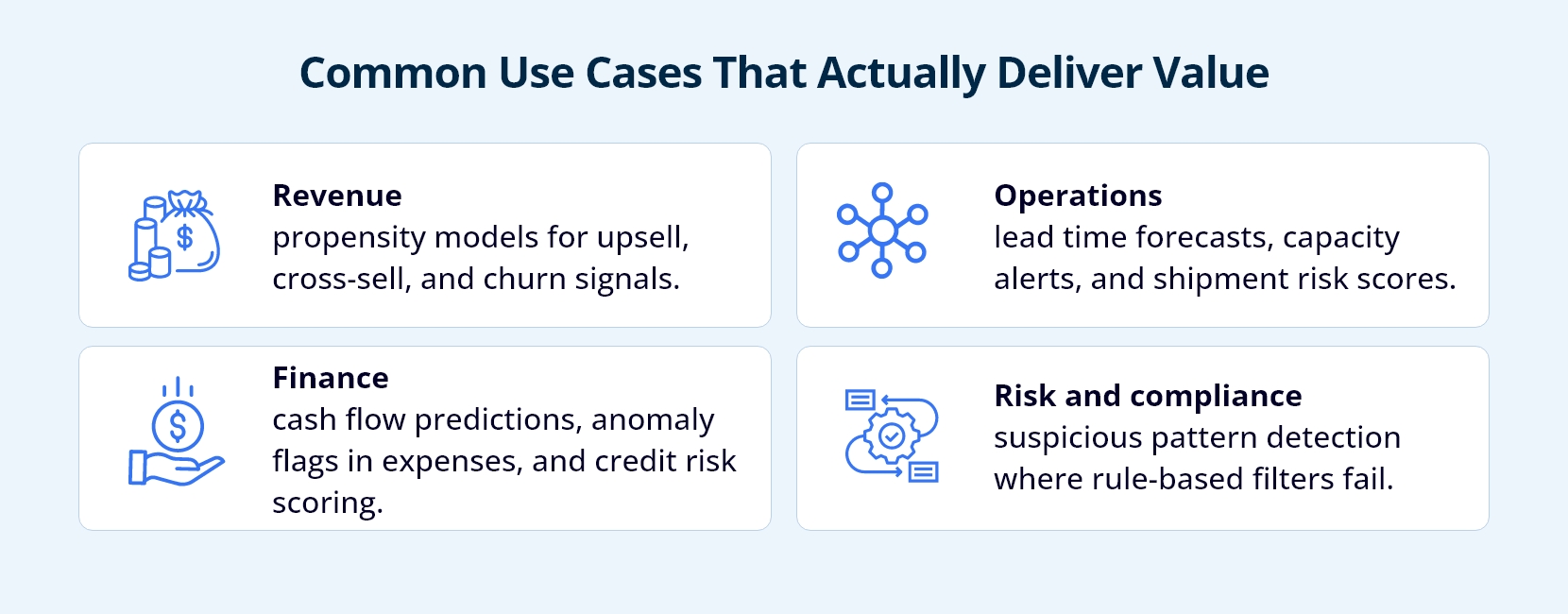
Common Use Cases That Actually Deliver Value
Predictive analytics can be applied almost anywhere, but a few patterns repeatedly pay off for large organizations.
- Revenue: propensity models for upsell, cross-sell, and churn signals.
- Operations: lead time forecasts, capacity alerts, and shipment risk scores.
- Finance: cash flow predictions, anomaly flags in expenses, and credit risk scoring.
- Risk and compliance: suspicious pattern detection where rule-based filters fail.
The thread running through all of these is clear ownership and a defined action when a model is right, wrong, or uncertain.
Building Trust: Governance, Guardrails, And Change Management
Technical accuracy alone doesn’t convince seasoned managers. They want to know who checks the models, how often, and what happens when something goes wrong.
Strong governance for AI decision support doesn’t have to be heavy. It does need clear roles: who approves use cases, who validates data, who signs off on model updates, and who can pause an automated flow.
A practical pattern is a “model playbook” per use case. One concise document per model that describes its purpose, inputs, known blind spots, monitoring rules, and escalation paths. This gives leaders something concrete to review and auditors something concrete to reference.
Bringing Business Experts Into The Loop
The fastest way to kill trust is to build models in isolation. Business experts should be involved from scoping through rollout, not just invited to a final demo.
Workshops where analysts and domain leads replay real past decisions can be especially effective. Show how the system would have scored those cases, then discuss where it helped, where it missed, and why.
Over a few cycles, this collaboration sharpens both sides. Data teams stop modeling irrelevant noise. Business teams gain intuition for model behavior and limits, which reduces both blind faith and knee-jerk rejection.
Practical Workflow: Combining Humans And Automation
To make augmented analytics real, you need a simple, repeatable workflow that everyone understands. Overcomplicated processes look great in diagrams and fail in day-to-day use.
A good pattern is “machine-first, human-final” for medium-risk decisions. The system gathers data, runs models, and presents a ranked set of options with reasons. A human then confirms, edits, or rejects with a short note.
Over time, those notes form a labeled catalog of disagreements, which is gold for model refinement.
Designing Interfaces That Support Judgment
The way insights are presented matters as much as the model behind them. Interfaces that drown users in metrics can quietly kill AI insights before they even get a chance.
A useful screen for a decision maker answers three questions fast: what changed, why it likely changed, and what action is recommended. Everything else should be available but secondary.
Simple, constrained choices work better than wide-open dashboards when time is tight. Think of “approve,” “approve with changes,” or “send for review” instead of endless filters and charts.
Automating The Boring, Not The Core Judgment
Intelligent analytics doesn’t mean replacing expert calls. It means taking the grunt work off their plate: pulling data from five systems, doing the same sanity checks, and updating trackers.
Many teams start with small “micro-automations” around a single step: auto-generating a summary of key drivers for a forecast, drafting an email for an exception, or pre-filling fields in a request system.
Those small changes are how automated data analysis becomes a habit instead of a one-time initiative.
Technology Choices And Architecture Considerations
Once the decision framework is clear, technology comes into play. The right stack for AI data analytics balances speed of experimentation with control, especially in regulated industries.
Organizations often combine a cloud data platform with specialized tools for augmented analytics, plus orchestration for repeatable pipelines. The goal is not to standardize on a single tool but to standardize how data moves and how models reach production.
For many enterprises, the missing piece is a shared layer for AI insights that can feed different applications without rework, while still keeping a single source of truth for core metrics.
Teams that treat architecture as a living product, adjusted as new use cases land, avoid the trap of a one-time “modernization” that is outdated in two years.
Conclusion
Enterprises that win with AI data analytics don’t chase every new model. They design around real decisions, involve experts early, and automate the grind while keeping judgment in human hands.
If you’re rethinking how your analytics teams and tools work together, treat this as an ongoing practice, not a project. Partners like Infocepts can help, but the real shift happens inside your culture, one decision workflow at a time.
Frequently Asked Questions
Turn Data into Actionable AI Insights
Empower your teams with AI-driven analytics that improve decisions, increase productivity, and deliver measurable business outcomes.
Recent Blogs



Infocepts