
6 Tests CISOs Should Run Before Buying Another Security Platform
Every security platform evaluation ends with the same question. Will this tool move a number the board cares about, or will it become one more renewal nobody can defend? Budgets make that question sharper every year. An IANS Research and Artico Search benchmark of 587 CISOs found that security budget growth slowed to 4% in 2025, half the prior year’s rate (IANS Research). At that pace, security control validation, board-ready security reporting, and provable security tool ROI stop being extras. They are the price of entry.
Most vendor checklists still test features: how many integrations, how many dashboards, how much AI. We think CISOs should test outcomes instead. Below are the six tests Infocepts recommends for any security platform evaluation during 2027 planning, including an evaluation of our own Cyber Vigilance 360. A scorecard you can take into vendor meetings follows.
Test 1: Will it reduce exposure you can measure?
Security teams are not short on findings. They are short on a ranked order. IBM X-Force found that vulnerability exploitation accounted for 40% of the incidents it observed in 2025 (IBM X-Force). Verizon’s 2026 DBIR shows the stakes: ransomware appeared in 48% of all breaches, up from 44% the year before (Verizon DBIR executive summary).
A longer list does not fix that. A must-have platform ranks each issue by how much it adds to real risk and shows the exposure trend falling over time. Ask every vendor to show you that trend for a customer like you. Cyber Vigilance 360 scores risk across tools, assets, departments, and human risk, with the reasoning attached. In Infocepts assessments, roughly 5% of entities drive 80% of risk ,and the scoring is built to find them first.
Test 2: Does it fit the stack you already own?
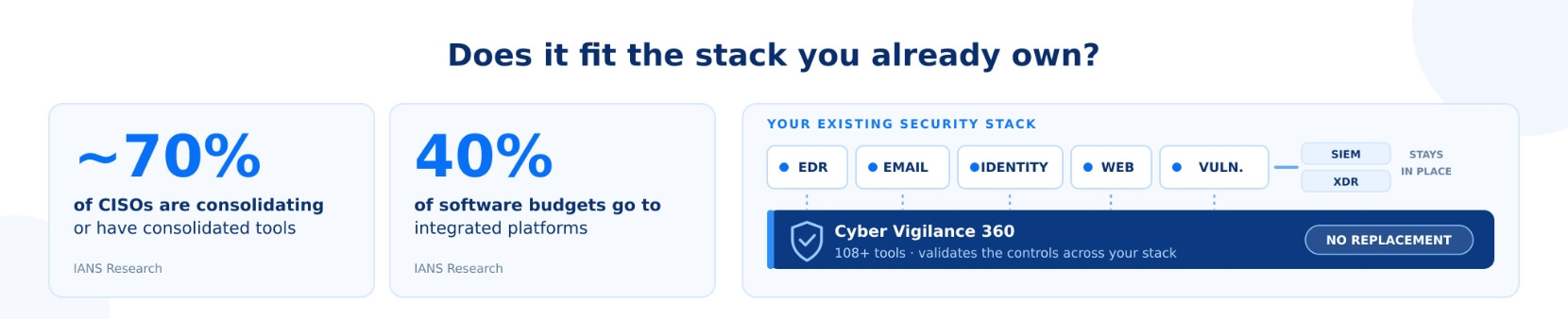
Consolidation is the dominant buying pattern. IANS Research found that about 70% of CISOs are consolidating or have already consolidated tools onto integrated platforms, and that platform users now put an average of 40% of their software budgets into those platforms. Microsoft, CrowdStrike, and Palo Alto Networks were named most often (IANS Research).
Consolidation reduces the number of consoles. It does not confirm that the platforms you keep are configured the way you think. Each vendor’s console grades its own product, and none of them will flag that a policy was switched off last month. A must-have platform reads across the whole stack and asks you to replace nothing. Cyber Vigilance 360 connects to more than 108 tools across EDR, email security, identity, web, and vulnerability management, and it works alongside your SIEM and XDR by validating the controls that feed them.
Test 3: Can it produce board-ready security reporting from live data?
Security now reports higher in the company than it used to. Gartner’s 2026 survey of more than 1,600 CISOs found that more of them report metrics directly to the CEO or legal team, and 47% of those focused on cyber risk management name data-driven decisions as a core goal (Evanta, a Gartner company). Wiz found that more than half of security leaders believe their organizations still aren’t investing enough (Wiz). Winning that argument with a board takes evidence, not a tool inventory.
A posture deck built by hand can be up to a month old by the time directors see it. Cyber Vigilance 360 generates board views from live data, tracking posture improvement, coverage, license use, and security tool ROI.
Test 4: Does it keep MITRE ATT&CK mapping and compliance evidence current?
Gartner named global regulatory volatility one of its top cybersecurity trends for 2026 (Gartner), and CISOs in its leadership survey cite NIS2, the EU Cyber Resilience Act, and HIPAA as active drivers.
Yet many teams still map controls to MITRE ATT&CK and CIS once per audit and watch that evidence age. Ask each vendor how its mapping stays current after onboarding. Cyber Vigilance 360 keeps MITRE ATT&CK mapping, CIS mapping, and threat-actor technique mapping current, so your governance, risk, and compliance team answers auditors from today’s data. [Customer example to confirm: audit preparation time before and after, for example “from [N] weeks to [N] days.”]
Test 5: Does it govern AI risk, and can it explain its own AI?
AI risk has reached the security stack itself. IBM’s Cost of a Data Breach Report 2026 found that more than 20% of organizations reported a breach targeting AI models or applications (IBM). Employees widen the exposure. A Gartner survey found that 57% use personal GenAI accounts for work and 33% admit entering sensitive information into unapproved tools, and Gartner urges leaders to build human-in-the-loop checks into AI-driven security operations (Gartner). Oversight is catching up: the share of organizations with a process to assess the security of AI tools rose from 37% to 64% in a year (World Economic Forum).
That makes explainability a buying criterion, not a nice extra. If a platform’s AI ranks an asset as your top risk, your analysts need to see why. Cyber Vigilance 360 attaches the rationale to every recommendation. It is cloud-native and lakehouse-ready, and sensitive data stays inside your environment.
Test 6: Can your team run it next quarter, not next year?
This test rules out more platforms than the other five combined. IANS found that only 11% of CISOs consider their teams adequately staffed (IANS Research), and 68% rely on at least one managed security service provider (IANS Research). A platform that needs a six-month rollout and two new hires to tune it fails this test no matter how good the demo looks.
Cyber Vigilance 360 is fully managed. Configuration takes about four hours, first results arrive inside a day, and Infocepts runs 24×7 monitoring that keeps integrations, framework mapping, and alert noise under control. Teams can start with one business unit, a priority set of tools, or their highest-risk controls.
The six-test scorecard
Take this into your next vendor meeting. Any platform, ours included, should clear every row.
| Test | Ask the vendor | Red flag |
|---|---|---|
| 1. Measurable exposure | Show a 90-day exposure trend for a customer like us | A longer findings list with no ranking |
| 2. Stack fit | Which of our tools do you connect to on day one? | “Replace this tool to get full value” |
| 3. Board-ready reporting | Show the board view built from live data | Reports an analyst rebuilds every month |
| 4. Compliance evidence | How does MITRE ATT&CK and CIS mapping stay current? | Mapping done once, at onboarding |
| 5. AI governance | Why did your AI rank this asset first? | Risk scores with no explanation |
| 6. Time to value | When do we see results, and who runs it? | A multi-quarter rollout or new hires |
How manufacturers should weight the scorecard
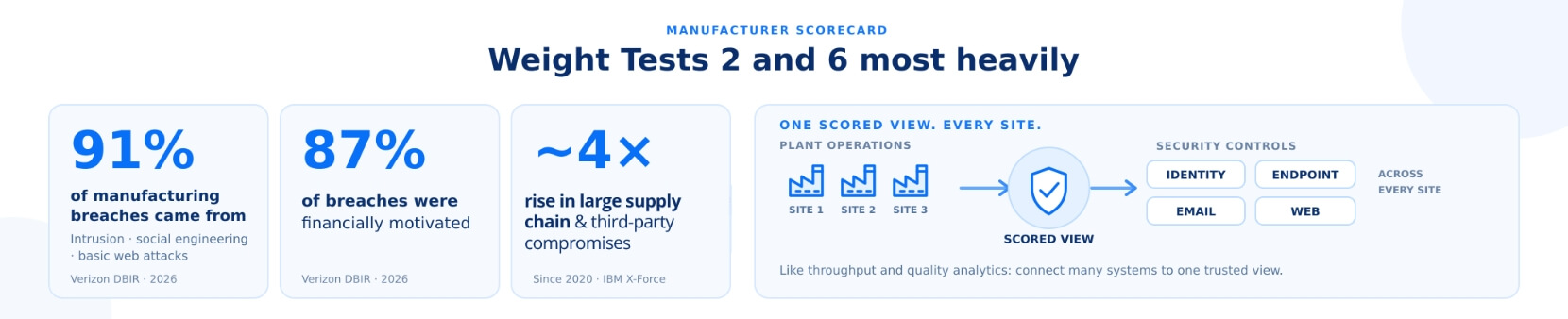
Manufacturers should weight Tests 2 and 6 most heavily. Verizon’s 2026 DBIR found that system intrusion, social engineering, and basic web application attacks made up 91% of manufacturing breaches, and that financial gain drove 87% of them (Verizon DBIR executive summary). IBM X-Force reports a nearly fourfold increase in large supply chain and third-party compromises since 2020 (IBM X-Force). Partner access, identity, and exposed applications are IT controls, and they sit on the path from the corporate network to production.
Manufacturers already expect one trusted view built from many systems. That is what industrial manufacturing analytics does for throughput and quality data across plants. Hold security to the same standard. A platform that can’t show identity, endpoint, email, and web controls across every site in one scored view fails Test 2 for a multi-plant manufacturer.
What nice-to-have costs you
When Infocepts validates security configurations inside enterprise environments, 55% turn out to be disabled or mistuned [confirm sample size]. We explore what that means for 2027 budgets in Is Half Your Security Stack Switched Off?. Every quarter a gap like that stays open, you pay full price for partial protection.
Bring the scorecard to New York
Infocepts and Discern Security are hosting a CISO roundtable and dinner in New York on October 28, from 6:00 to 9:00 PM, in a private room at Tamarind Tribeca. Seats are limited to one private room. Bring the six tests and compare notes with peers who are running the same evaluations. Reserve Your Seat
Can’t make it? Book a 30-minute posture briefing with Infocepts and run all six tests against your own environment. It is a working session, not a demo, and there is no commitment.
Frequently Asked Questions
Run the Six Tests Against Your Own Environment
Book a 30-minute posture briefing with Infocepts. It is a working session, not a demo, and there is no commitment.
Recent Blogs


Infocepts