
Scaling AI without a clear AI governance framework tends to go one of two ways: slow, fearful pilots that never reach production, or fast experiments that trip legal, security, and ethics flags the moment they get noticed. Neither path is sustainable for an enterprise that wants AI to be part of how it actually operates.
If you want AI to move beyond slideware and isolated proofs of concept, you need structure: who can use what, on which data, under which rules, with which controls. That structure is what good AI governance provides, and it has to be designed for your business, not just copied from a generic policy template.
Why Enterprises Need A Real AI Governance Framework
Most large organizations discover the need for AI governance only after a scare: a model goes live with biased outputs, a cloud bill explodes, or a regulator asks questions nobody can answer. The trigger is usually some mix of compliance, brand risk, and security concerns that were never fully mapped.
A practical framework does three things well. It defines decision rights for AI, it sets boundaries around data and model use, and it connects AI work to business outcomes instead of hobby projects. Without those basics, every new AI initiative feels like starting from zero, arguing the same points again and again.

Core Pillars Of Enterprise AI Governance
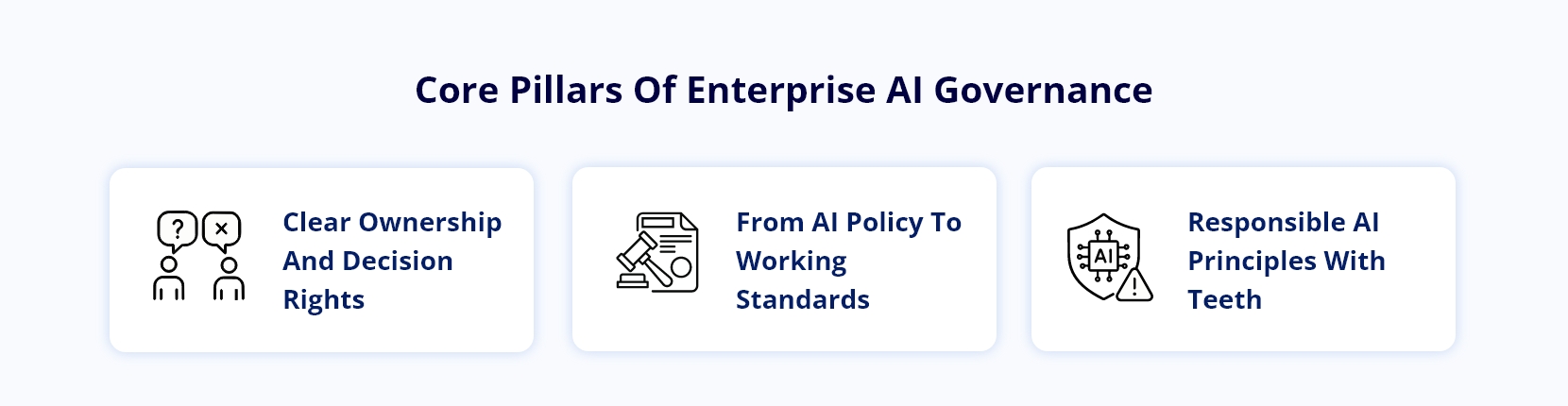
Strong enterprise AI governance rests on a small set of pillars that repeat across industries, even if the details change. Think of them as the scaffolding that keeps AI from drifting into risky or pointless territory.
These pillars usually include strategy and ownership, policy and standards, risk controls, technical safeguards, and monitoring. If one of these is missing, you see it quickly: lots of pilots, but no scale, or fast scale with no audit trail.
Clear Ownership And Decision Rights
The first pillar is unglamorous but decisive: who owns AI decisions. That means a cross-functional body that can speak for legal, security, data, and the business, not just a single enthusiastic sponsor in IT.
This group sets priorities, approves high-impact use cases, and arbitrates conflicts. Without it, projects stall in email threads, or local teams quietly launch models with no shared guardrails.
From AI Policy To Working Standards
Most organizations start by drafting a high-level AI governance policy. That’s necessary, but it’s not enough. Teams need that policy broken down into checklists, templates, and patterns they can reuse without calling a committee for every new experiment.
For example, you might define standard categories for use cases: low-risk internal productivity tools, customer-facing applications, and high-risk automated decisions. Each category gets a standard review path, documentation pack, and approval authority.
Responsible AI Principles With Teeth
Responsible AI is often framed as a set of nice-sounding values: fairness, transparency, accountability. Those matter, but people in the business need to know what they mean in day-to-day choices, not just on a poster.
A workable approach is to translate each principle into specific checks: fairness means agreed thresholds for disparate impact, transparency means a documented model card, and accountability means an identified business owner for every significant model in production.
Designing A Practical AI Risk Management Approach
Too much AI risk management makes everything grind to a halt. Too little turns every AI initiative into a potential incident report. The balance comes from matching controls to the type and scale of the risk, not treating all projects the same.
A good pattern is to triage use cases by impact and data sensitivity. A chatbot helping employees draft internal memos does not need the same level of scrutiny as a model approving loans or triaging medical referrals.
Building An AI Risk Framework That Scales
A consistent AI risk framework gives risk teams and builders a shared language. Map each use case against a small number of risk dimensions: regulatory exposure, data sensitivity, level of automation, and potential customer harm.
Each combination points to a required set of controls: privacy review, security testing, fairness assessment, or external legal sign-off. Once that map exists, you avoid constant one-off debates and create a pattern teams can plan around.
Integrating AI Compliance Into Existing Processes
Instead of inventing a separate AI compliance process, tie AI reviews into governance mechanisms you already have. That usually means your change advisory board, information security reviews, model risk management functions, and vendor assessment processes.
The key is not to duplicate approvals but to add AI-specific checks: questions about training data provenance, model monitoring commitments, and reliance on third-party APIs that may change behavior without notice.
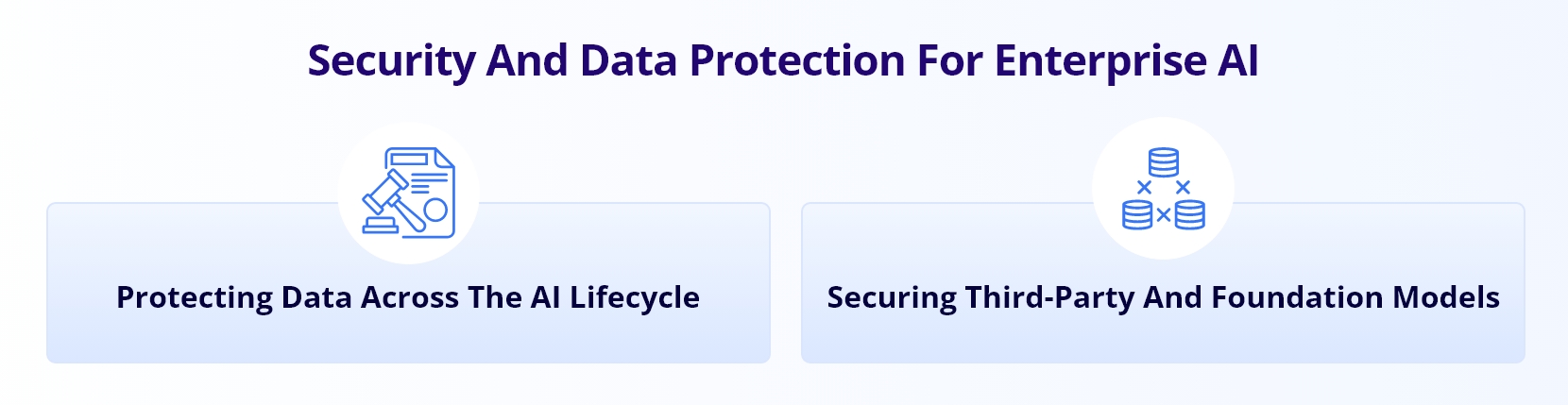
Security And Data Protection For Enterprise AI
Every meaningful AI initiative touches sensitive data, and that’s where legal, security, and privacy teams start to get nervous. Their concerns are usually justified, especially once generative models and external APIs are involved.
A disciplined approach to AI security keeps experimentation alive without exposing the organization to obvious mistakes like pasting confidential data into public tools or routing critical workloads through unvetted services.
Protecting Data Across The AI Lifecycle
Data risk shifts as it moves from raw sources to training pipelines, to models in production, and finally to logs and monitoring. Each stage needs its own controls, but they should feel familiar to your data and security teams.
Standardize how you classify data, codify which data classes can be used with which model types, and define where encryption, tokenization, or redaction are mandatory. That keeps engineers from guessing and auditors from chasing shadows.
Securing Third-Party And Foundation Models
Most enterprises rely on external models, which raises different security and AI policy questions than homegrown systems. You don’t control the model weights, but you can control how they’re used and what they see.
Build a simple gating model: which workloads stay on-premises, which can use private cloud deployments, and which are allowed to call public APIs. Tie each gate to specific data classifications and business justifications.
Operationalizing Responsible AI Across The Enterprise
The biggest gap in responsible AI programs isn’t intent, it’s execution. Teams agree with the principles, but nothing in their day-to-day workflow nudges them toward better choices or captures evidence that they followed the rules.
To make responsible AI real, you have to bake these checks into the tools and processes people already use, from experiment tracking to change management to ongoing model monitoring.
Embedding Governance In The AI Delivery Lifecycle
Think of your AI lifecycle as a series of gates: idea intake, design, development, testing, launch, and post-launch monitoring. Each gate gets a small, clear set of required artifacts tied back to your AI ethics and risk principles.
For instance, during design, teams complete a short impact assessment that flags potential bias, customer misunderstanding, or misuse. Before launch, they document monitoring thresholds and an agreed rollback plan if things drift.
Measuring Maturity Of Your AI Governance
Enterprises move from scattered efforts to a coherent AI governance framework in stages. Early on, metrics are basic: number of use cases assessed, policies published, and core roles filled.
As you mature, you start tracking leading indicators: percentage of AI projects going through standard review, average review time, and incidents avoided or caught early. Those numbers help you argue for investment without relying purely on fear of fines.
Making AI Governance Work Across Regions
Global organizations face an extra layer of complexity: regulations in the United States, the AI Act in Europe, and sector-specific rules that don’t always align. You can’t run a different process in every country without burning out your experts.
The workable pattern is a global backbone with local extensions. Shared policies, templates, and review steps, with targeted localization only where law or customer expectations demand it.
Harmonizing Global And Local Requirements
A practical approach is to define a global baseline for AI governance that meets or slightly exceeds the strictest regime you operate under, then let regions add controls where needed. That keeps your core documentation and training consistent.
Local teams can then plug in jurisdiction-specific steps, such as impact assessments required by European regulators or specific record-keeping duties in financial services and healthcare.
Conclusion
Enterprises that treat AI governance as a one-off compliance task tend to stall. Those that build a living AI governance framework tied to real use cases, risk, and security concerns create the conditions for responsible scale. The difference shows up in how quickly teams can move from idea to deployment without endless rework.
Frequently Asked Questions
Build AI Governance for Responsible Scale
Establish the policies, controls, and governance frameworks needed to deploy AI securely, compliantly, and with confidence.
Recent Blogs



Infocepts