



I’ve spent enough time working alongside media sales organizations – and with friends who lead advertising sales teams – to know what great meeting preparation looks like. More importantly, I’ve seen the commercial cost when sellers walk into an important customer conversation without the right context.
You know the scene.
It’s 8:47 a.m. An Account Director has a 10:00 a.m. meeting with a major advertiser. Multiple browser tabs are already open – Salesforce, campaign reports, audience insights, email threads, spreadsheets, and presentation decks from previous quarters. Before the conversation has even begun, they’re still trying to answer a basic question:
“What does this customer actually need to hear today?”
That ninety-minute window is arguably the most revenue-critical stretch of a seller’s week, and it’s being spent assembling information instead of shaping strategy. Multiply that across every seller and every account, and what looks like an individual productivity problem is actually sitting on your forecast.
Salesforce’s State of Sales Report puts it plainly: reps spend only about 30% of their time actually selling. The rest goes to research and internal coordination. In media and entertainment, where every advertiser interaction can shape a renewal, that lost time shows up directly in revenue.
What an AI Sales Assistant Actually Does
An AI sales assistant works alongside a rep rather than replacing them. It handles the admin and retrieval work that sits between a seller and an informed conversation. In media ad sales specifically, that means five concrete jobs:
- Summarizes the account on demand. Ask in plain language where an account stands and get a grounded answer pulled from CRM, email threads, and past campaign performance — instead of opening six systems to assemble it manually.
- Drafts the follow-up. Generates the recap email or the first pass at a pitch deck, built on what actually happened in the account, not a blank template.
- Surfaces pricing precedent. Answers “has this advertiser had a discount like this before?” against real historical deal data, so pricing calls stop depending on what someone remembers.
- Flags commercial risk early. Stakeholder turnover, pacing slippage, renewal timing — signals that would otherwise surface in a monthly report, surfaced while there’s still time to act.
- Checks inventory before a number gets promised. Real availability at the moment of the conversation, not last week’s snapshot.
That’s the working definition. The gap between that and what most vendors are actually selling is the rest of this piece.
The Dashboard Trap
Much of what’s marketed today as an AI sales assistant is a dashboard with a machine-learning label attached – another interface, another report to interpret before a call.
That isn’t intelligence. It’s additional work.
The best commercial teams don’t outperform because they have more reports. They outperform because every conversation starts with clarity – pricing history, inventory, risk, all already known before the room.
An Account Director shouldn’t open six systems to start the day. They should open one clear recommendation they can act on.
Dashboard vs. AI Sales Assistant
| A Dashboard | An AI Sales Assistant | |
|---|---|---|
| What it delivers | A chart to interpret | An answer to act on |
| How you use it | Navigate to the right report | Ask a question in plain language |
| When risk surfaces | When someone checks | The moment it appears |
| Who does the analysis | The seller, manually | The system, automatically |
| Account prioritization | All accounts look equal | Ranked by risk and opportunity |
| Pricing guidance | Historical data to review | Comparable deals, in context |
| Prep time | Hours of assembly | Minutes of review |
| The question it answers | “What happened?” | “What should I do next?” |
The Proof: 4 Hours Down to 15 Minutes
One of the world’s largest media advertising organizations faced exactly this problem.
Before an AI-driven commercial intelligence layer, Account Directors spent 2.5 to 4 hours prepping for a single major advertiser meeting – pulling reports, checking pacing, searching CRM records, looping in analysts.
After: under 15 minutes.
The gain didn’t come from faster reporting. It came from not needing to build the picture by hand – sellers opened the day with one brief connecting performance, history, risk, and opportunity. Conversations shifted from explaining last quarter to planning the next one. (A related shift is documented in our Ad Sales Analytics case study, where near real-time insight lifted advertiser ROI for a media client.)
That’s where commercial value actually gets created – inside the conversation, not the dashboard.
What It Costs When Nobody Catches It
The same gap shows up after the deal closes, not just before it.
In one cross-platform campaign worth $3.9M, a single line item never launched at all — zero impressions, for weeks, before anyone noticed. A second line launched five weeks late. By the time the shortfall surfaced, the damage was done: $1.53M in make-goods against $2.93M contracted, with only $190K actually invoiced.
Nobody needed a data problem for that to happen. They needed nobody catching a silent failure early enough to fix it — which is exactly what a periodic dashboard check will always miss.
Automation Isn’t Intelligence
Automation and intelligence get used interchangeably. They aren’t the same thing.
Automation completes existing tasks faster. Intelligence improves the quality of the decision underneath the task — which pricing call, which renewal conversation, which inventory tradeoff gets made and how.
One approach tells you what happened. The other tells you what to do about it.
This is also why the architecture underneath matters. Systems built on agentic AI — where specialized agents each own one part of the problem and a supervising layer assembles one answer — behave differently from a reporting tool with an AI label on it. One retrieves and reasons. The other displays.
Where SalesNav AI Fits
This is the thinking behind SalesNav AI – built with media organizations simplifying their pitch-to-pay process without bolting on another standalone tool.
Instead of six systems before a call, it pulls commercial signals, campaign data, advertiser history, and inventory position into one place sellers already work from. Fewer places to look before a decision gets made — not a smarter dashboard, a shorter path to the decision. For a technical breakdown of how SalesNav AI’s architecture actually works — Unity Catalog, Vector Search, and the multi-agent system underneath — see How SalesNav AI’s Architecture Works: Databricks Under the Hood.
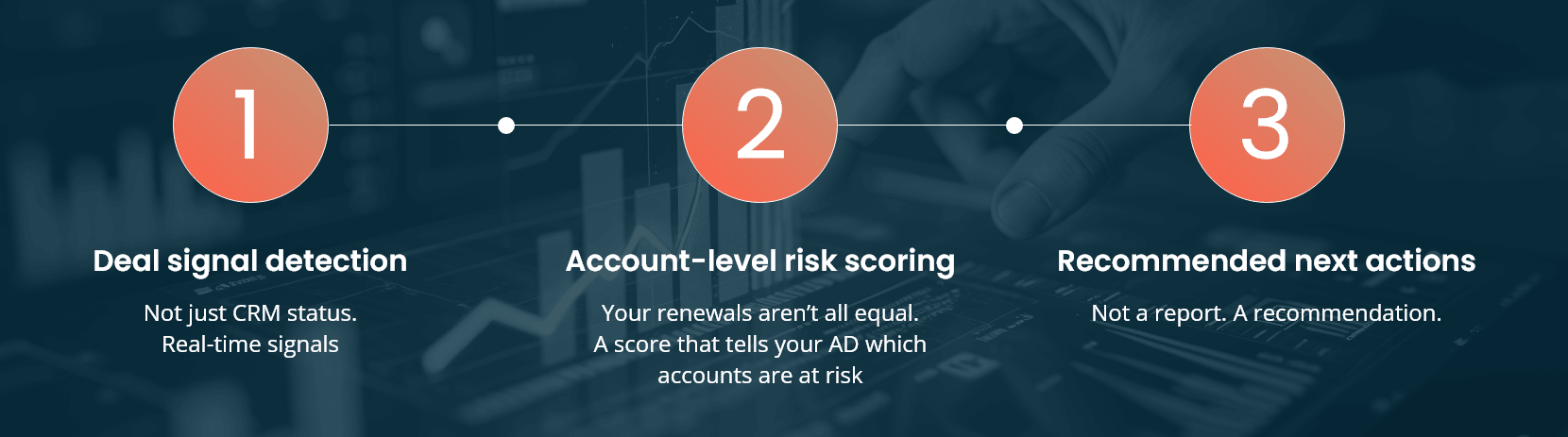
Three Questions to Ask Any AI Sales Assistant Vendor
When you’re evaluating any AI solution for your ad sales team, ask whether it does these three things – and whether it does them automatically, not on request.
One: Deal signal detection – Not just CRM status. Real-time signals – payment history, campaign delivery rate, stakeholder turnover at the advertiser account, competitive activity. An AI that only knows what your team has already entered into Salesforce isn’t intelligence. It’s a mirror.
Two: Account-level risk scoring – Your renewals aren’t all equal. A score that tells your AD which accounts are at risk – and what’s driving that risk – before the client brings it up is worth more than any post-mortem review. This is the difference between proactive selling and reactive fire-fighting.
Three: Recommended next actions – Not a report. A recommendation. “Based on this advertiser’s behavior and current campaign performance, the most effective conversation this week is X.” That’s what AI should do in an $8B ad sales operation. That’s what it does in ours.
The Real Shift
Every media company has spent the last decade buying technology. Sellers are still spending real time assembling information before they can even think about the customer – and that cost shows up on your side of the ledger as forecast volatility, slower ramp times, and renewal risk you find out about too late.
That’s not a tooling problem. It’s a connection problem. The revenue leaders pulling ahead aren’t buying more software – they’re putting what they already own in front of the seller at the exact moment a decision needs to get made, and building forecast confidence on top of it.
Because in media sales, the edge rarely comes from having more data. It comes from every seller on your team knowing exactly what to do with it, every time – not just your best performers.
Related listening: our conversation with Instacart’s VP of Ads on Episode 7 of The Intelligent Leader podcast covers similar ground from the retail media side.
Frequently Asked Questions
Recent Blogs



The Enterprise AI & Data Transformation Partner. Delivering measurable business impact globally.
#1 on Gartner Peer Insights · 97.2% client retention