
Your cloud FinOps efforts probably started with EC2 and storage, not with Snowflake, Databricks, or BI tools. Yet for many enterprises, data platforms now eat 30–50% of total cloud analytics cost and keep growing faster than revenue.
If you run data platforms for a large organization, you don’t need theory. You need a way to see where money actually goes, how to stop waste without breaking SLAs, and how to get product teams to care about cost. This guide walks through a practical approach that works for Snowflake, Databricks, and broader cloud analytics cost management.
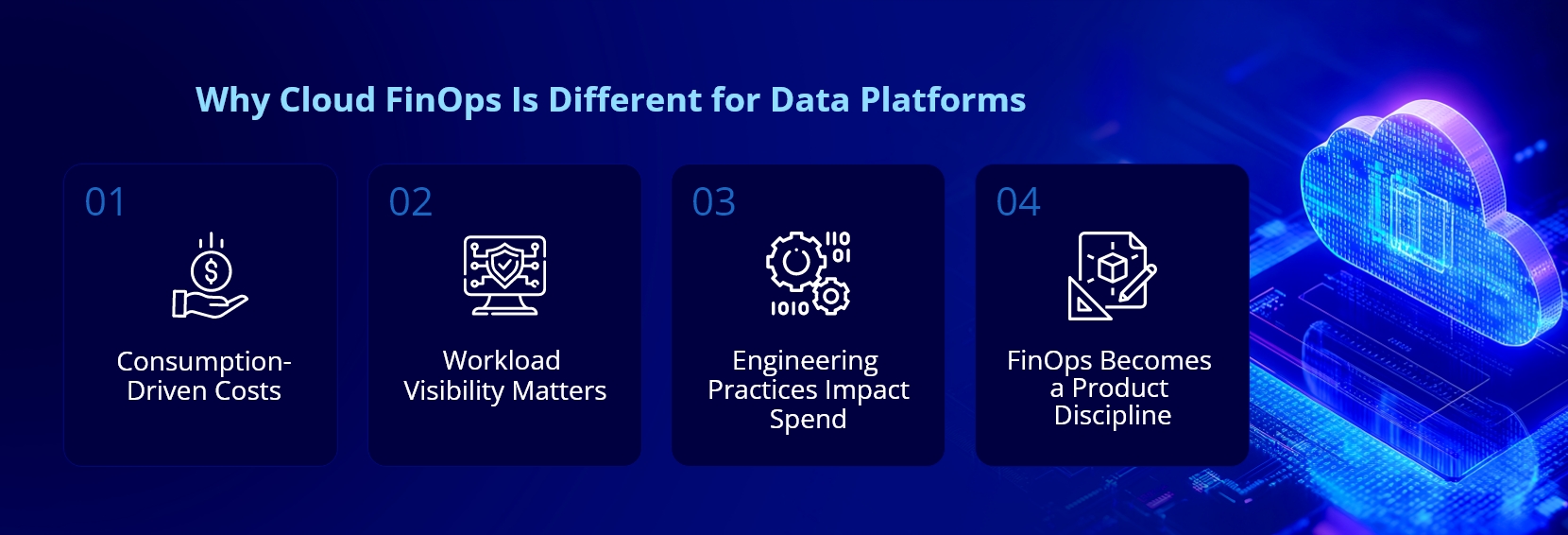
Why Cloud FinOps Is Different For Data Platforms
Most cloud cost optimization frameworks were written around VMs and containers. Data platforms behave differently: they’re elastic, often shared across dozens of teams, and their spend tracks query behavior more than infrastructure size.
Snowflake cost optimization is less about list price and more about who is running what workloads, when, and with which warehouses. The same is true for other data warehouses and query engines, where a single badly written dashboard can burn thousands of dollars a month.
With Databricks cost optimization, the story shifts again. Long-running interactive clusters, mis-sized job clusters, and idle all-purpose clusters quietly accumulate charges while everyone assumes “it’s just for development.” Cost risk hides in engineering culture as much as in configuration.
Traditional cloud cost management treats spend as an infrastructure problem owned by central IT. Data platforms force you to treat it as a product problem owned by domain teams who create and consume analytics products every day.
Map Your Data Platform Spend To Business Value
Before you enforce any guardrails, you need a clear picture of cloud analytics cost by domain, product, and environment. Without that mapping, every optimization attempt turns into a political argument instead of a business decision.
A focused cloud spend management baseline usually includes three views: by application or domain, by environment (dev, test, prod), and by workload type (batch, interactive, BI, experimentation). Build these views from existing tags and account structures first, then clean up gaps over time.
Strong FinOps strategy for data platforms means you can answer simple questions fast: “Which business unit spent the most on Snowflake last month?”, “Which 10 jobs or dashboards are responsible for half of our Databricks bill?”, and “What changed in the last seven days?” If you can’t answer those yet, start here.
Expect the first pass to be messy. Many large companies find 20–30% of spend in “unallocated” buckets. Treat that as a project, not an afterthought, and assign owners to drive better tagging and workspace hygiene.
Build A Practical FinOps Data Model
A data platform FinOps model does not need to be perfect, but it must be consistent. Define a small, non-negotiable set of tags: business unit, application, owner, environment, and cost center. Apply them at the account, workspace, warehouse, and job level wherever possible.
Cloud cost governance for data platforms depends on this model. Without it, you cannot distinguish an experiment from a regulatory report, or a POC from a production feed. The governance conversation turns from “cut spend by 15%” to “reduce non-critical dev and POC workloads in Line of Business X.”
Control Snowflake Spend Without Slowing The Business
Snowflake is deceptively easy to spin up. Warehouses multiply, auto-suspend is disabled “just for now,” and credit consumption drifts until finance steps in. You need controls that shape behavior without forcing every query through a central team.
Start with warehouse design. Right-size warehouses to the workload, cap the maximum size, and avoid XXL warehouses except for true edge cases. This simple discipline often cuts Snowflake cost optimization effort by 10–20% on its own just by preventing unnecessary scaling.
Next, set clear auto-suspend and auto-resume policies. Most analytic workloads can tolerate 30–60 second cold starts. For shared warehouses, align schedules with real business hours instead of running 24/7 “just in case.”
Then look at query behavior. Use built-in query history and performance views to flag top spenders by user, role, and application. Work with those teams to tune queries, reduce data scanned, and move heavy repeated transformations into scheduled tasks or materialized views.
Practical Snowflake FinOps Guardrails
FinOps consulting teams often introduce a handful of low-friction guardrails first, then tighten over time. For Snowflake, useful examples include naming conventions that encode environment and owner, warehouse creation standards, and approval for new XXL or multi-cluster warehouses.
Automated alerts help here. Send notifications when a warehouse runs continuously for more than a defined number of hours, when a new warehouse exceeds a credit threshold, or when total daily spend jumps significantly compared with baseline.
Reining In Databricks And Compute-Heavy Analytics
Databricks and similar platforms blur the line between data engineering, data science, and streaming. That flexibility is powerful, but it also means cost can grow quietly in the background, especially in shared workspaces.
Start your Databricks cost optimization effort by classifying clusters: interactive, job, and all-purpose. Each type needs different policies. Interactive clusters should auto-terminate aggressively, job clusters should be right-sized for SLA rather than peak experiments, and all-purpose clusters should be limited and clearly owned.
Then focus on job scheduling. Many enterprises discover hundreds of daily or hourly jobs that no one remembers owning. Retire unused jobs, reduce frequency where latency requirements are soft, and consolidate similar jobs into shared pipelines.
Pay attention to spot or preemptible instances and photon or similar execution engines if your provider offers them. Used carefully, they can drive significant cloud cost optimization savings for batch workloads that tolerate retries.
Reducing Waste In Engineering And BI Workloads
Cost waste is not only in data engineering pipelines. BI tools can generate highly inefficient queries against Databricks SQL or cloud warehouses, especially when dashboards refresh too frequently or pull wide tables instead of targeted views.
Align your cloud cost management practices with product and analytics teams. Set default refresh intervals, create curated semantic layers or views for BI tools, and restrict direct access to raw tables for routine reporting.
Operating Model And Culture For Cloud FinOps
Technology fixes are the easy part. Long-term impact comes from establishing an operating model that treats cost as a standard dimension of quality alongside reliability and performance.
Effective cloud cost management for data platforms usually follows a simple loop: inform, optimize, and operate. First you give teams visibility, then you work with them to change configurations and code, and finally you bake those behaviors into ongoing processes.
Formal cloud cost governance helps hold the line when pressure builds. Define which decisions sit with central data platform teams, which belong to domain product owners, and which require executive or finance review.
Practical Dashboards, Policies, And Incentives
Teams change behavior when you make cost visible, relevant, and fair. Build dashboards that show spend per product, per feature, and per environment, and review them in the same forums where reliability and performance are discussed.
Align your FinOps consulting, internal or external, around outcomes that matter to the business. Examples include keeping analytics spend below a percentage of revenue for a line of business, or funding new data products from savings realized by rightsizing underused workloads.
Making Cloud FinOps Work Across Vendors
Most large enterprises run a mix of data warehouses, data lakes, streaming platforms, and BI tools. Trying to manage each one in isolation leads to finger-pointing and partial optimizations that simply push cost between systems.
A cross-platform FinOps strategy should start with common principles: every workload has an owner, every environment has spend limits, and every product team sees its own unit cost. Tooling can vary, but principles should not.
For mature teams, cloud spend management becomes part of product roadmaps. New features ship with an estimated marginal cost per run, and teams monitor that metric over time. When cost per unit of value rises, it triggers investigation just like an error spike would.
Central platform teams then focus on shared building blocks: standardized ingestion patterns, governed data products, and shared compute tiers that balance performance with predictable cost.
Conclusion
Running a modern data platform without a clear cloud FinOps approach is an open invitation to surprise bills and tough conversations with finance. The good news is that you do not need exotic tooling to regain control; you need ownership, visibility, and a few disciplined guardrails across Snowflake, Databricks, and analytics workloads.
Enterprises that treat cost as a shared responsibility across data, engineering, and business teams see the most durable results, and partners like Infocepts can help structure that journey. Start by mapping spend to value, then introduce targeted controls, and keep refining the model as your data platform and the business grow.
Frequently Asked Questions
Cloud FinOps is a framework that helps organizations manage and optimize cloud spending across data platforms such as Snowflake, Databricks, data lakes, and BI tools. It combines financial accountability, operational visibility, and governance practices to align cloud costs with business value.
Data platforms often account for 30–50% of analytics-related cloud costs because they support large-scale data processing, analytics, machine learning, reporting, and business intelligence workloads. Their elastic nature can also lead to uncontrolled spending if not monitored properly.
Organizations can reduce Snowflake costs by right-sizing warehouses, enabling auto-suspend and auto-resume policies, monitoring query performance, optimizing data scans, eliminating unused warehouses, and implementing governance controls for warehouse creation and scaling.
Databricks cost optimization typically includes auto-terminating idle clusters, right-sizing compute resources, optimizing job schedules, eliminating unused workloads, consolidating pipelines, using Photon acceleration where appropriate, and leveraging spot instances for eligible workloads.
A FinOps data model is a structured framework that categorizes cloud spending using tags such as business unit, application, environment, owner, and cost center. It helps organizations accurately allocate costs and identify optimization opportunities.
Tagging and governance provide visibility into who owns workloads, where costs originate, and which business processes consume resources. This enables accountability, cost allocation, budgeting, forecasting, and proactive optimization.
FinOps guardrails include warehouse and cluster standards, auto-shutdown policies, spending thresholds, workload ownership requirements, resource usage alerts, approval workflows, and automated monitoring to prevent cost overruns.
Modernize Cloud FinOps for Data and Analytics
Enable cost transparency, intelligent governance, and continuous optimization across Snowflake, Databricks, BI, and cloud-native analytics platforms.
Talk to Our FinOps Advisor
Frequently Asked Questions
Modernize Cloud FinOps for Data and Analytics
Enable cost transparency, intelligent governance, and continuous optimization across Snowflake, Databricks, BI, and cloud-native analytics platforms.
Recent Blogs



Infocepts