



Your team is drowning in reports, yet no one trusts the numbers. That’s the moment most enterprises realize they don’t have a tooling problem, they have a data quality management problem.
The hard part isn’t agreeing that “we need better data.” The hard part is turning messy, conflicting, duplicated records into information executives will actually bet decisions on, without grinding projects to a halt or burying analysts in manual checks.
Why Data Quality Fails In Large Enterprises
Most organizations don’t wake up one morning with broken data. It degrades slowly, across systems, until sales, finance, and operations are all working from different truths about the same customer or product.
In many cases, leaders only talk about data quality after something embarrassing happens: a CEO call derailed by a bad KPI, a failed integration, or a regulator questioning reports. By then, the root causes are spread across processes, not just platforms.
Common Symptoms Of Untrusted Enterprise Data
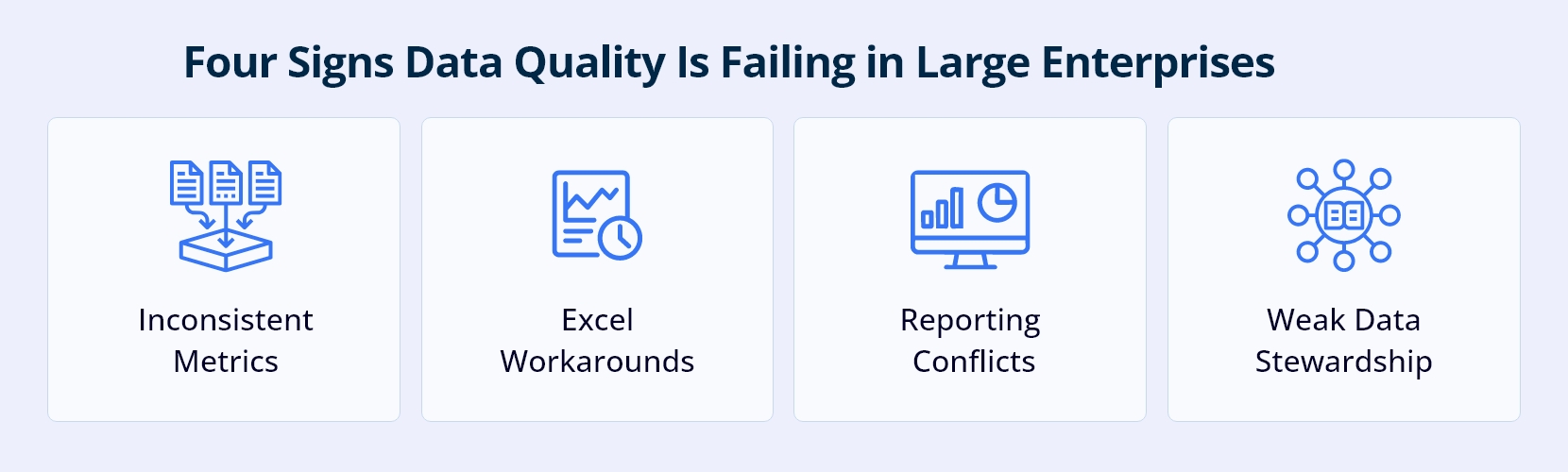
You rarely need a full audit to spot trouble. Teams start exporting data to Excel “just to be safe.” Analysts debate which dashboard is correct instead of what action to take. Two systems show different revenue for the same period.
These are all signs that basic disciplines like data validation and stewardship have taken a back seat to speed, often because project deadlines rewarded delivery, not accuracy.
Building A Practical Data Quality Framework
To fix this, you need more than a tool purchase. You need a consistent, agreed way to define, measure, and improve trust in data across domains. That’s what a strong data quality framework actually does.
The right approach is light enough for teams to adopt quickly, but structured enough that marketing, finance, and operations can all describe “good enough” in comparable terms.
The Six Dimensions That Matter Most
Most enterprises find that focusing on a small set of dimensions keeps conversations concrete. For example, timeliness, accuracy, completeness, consistency, uniqueness, and validity cover the vast majority of issues in enterprise data quality.
The trick isn’t defining these once; it’s tying them to specific rules and thresholds for each domain, so “complete” for customer records doesn’t mean the same thing as “complete” for product catalogs.
From Principles To Working Rules
A framework only starts to pay off when it turns into rules that business and IT both recognize. That’s where data governance comes in: agreeing who owns a domain, which rules are non-negotiable, and how exceptions are handled.
Without this, quality improvement turns into a series of one-off cleanups that never change how data is created in the first place.
Choosing And Using Data Quality Tools Wisely
Once the rules are clear, tools finally make sense. At this point, the question isn’t “What’s the best platform?” but “Which data quality tools can enforce the rules we’ve agreed, across the systems we actually use?”
Enterprises that skip straight to license negotiations usually end up paying for features their teams never touch or running overlapping tools in different business units.
Non-Negotiable Capabilities To Look For
Most large organizations need a handful of core features. Profiling to understand current issues, rule-based checks, matching and deduplication, and automated remediation cover the bulk of practical needs in data management.
Integration matters more than fancy dashboards. If a platform can’t sit close to your main data stores and pipelines, it will become another silo instead of part of the solution.
Where Data Cleansing Fits In
There’s a temptation to launch a massive cleanup project and “fix everything.” Focus instead on the domains that hurt you the most. In many cases, targeted data cleansing on customer, product, and supplier records delivers visible wins in a few months.
The key is to design cleansing rules so they can later run as part of your everyday pipelines, not just as a one-time project script.
Making Quality Part Of The Data Lifecycle
Organizations that actually move the needle don’t treat quality as a separate initiative. They bake checks into ingestion, modeling, and reporting, and they watch the numbers like they would any other operational KPI.
This means product owners and domain leaders start asking about failed checks the way they already ask about uptime and performance.
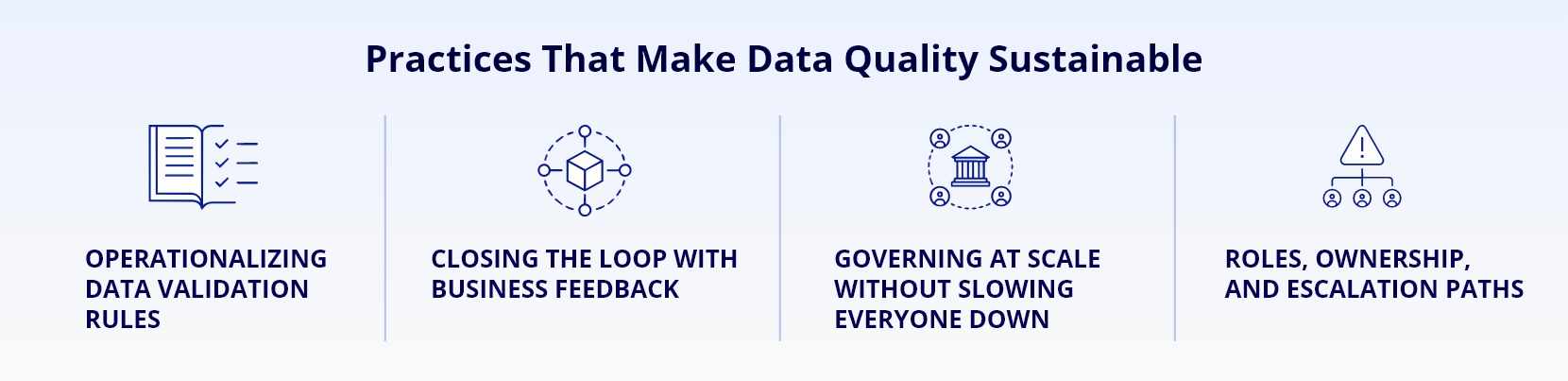
Operationalizing Data Validation Rules
The most effective teams express business logic as code or configuration close to their pipelines. Good data quality monitoring doesn’t just send alerts; it gives owners enough context to decide if an exception needs fixing now or can be addressed in the next sprint.
That’s why simple, human-readable rules win. Analysts can help refine them, and engineers can wire them into orchestration without guessing what the business wanted.
Closing The Loop With Business Feedback
Dashboards can tell you that error rates are falling, but your best signal is still whether end users trust the numbers. Regular review sessions with key consumers reveal gaps even the best data quality metrics won’t catch on their own.
This is often where you discover that a “low priority” field is actually driving a pricing model, or that a legacy rule no longer matches how the business sells.
Governing At Scale Without Slowing Everyone Down
Central teams can set standards and platforms, but quality lives and dies in the domains. The sweet spot is a model where central experts provide patterns and guardrails while business units own their rules and exceptions.
That balance is easier to maintain when leadership treats quality objectives as part of performance, not as a side project led only by IT.
Roles, Ownership, And Escalation Paths
Clear roles prevent endless debates about “who owns this field.” Data owners, stewards, engineers, and analysts all have a part to play in data quality management, but they need crisp expectations and documented escalation paths.
When those are clear, teams stop arguing about responsibilities and start assessing trade-offs together, especially when quality conflicts with delivery dates.
Conclusion
Turning unreliable data into trusted insight is less about a silver-bullet platform and more about consistent habits, clear rules, and the right ownership model. Enterprises that treat data quality management as part of how they run the business, not as a one-off project, see trust and speed rise together.
If you’re serious about getting to that point, start small: pick one domain, define what “good” looks like, and measure it. Partners like Infocepts can help with the heavy lifting, but the commitment to quality has to start at the top.
Frequently Asked Questions
Turn Trusted Data Into Better Decisions
Improve data accuracy, consistency, and confidence across your organization.
Recent Blogs



The Enterprise AI & Data Transformation Partner. Delivering measurable business impact globally.
#1 on Gartner Peer Insights · 97.2% client retention