
Your analytics team keeps asking for better data lineage, but what they really want is simple: to trust the numbers on the dashboard and explain them in seconds. If a board member questions a revenue figure, you should be able to click once, trace it back through every transformation, and see the exact source tables.
Most enterprises can’t do that. Instead, they rely on tribal knowledge, screenshots from old solution designs, and a few overworked people who “just know” how data flows. That falls apart the minute you add AI workloads, new regulations, or a major platform migration.
Why Data Lineage Matters More In The Age Of Enterprise AI
AI and advanced analytics break quickly when you can’t see how data moves, changes, and combines across systems. The models may still run, but they’ll drift, bias will creep in, and trust will evaporate long before anyone notices in a traditional BI setup.
With clear enterprise data lineage, you can answer hard questions that regulators, auditors, and business leaders now ask as standard, especially around model inputs, training sets, and decision logic.
Real-World Failure Modes Without Lineage
Think about a customer churn model trained two years ago. Since then, marketing added new channels, billing changed systems, and half the ETL jobs were “temporarily” patched. There’s no current documentation, and the one architect who remembers the original design just left.
When the model’s performance drops, the team spends weeks chasing data issues, re-running jobs, and running tests blind. Strong data governance would have surfaced the upstream pipeline change that quietly dropped a key feature column in a single morning.

What End-To-End Data Lineage Actually Covers
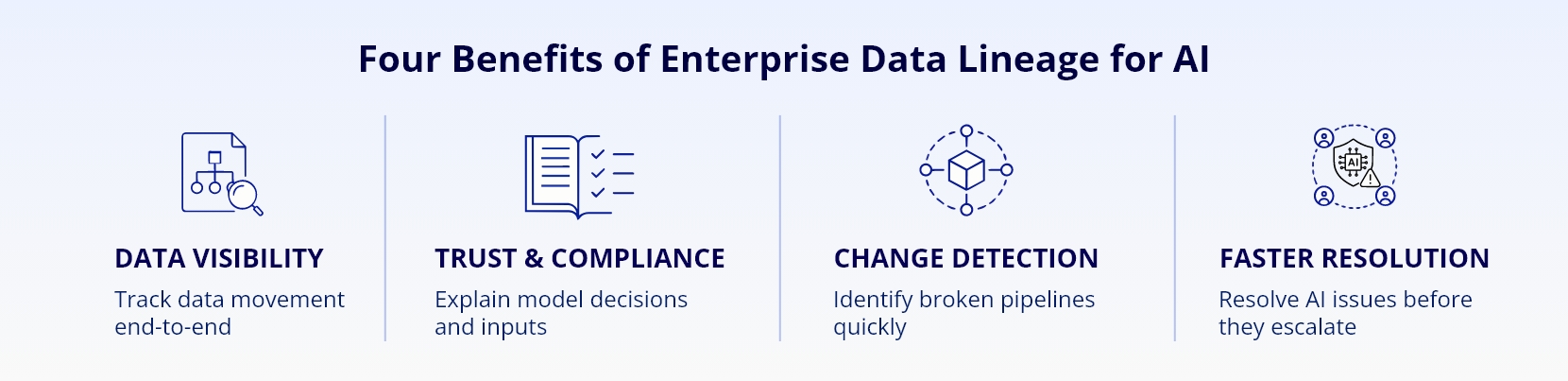
Most teams start by drawing arrows between source, staging, warehouse, and reports. That’s a start, but true enterprise coverage goes deeper: column-level transformations, branching logic, data copies for sandboxes, and temporary scripts that somehow became permanent.
Good lineage shows you not only where data came from, but also how it was filtered, joined, aggregated, and enriched along the way, so you can assess real data quality under pressure.
Key Questions Your Lineage Should Answer
A usable lineage view earns its keep by answering specific questions quickly, not by drawing pretty graphs. For example, “Which reports use this field?” when a field is deprecated, or “What downstream assets are impacted?” when a table is moved.
It should also help compliance teams understand exactly which data sets contribute to a regulatory report, which depends on tight metadata management across tools and platforms.
How Data Lineage Connects To Governance, Catalogs, And Observability
On its own, lineage is just a map. It becomes valuable when it’s wired into the rest of your data governance program, so that ownership, policies, and controls sit next to the actual technical flows.
A modern data catalog should bring those threads together in one place: business definitions, owners, classifications, and a navigable graph that shows how assets relate along the pipeline.
Data Quality And Observability Depend On Lineage
Data teams still treat broken dashboards as isolated incidents, but the same upstream bug often affects ten different reports in subtle ways. Without a clear view of upstream and downstream links, you’re fixing the same problem repeatedly.
Rich data observability tools become dramatically more useful when they sit on top of lineage, because you can move from “this table is late” to “these are the four impacted products” in a few clicks.
Choosing The Right Data Lineage Tools For Your Stack
Most enterprises already own at least one platform that claims to provide lineage. The trouble is, it usually covers just part of the estate: maybe the warehouse and a few ETL tools, but not the shell scripts, notebooks, or SaaS exports that quietly process critical data.
When you evaluate new options, start by listing the systems that create, move, or transform important data, then map which data lineage tools can actually connect to them out of the box.
Capabilities That Matter More Than Vendor Demos
Focus on how lineage is captured and kept current. Full automation is ideal, but most enterprises end up with a mix of automated scans and curated documentation for edge cases and legacy code.
Before signing anything, ask to see how the data lineage software handles SQL in stored procedures, dynamic queries in code, and scheduling metadata from your orchestration layer.
Integrating Lineage With Existing Data Platforms
New tools don’t live in a vacuum. Lineage needs to tie into your monitoring stack, your ticketing system, and your development workflows so that change impact analysis is a normal part of releases, not a special audit exercise.
For many teams, the first quick win is using lineage to push impact information into existing incident channels, creating tighter data traceability around outages and fixes.
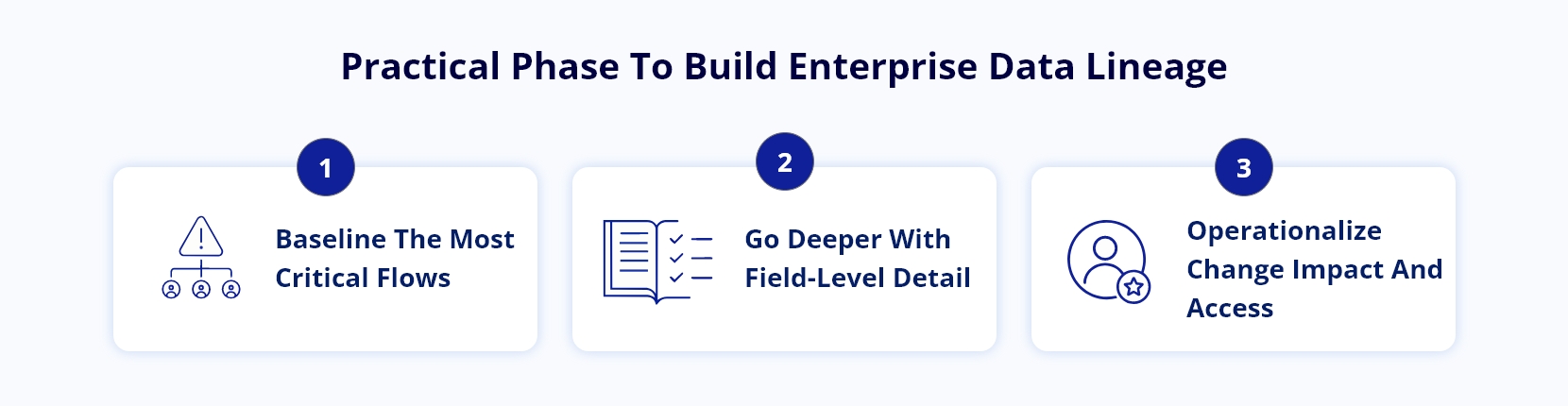
Practical Steps To Build Enterprise Data Lineage
You don’t need a multi-year program to see value. The trick is to avoid boiling the ocean and instead sequence work so that each phase delivers something concrete for users in analytics or AI teams.
Start with a critical business domain, like revenue recognition or risk scoring, and build a slice of lineage that answers specific questions for that group.
Begin by mapping source-to-report paths at the table level. Get key data engineers, analysts, and product owners in a room and walk through how data really moves, not how it was supposed to be designed.
This is where you uncover shadow pipelines and one-off jobs that have grown into key dependencies, which is the hidden source of many data quality failures.
Once basic flows are visible, drill into column-level transformations for the fields that drive decisions, such as pricing, credit limits, or risk flags.
Automated scanning helps here, but you’ll still need targeted reviews of complex logic to keep data observability alerts grounded in reality rather than in theory.
As lineage matures, connect it to change management. New features, schema changes, and deprecations should automatically trigger impact lists and notifications to owners.
Tie this to role-based access decisions, so that sensitive fields are controlled consistently from source systems through BI tools as part of your broader data governance practice.
Conclusion
Enterprise analytics and AI only work at scale when teams can trace every important number back to its origin, which is exactly what strong data lineage delivers. Done well, it turns late-night firefights into faster, calmer investigations and gives leaders clean answers to tough questions.
If you’re serious about scaling data products, treating lineage as core engineering work, not documentation, is the shift that matters. Partners like Infocepts can help you map what you have, close the gaps, and build a traceable foundation for the next wave of analytics and AI.
Frequently Asked Questions
Increase Trust Through End-to-End Data Lineage
Gain complete visibility into your data journey and improve trust in insights.
Recent Blogs



Infocepts