
Your dashboards look great. Your teams talk about being “data driven.” Yet when a critical call lands on your desk, decision intelligence is still mostly gut feel backed by a few charts. That gap between information and action is exactly where many enterprises get stuck.
Traditional business intelligence (BI) has helped leaders see what happened. But seeing is not the same as deciding. As data volumes grow and AI matures, the question is no longer “Do we have the data?” but “Can we trust the next move we make with it?” That’s where a different approach is starting to matter.
Why Business Intelligence Alone Is No Longer Enough
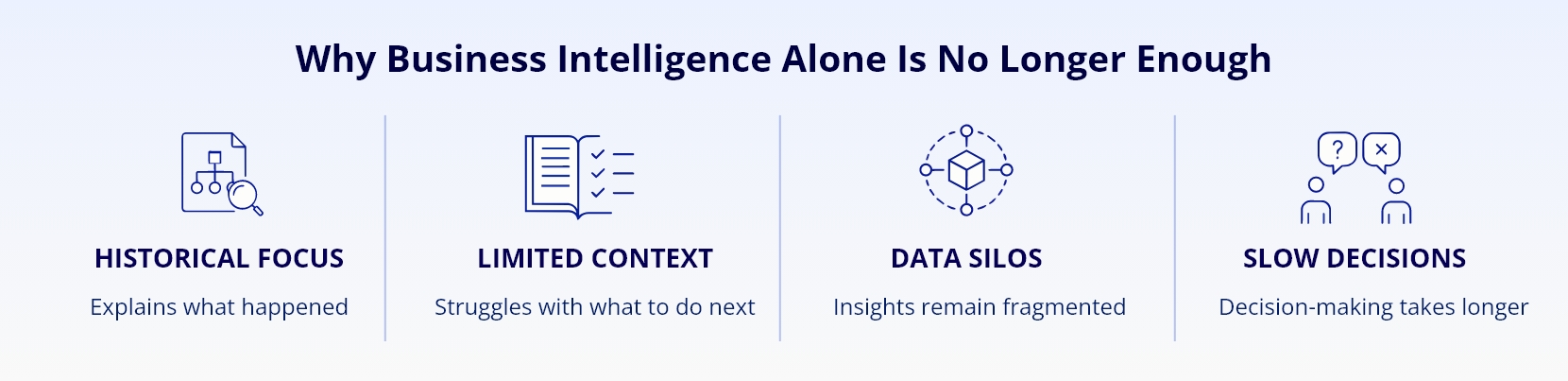
Business intelligence was built to answer descriptive questions: What happened last month? Which region hit quota? How many defects did we ship? Classic BI stacks still anchor most enterprise analytics programs.
The problem shows up when the questions shift from “what” to “what now.” Teams bounce between BI reports, Excel, email threads, and chat, trying to stitch together an answer. This is where business intelligence vs decision intelligence starts to feel like a real fork in the road.
BI also tends to live in silos: finance has its cubes, supply chain has its reports, sales has its dashboards. Each view is accurate on its own, but decisions cut across all of them. That friction slows you down exactly when speed matters most.
What Decision Intelligence Actually Adds
Decision intelligence starts with a different goal: model how decisions are made, not just how data is stored. Instead of stopping at reports, it connects data, analytics, and business rules into repeatable decision flows that can be monitored and improved.
A mature decision intelligence platform doesn’t replace BI; it sits on top of it and orchestrates how data feeds specific decisions. Think of it as moving from “here are your numbers” to “here are the options, trade-offs, and recommended action.”
Good implementations capture not just outcomes, but the context behind them: who decided, what they saw, which scenario they selected, and how reality compared to the forecast. Over time, that feedback loop becomes as valuable as the original models.
From Reporting To AI-Driven Decision Flows
Most enterprises already say they do data driven decision making, but the reality on the ground looks closer to data-informed debating. People pull the reports that best support the position they walked in with.
Decision intelligence flips that script by starting from the decision backwards. You define the question, the constraints, the options, and the success metrics. Then you attach the right data and analytics to each step, so the path from question to action is explicit.
How AI Changes The Decision Pipeline
When people hear AI decision making, they often imagine a black box that spits out answers. In practice, AI works best as a collaborator that tests scenarios, highlights risk, and ranks options instead of quietly replacing human judgment.
In a pricing workflow, for example, AI can suggest optimal discounts for each deal while still letting sales override recommendations based on context. Those overrides aren’t noise; they’re training data, telling the system what nuance it missed.
Key Differences Between BI And Decision Intelligence
BI tools focus on filters, charts, and drill-downs; decision intelligence systems focus on journeys: from trigger, to analysis, to choice, to outcome. One is workspace-centered, the other is outcome-centered.
Under the hood, that means decision intelligence has to integrate not just dashboards but also simulation engines, rule engines, and collaboration tools so teams can move from insight to action inside a single flow.
The Analytics Stack Behind Decision Intelligence
Traditional enterprise analytics stacks evolved from reporting out. Data warehouses, semantic layers, visualizations – strong at explaining the past, weaker at exploring the future or encoding how decisions actually happen.
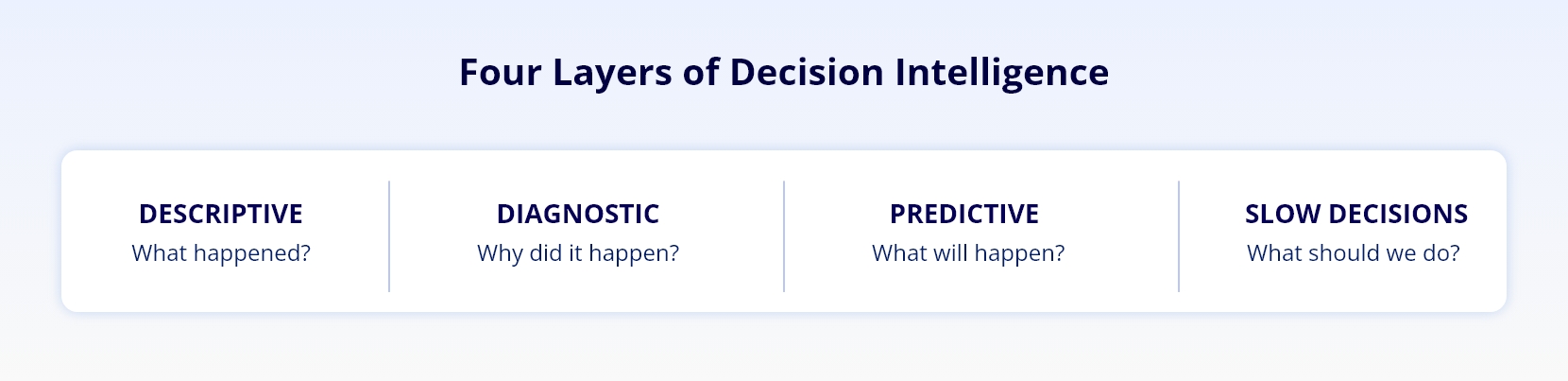
Decision intelligence stretches that stack across four types of analytics: descriptive, diagnostic, predictive, and prescriptive. BI handles the first two well; the second two are where the gap usually shows up in real projects.
Predictive And Prescriptive Analytics In Practice
Most teams start with predictive analytics: using historical data to estimate what’s likely to happen next, from demand spikes to customer churn to credit risk. These models are only useful if they’re close to the decisions they support.
Prescriptive analytics goes one step further by suggesting specific actions – raise spend here, cut inventory there, prioritize this claim – and scoring them against business constraints like budget, capacity, or compliance rules.
From Models To Decisions, Not Just Scores
What actually creates value is not a probability score in a model registry but a decision that changes behavior on the ground. That’s where decision analytics comes in, translating model outputs into human-readable options and trade-offs.
For example, instead of telling a planner “stock-out risk is 32%,” a decision layer can present three stocking strategies with different cost and risk levels so the trade is clear at a glance.
What Enterprises Should Look For In A Platform
Shopping for a decision intelligence platform like it’s just another BI upgrade is a good way to buy the wrong thing. You’re not only buying visualizations; you’re buying a way to formalize and improve how your organization decides.
Start by listing the 5 – 10 recurring decisions that hurt the most when they go wrong or slow: pricing approvals, inventory buys, marketing spend shifts, workforce scheduling. Those will anchor your first use cases.
Critical Capabilities For Decision Intelligence
At a minimum, the platform should connect directly to your existing BI layer so reports and metrics don’t have to be rebuilt. It should also map decisions into clear steps, with owners, SLAs, and governance baked in instead of treated as afterthoughts.
Strong AI analytics support matters too: native integration for ML models, scenario simulation, and the ability to call out to external services where your data science teams already deploy their work.
Governance, Adoption, And Change Management
Good technology won’t help if your people don’t trust the outputs. Formal decision reviews – where teams compare recommended versus actual actions and results – build confidence and surface model drift before it bites you.
Clear governance around who can change rules, models, and thresholds is non-negotiable in regulated industries, especially across the USA and Europe where expectations and rules can differ sharply.
Getting From BI-Centric To Decision-Centric
You don’t move from BI to full decision intelligence in one budget cycle. The shift is more like adding a new layer that initially sits on top of a few high-value decisions, then expands as trust and capability grow.
A practical starting point is to pick a single cross-functional decision – like quarterly demand planning – and build an end-to-end decision flow. That forces finance, supply chain, and sales to agree on inputs, scenarios, and success metrics.
Practical Steps To Start The Journey
First, map how the decision is made today: who triggers it, which reports are opened, what offline spreadsheets exist, where disagreements usually show up. That messy picture is your baseline for improvement.
Then, define a target workflow that explicitly calls out where data, models, and human judgment interact. That blueprint becomes the requirements document for both process changes and technology choices.
Conclusion
Enterprises that want faster, more consistent calls need to move from reporting-first to decision-first, and decision intelligence gives them the structure to do it. The goal isn’t to replace human judgment, but to surround it with better options, clearer trade-offs, and measurable feedback.
As platforms mature and practices spread, the gap will widen between teams that only see their numbers and those that can act on them with confidence. If you’re ready to explore what that shift could look like in your organization, Infocepts can be a practical partner in bringing decision intelligence from buzzword to everyday habit.
Frequently Asked Questions
Turn Insights into Smarter Decisions
Combine data, analytics, and AI to make faster, more confident business decisions at scale.
Recent Blogs



Infocepts